
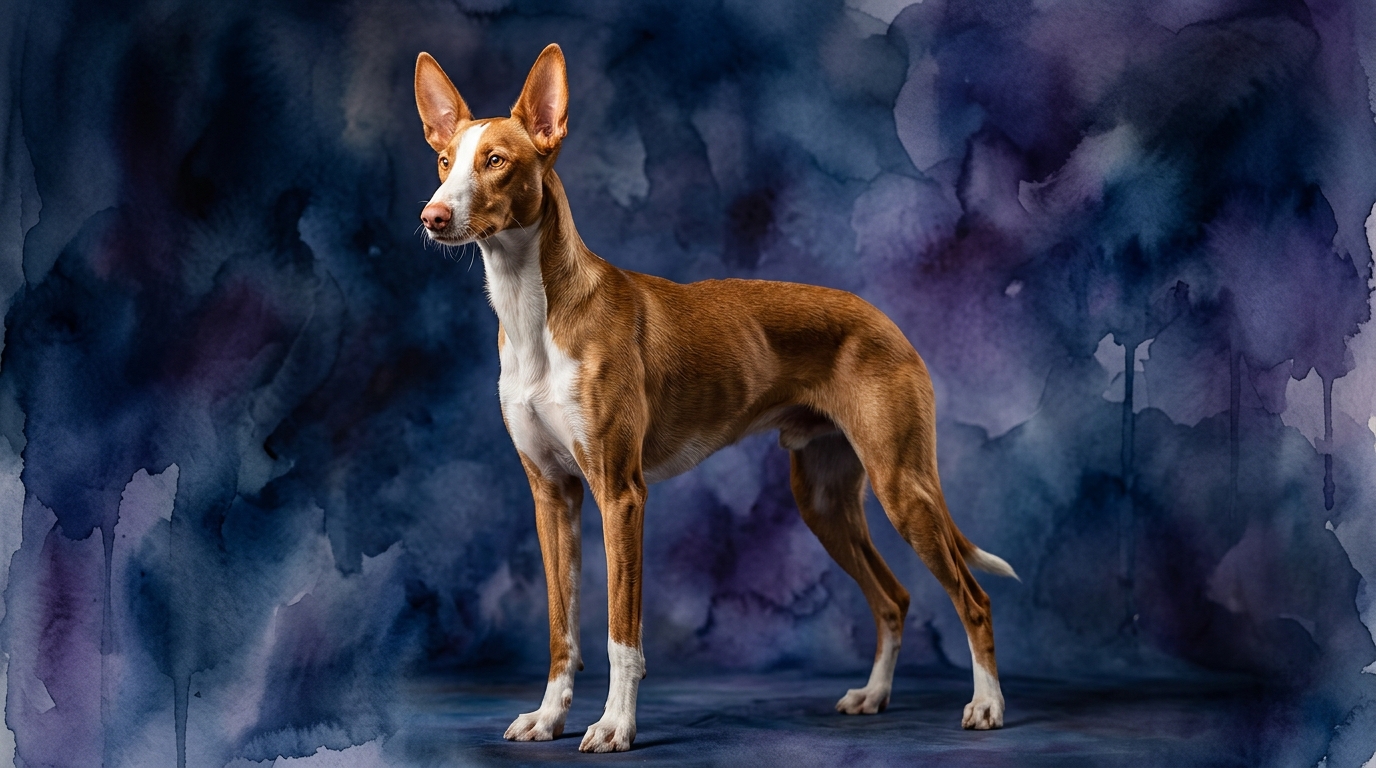
Side-by-Side Pet IQ Profile: Boerboel vs. Ibizan Hound
The Pet IQ Lab assesses five crucial dimensions of canine intelligence, and both the Boerboel and the Ibizan Hound register a consistent 3/5 across the board. However, this identical score masks profoundly different expressions of these cognitive traits, reflecting their inherent breed characteristics and ancestral purposes.
For **Problem Solving (3/5)**, the Boerboel excels at practical, real-world challenges directly impacting its environment and family security, such as figuring out how to access a specific area to patrol or retrieving an item for a family member. Its solutions are often grounded in its protective instincts and understanding of its territory. The Ibizan Hound, conversely, applies its problem-solving acumen to tasks related to its hunt, like navigating complex terrain at speed to maintain pursuit of a visual target or devising a path through obstacles during a chase. Its ingenuity is often tied to environmental mastery for a specific, prey-driven goal.
Regarding **Training Speed (3/5)**, the Boerboel can grasp commands with good alacrity when motivated by a clear, consistent leader and its inherent desire to please its family. Its strong will, however, means it can appear slower if the handler's expectations are not unambiguous or if it perceives a command as conflicting with its protective judgment. The Ibizan Hound also demonstrates a capacity for learning, but its independent spirit and powerful prey drive mean that 'learning' a command doesn't always equate to 'obeying' when a compelling environmental stimulus, like a distant movement, captures its focus. Training requires exceptional consistency and highly valued rewards to compete with its primal instincts.
In **Social Intelligence (3/5)**, the Boerboel exhibits deep, discerning bonds with its immediate family, reading human intent and subtle cues from those it trusts implicitly. It is adept at differentiating between familiar faces and potential threats, often displaying a reserved or wary demeanor towards strangers. The Ibizan Hound forms similarly strong, sensitive attachments with its chosen human companions, often showing playful affection within its inner circle. It can be quite aloof or shy with unfamiliar individuals, preferring the quiet company of its own kind or its trusted humans, and interprets social cues through its unique sighthound lens, sometimes appearing less outwardly responsive to complex human interactions.
Their **Instinctive Drive (3/5)** highlights their core differences. The Boerboel possesses a powerful guarding and protective drive, motivated by an innate desire to secure its territory and safeguard its family. This leads to constant vigilance and a readiness to act when it perceives threats, making it an ever-watchful sentinel. The Ibizan Hound's drive is primarily a powerful prey drive, fueled by the sight and movement of potential quarry. This instinct propels its desire to chase, hunt, and explore, making off-leash reliability a significant and ongoing training challenge due to its overwhelming impulse to pursue.
Finally, for **Memory (3/5)**, the Boerboel retains an excellent recall for routines, family members, past experiences (both positive and negative), and the learned boundaries of its territory. It remembers training cues and the consequences of its actions within its home environment. The Ibizan Hound also remembers commands and routines, but its memory is particularly sharp for visual cues, successful hunting strategies, and the precise locations where prey was last sighted. They recall optimal chase routes and areas of interest with remarkable precision.
Where the Boerboel Wins Cognitively
The Boerboel's cognitive strengths shine brightest in contexts demanding practical discernment and unwavering loyalty within a family structure. Its problem-solving is highly effective when it concerns the security and well-being of its human companions and territory. A Boerboel might independently assess a situation, such as a gate left ajar, and take action to rectify it or alert its owner, demonstrating a proactive intelligence rooted in its protective role. Its social intelligence is geared towards understanding the nuances of its family unit, allowing it to quickly identify changes in mood or potential threats, making it an exceptional, albeit subtle, guardian. This breed's memory is particularly adept at recalling past interactions with strangers, enabling it to apply learned caution or acceptance accurately.
Where the Ibizan Hound Wins Cognitively
The Ibizan Hound's cognitive advantages are most evident in situations requiring independent thought, swift reaction, and environmental mastery. Its problem-solving abilities are unparalleled when it comes to navigating complex, open spaces at high speeds, demonstrating a remarkable capacity to map and react to dynamic visual stimuli during a chase. This breed excels at recognizing subtle movements in the distance and strategizing a pursuit path almost instantaneously, a testament to its specialized sighthound intellect. Its memory is exceptional for visual landscapes and the precise locations of past prey sightings, allowing it to efficiently 're-hunt' areas or remember optimal routes for exploration. The Ibizan's social intelligence, while reserved, allows it to form incredibly sensitive bonds, often picking up on subtle emotional cues from its trusted humans, responding with gentle affection or quiet companionship.
Which is Easier to Train, and Why?
Determining which breed is 'easier' to train is nuanced, given their distinct motivations and behavioral drivers. The Boerboel, while possessing a strong will, generally aims to please its family and seeks to be a respected member of the household, which can be a powerful motivator in training. Their desire for structure and their protective instincts mean they often respond well to consistent, firm, and fair leadership. They are less likely to be distracted by external stimuli if they are focused on their handler and the task at hand, especially within their familiar territory. Their training benefits from a calm, confident approach that reinforces their role as a guardian and companion.
The Ibizan Hound, on the other hand, presents a different set of training challenges due to its deeply ingrained independence and formidable prey drive. While intelligent, their primary focus in an open environment is often on visual stimuli and potential chase opportunities, making recall and off-leash reliability particularly difficult to achieve. They are less inclined to perform simply to please a human if there's a more interesting, instinct-fulfilling alternative available. Training an Ibizan requires immense patience, creativity, and high-value rewards to compete with their natural hunting impulses. They thrive on positive reinforcement and mental engagement that taps into their problem-solving skills, but their responses can be inconsistent if their sighthound instincts are triggered. Therefore, while both are capable learners, the Boerboel's inherent desire to work cooperatively within a family structure often makes its training journey more straightforward for the average owner compared to the independent, chase-driven Ibizan Hound.
Which Suits Active Owners vs. Relaxed Owners
Neither the Boerboel nor the Ibizan Hound are suitable for truly 'relaxed' owners in terms of cognitive engagement and physical demands, as both require significant investment. However, their activity needs manifest differently. An 'active owner' for a Boerboel is someone who is consistently engaged in providing clear leadership, structured training, and ample socialization from a young age. They thrive with owners who can integrate them into family life while providing mental stimulation through scent work, obedience, or protection sports, alongside regular, moderate physical exercise to maintain their powerful physique. Their 'activity' is often tied to their role as a family member and guardian, requiring consistent mental and physical input to channel their protective instincts appropriately.
For the Ibizan Hound, an 'active owner' is someone who can facilitate bursts of intense physical activity in secure, fenced environments where they can gallop freely and safely. These owners must be prepared for long, vigorous walks or runs, often needing access to large, enclosed spaces for off-leash sprints. Their cognitive stimulation comes from activities that engage their sighthound nature, like lure coursing or fast-paced games that mimic a chase. While they can be calm indoors, their need for high-speed exercise is non-negotiable, making them ideal for owners who enjoy or can provide consistent outlets for their incredible athleticism and prey drive. Therefore, 'active' for a Boerboel means active participation in consistent training and leadership, while 'active' for an Ibizan Hound means actively facilitating its need for high-speed, open-field running.
The Verdict
Choose the Boerboel if you seek a devoted, discerning guardian who thrives on clear leadership and integrated family life, and you are prepared for consistent training to channel its protective instincts. This breed suits an owner who values a steadfast companion capable of practical problem-solving within its home environment.
Opt for the Ibizan Hound if you are an energetic individual or family who can provide extensive opportunities for high-speed running in secure areas, appreciating a sensitive, independent companion. This breed is ideal for those who admire a sighthound's unique athleticism and keen, visually-driven intelligence.
🧠 Find Your Pet's IQ Score
Our Pet IQ Lab assessment covers 25+ tests across 5 cognitive dimensions — personalized to your breed.
Take the Full IQ Test →Frequently Asked Questions
Do Boerboels and Ibizan Hounds have similar exercise requirements?
While both breeds require significant exercise, their needs differ fundamentally. Boerboels need moderate, consistent exercise and mental stimulation that engages their protective and working drives, such as long walks, training sessions, or supervised play. Ibizan Hounds, conversely, demand bursts of intense, high-speed running in large, secure areas to satisfy their sighthound instincts.
Which breed is better with children?
Both breeds can be good with children when properly socialized and raised. Boerboels, with their strong protective instincts, often form deep bonds with 'their' children, acting as gentle guardians, but require supervision due to their sheer size. Ibizan Hounds are generally gentle and playful, though their independent nature means they might prefer quieter interactions and require children to respect their space.
Are Boerboels and Ibizan Hounds suitable for first-time dog owners?
Neither breed is typically recommended for first-time dog owners due to their strong personalities and specific needs. Boerboels require experienced leadership and extensive socialization to manage their protective instincts, while Ibizan Hounds demand owners who understand sighthound independence and can manage their powerful prey drive and intense exercise requirements.