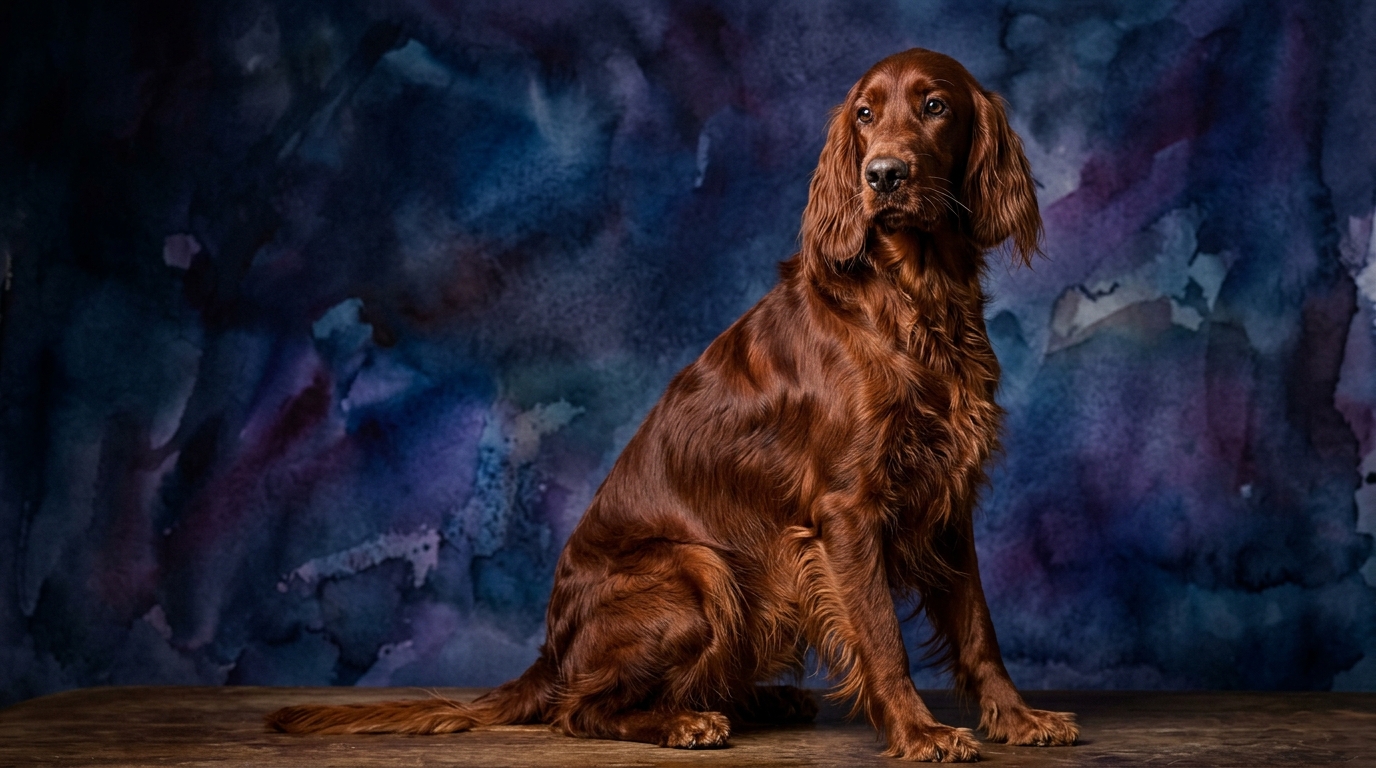

Side-by-Side Cognitive Profiles
The Irish Setter, a vibrant member of the Sporting group, holds a respectable Coren rank of #35, indicating a strong capacity for obedience and working intelligence. Our Pet IQ Lab scores reveal a problem-solving ability of 4/5, reflecting their aptitude for navigating complex environments and overcoming obstacles. Their training speed also sits at 4/5, suggesting a quick grasp of new commands and routines, which aligns with their historical role as a biddable field dog. Social intelligence is rated 3/5, meaning they are capable of understanding human cues but perhaps not to the nuanced extent of some herding breeds. An instinctive drive of 3/5 points to a moderate but focused natural inclination for specific tasks, while a memory score of 4/5 highlights their excellent retention of learned behaviors and experiences.
In contrast, the Brussels Griffon, a charming Toy breed, is not Coren-ranked, which is common for breeds whose primary role is companionship rather than complex tasks. Their Pet IQ Lab scores are consistently at 3/5 across all five dimensions: problem-solving, training speed, social intelligence, instinctive drive, and memory. This indicates a general competence rather than exceptional aptitude in any single area. Their 3/5 problem-solving suggests they can figure things out but might not actively seek out cognitive challenges. A 3/5 training speed implies they are trainable, though they may require more patience and repetition than a Setter. Similarly, their 3/5 social intelligence points to an ability to connect with humans, while a 3/5 instinctive drive suggests a moderate natural inclination, often expressed in their role as a vigilant companion. Their 3/5 memory means they retain information adequately, but perhaps less perfectly than breeds with higher scores.
Where the Irish Setter Excels Cognitively
The Irish Setter's superior scores in problem-solving (4/5), training speed (4/5), and memory (4/5) give them a clear advantage in tasks requiring quick learning and retention. Their ability to rapidly process new information and apply it to novel situations makes them adept at advanced obedience, agility, and field work. For instance, an Irish Setter can quickly learn a multi-step retrieve pattern or navigate a complex agility course after minimal demonstrations, remembering each sequence with precision. This keen memory is crucial for recalling specific commands even after long periods or remembering the precise location of a hidden object, a direct benefit of their retrieving heritage. Their proactive approach to overcoming obstacles, whether finding a hidden toy or navigating a new environment, stems from their robust problem-solving score.
Where the Brussels Griffon Shows Unique Strengths
While the Brussels Griffon's numerical scores are moderate, their cognitive strengths lie in their nuanced social engagement and adaptability within a domestic setting, tailored to their companion role. Their 3/5 social intelligence, while numerically equal to the Setter, manifests differently; it's less about following complex human directions in a field and more about reading subtle human emotional cues and integrating seamlessly into family dynamics. They often excel at understanding household routines and anticipating their owner's moods, a practical application of their cognitive abilities. Their instinctive drive (3/5) often translates into a keen awareness of their immediate surroundings and a protective demeanor towards their family, making them excellent little sentinels, which is a specific and valuable form of intelligence for a toy breed. Their problem-solving, though 3/5, is often applied to figuring out how to get attention or manipulate situations for comfort, demonstrating a different kind of practical, companion-focused intelligence.
Training: Biddable Learner vs. Patient Companion
The Irish Setter is generally easier to train for obedience and complex tasks due to their higher training speed (4/5), problem-solving (4/5), and memory (4/5). They are eager to please and bred for cooperative work, meaning they typically respond well to consistent, positive reinforcement methods and grasp new commands quickly. Their strong memory ensures that once a behavior is learned, it is retained. However, their moderate instinctive drive (3/5) can mean they might become distracted by environmental stimuli, requiring focused training to maintain attention in busy settings.
The Brussels Griffon, with scores of 3/5 across the board, requires a more patient and engaging approach to training. They are capable of learning, but their motivation might not always be to simply 'obey' but rather to find personal gain or enjoyment in the interaction. Their independent toy breed nature means they might test boundaries more frequently, and trainers must make the process highly rewarding and fun to maintain their interest. Their problem-solving (3/5) might be applied to avoiding unwanted tasks, necessitating creativity in training methods. Consistency and positive reinforcement are paramount, as they thrive on close, trusting relationships with their owners.
Owners: Active Pursuits vs. Close Companionship
An Irish Setter is an ideal match for active owners who seek a partner for outdoor adventures, dog sports, or advanced training. Their high problem-solving, training speed, and memory scores indicate a mind that thrives on mental and physical stimulation, making them suitable for activities like agility, obedience, hunting trials, or long hikes. They require regular outlets for their energy and cognitive abilities, and a sedentary lifestyle would likely lead to boredom and potential behavioral issues.
The Brussels Griffon suits owners who appreciate close companionship and a dog that can adapt well to various home environments, though they are not entirely sedentary. While they are a Toy breed, their 3/5 instinctive drive and moderate scores across the board mean they still benefit from consistent interaction, short walks, and engaging mental games. They are adaptable to apartment living but thrive on being an integral part of family life, enjoying interactive play and opportunities to engage their perceptive social intelligence. Owners who enjoy a dog with a distinct personality and who are willing to invest patience in training will find a rewarding companion.
The Verdict
Choose an Irish Setter if you are an active owner seeking a biddable companion for advanced training, dog sports, or outdoor adventures, appreciating a dog that quickly grasps and retains complex tasks.
Choose a Brussels Griffon if you are looking for an adaptable, charming companion who thrives on close interaction and subtle communication, and who is patient with training that might require more creativity and positive reinforcement.
🧠 Find Your Pet's IQ Score
Our Pet IQ Lab assessment covers 25+ tests across 5 cognitive dimensions — personalized to your breed.
Take the Full IQ Test →Frequently Asked Questions
Are Irish Setters prone to hyperactivity?
Irish Setters possess a significant amount of energy stemming from their Sporting dog heritage and moderate instinctive drive. While not necessarily hyperactive, they require consistent physical exercise and mental engagement to channel their energy constructively and prevent boredom-related behaviors.
Can Brussels Griffons be trained for tricks or complex behaviors?
Yes, Brussels Griffons can certainly be trained for tricks and complex behaviors, despite their moderate training speed. Their 3/5 problem-solving and memory scores mean they are capable learners, but success hinges on positive reinforcement, short engaging sessions, and making the training feel like a fun game rather than a chore.
How do their social intelligence scores affect their interactions with strangers or other pets?
Both breeds have a 3/5 social intelligence score, but this manifests differently. Irish Setters are generally outgoing and friendly, often greeting strangers enthusiastically, and typically get along well with other pets with proper socialization. Brussels Griffons can be more reserved or discerning with strangers, often preferring their immediate family, and their interactions with other pets may depend on individual personality and early exposure, sometimes exhibiting a bold confidence despite their small size.