
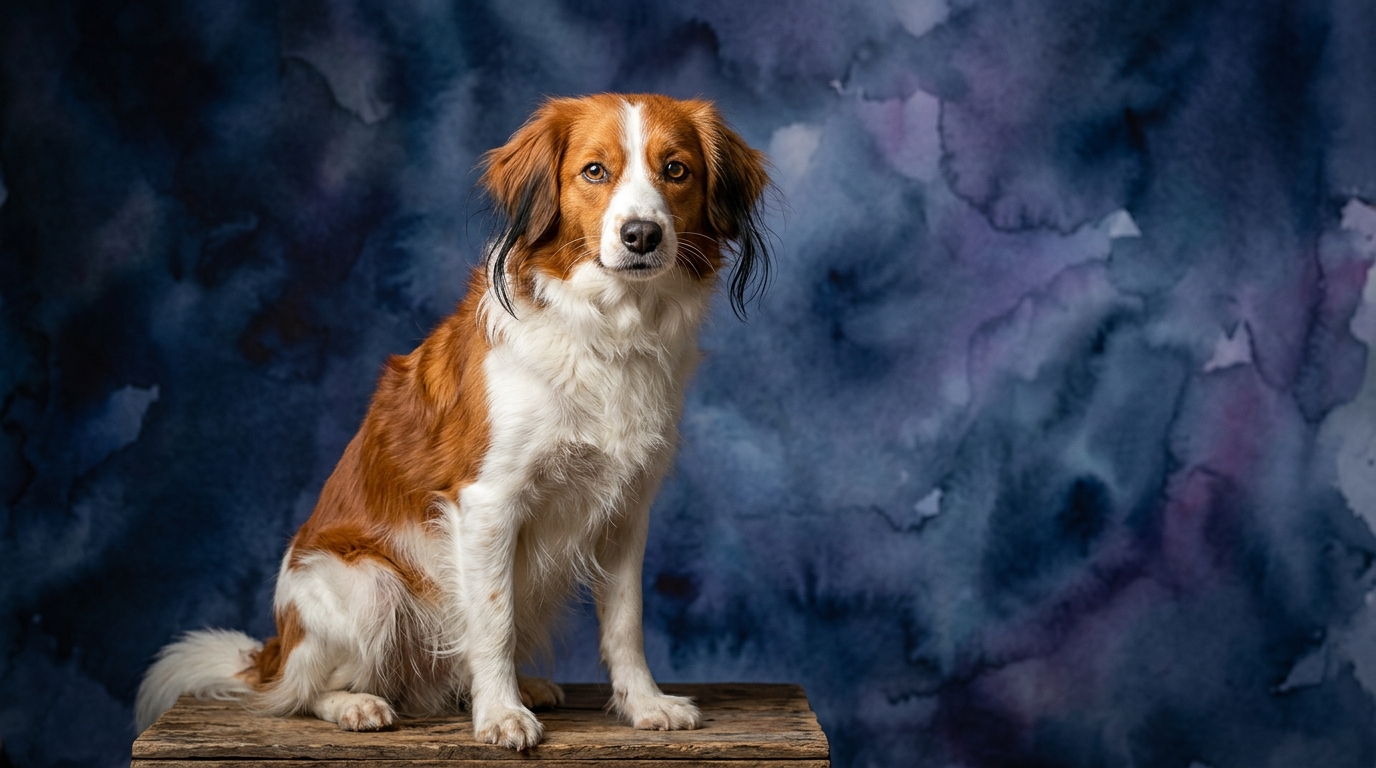
Side-by-Side IQ Profile: Irish Setter vs. Kooikerhondje
The Cosmic Pet Pet IQ Lab assesses canine cognition across five crucial dimensions: Problem Solving, Training Speed, Social Intelligence, Instinctive Drive, and Memory. These metrics offer a granular view of how each breed processes information and interacts with its environment, moving beyond simple labels to reveal specific aptitudes.
The Irish Setter, a striking Sporting breed, boasts a robust cognitive profile. It scores 4/5 in Problem Solving, indicating a strong capacity for independent thought and navigating novel situations. Its Training Speed is also 4/5, suggesting quick command acquisition. Social Intelligence and Instinctive Drive are both rated 3/5, demonstrating a balanced understanding of human cues and a moderate, manageable prey drive. A Memory score of 4/5 rounds out its profile, reflecting excellent retention of learned behaviors and experiences. This breed also holds a notable Coren rank of #35, placing it among dogs that grasp new commands quickly and consistently.
The Kooikerhondje, another spirited Sporting dog, presents a consistently balanced cognitive makeup. It registers 3/5 across all five dimensions: Problem Solving, Training Speed, Social Intelligence, Instinctive Drive, and Memory. While not Coren-ranked, this uniform scoring suggests a steady, reliable intellect. Its 3/5 in Problem Solving indicates competency in straightforward challenges, while its 3/5 Training Speed means it learns effectively with consistent instruction. Like the Setter, its 3/5 Social Intelligence points to a good grasp of human interaction, and its 3/5 Instinctive Drive reflects a moderate working impulse, historically tied to its duck-decoying heritage.
Where the Irish Setter Wins Cognitively
The Irish Setter clearly demonstrates an edge in several key cognitive domains, particularly in its capacity for independent thought and rapid learning. With a Problem Solving score of 4/5 versus the Kooikerhondje’s 3/5, Setters are generally more adept at figuring out complex puzzles, adapting to unexpected changes in routine, or creatively navigating their environment to achieve a goal. This superior analytical ability means they can often connect disparate pieces of information more readily, leading to faster self-correction or innovation when faced with obstacles.
Furthermore, the Irish Setter’s Training Speed of 4/5 outpaces the Kooikerhondje’s 3/5, signifying that Setters typically grasp new commands and concepts with fewer repetitions. This translates into a more efficient training process, allowing owners to progress to more advanced obedience or intricate dog sports at a quicker pace. Their higher score in Memory (4/5 compared to 3/5) also reinforces this advantage, ensuring that once a Setter learns something, it is retained effectively over time, reducing the need for constant refreshers.
The Irish Setter's Coren rank of #35 provides external validation of its impressive cognitive aptitude. This ranking, based on a comprehensive study of obedience and working intelligence, underscores the breed's ability to understand and execute commands reliably, showcasing a cognitive efficiency that makes it a formidable learner in various structured environments.
Where the Kooikerhondje Wins Cognitively
While the Kooikerhondje doesn't outscore the Irish Setter in any specific cognitive dimension according to our metrics, its consistent 3/5 across all categories presents a unique cognitive advantage: a balanced and predictable intellect. This uniformity means owners can expect a steady, reliable cognitive performance without the higher peaks and valleys that might accompany a more 'brilliant' but potentially more independent mind. This predictability can be a significant 'win' for owners who value consistency and a straightforward learning trajectory.
The Kooikerhondje’s balanced cognitive profile might also translate into fewer complex behavioral challenges stemming from extreme cleverness or chronic under-stimulation. A dog with a 4/5 in Problem Solving might, for example, be more prone to outsmarting its owner or finding innovative ways to engage in mischief if not adequately challenged. The Kooikerhondje, with its competent but not overly ingenious problem-solving score, is less likely to engage in such elaborate 'schemes,' offering a more manageable cognitive engagement.
Historically, the Kooikerhondje’s role as a decoy dog for duck hunting required a specific application of intelligence: focused persistence, the ability to work independently within a defined task, and a certain resilience. This specialized form of cognitive success, rooted in its instinctive drive and steady learning capacity, demonstrates a practical, task-oriented intellect perfectly suited for its original purpose, representing a win in applied, purpose-driven cognition.
Which is Easier to Train and Why
When considering ease of training, the Irish Setter generally holds an advantage due to its higher scores in Training Speed (4/5) and Problem Solving (4/5). These metrics indicate that Setters typically grasp new commands and complex sequences with greater alacrity and fewer repetitions. They often exhibit an eagerness to engage in training sessions, enjoying the mental stimulation of learning and mastering new skills.
The Irish Setter's quick cognitive uptake means it can progress through various training levels more rapidly, excelling in activities like advanced obedience, agility, or field work. However, this higher problem-solving ability can also manifest as a spirited independence; if training isn't consistently engaging or challenging, a Setter might use its cleverness to find its own entertainment or test boundaries, requiring an owner who can consistently provide stimulating mental work.
The Kooikerhondje, with its consistent 3/5 in Training Speed and Problem Solving, is a steady and willing learner, though it may require more patience and repetition than the Setter. Its training success hinges on clear, consistent communication and positive reinforcement. While it might take a bit longer to solidify commands, its balanced memory and social intelligence mean that once a Kooikerhondje understands what is expected, it will reliably perform, often with a dedicated focus. They are less likely to 'overthink' or try to outsmart their handler, making them a predictable and rewarding training partner for those who appreciate a consistent approach.
Which Suits Active Owners vs. Relaxed Owners
Both the Irish Setter and the Kooikerhondje are members of the Sporting group, meaning both inherently possess an active nature and require regular physical activity. However, the *type* of engagement they thrive on, particularly mentally, differs, making them suitable for different owner lifestyles.
For active owners who seek a highly engaged, intellectually stimulating companion, the Irish Setter is an excellent match. Its higher Problem Solving (4/5) and Memory (4/5) scores indicate a dog that needs more than just physical exercise; it craves mental challenges. Owners who enjoy advanced obedience, competitive dog sports like agility or field trials, or who are keen to teach complex tricks will find the Setter's cognitive prowess incredibly rewarding. They thrive with owners who can consistently provide novel problems to solve and dynamic activities that engage both their body and their sharp mind.
Owners who appreciate a balanced, consistent companion that still enjoys activity but perhaps with less demand for constant novel intellectual stimulation might find the Kooikerhondje a better fit. With its uniform 3/5 cognitive profile, the Kooikerhondje thrives on regular physical exercise, consistent routines, and clear, structured training. While still energetic and capable in activities like fetch or long walks, its mental needs may be met through predictable training sessions and consistent engagement rather than a constant stream of brand-new, complex challenges. This makes it suitable for active owners who prefer reliability and a steady temperament in their canine partner.
The Verdict
Opt for the Irish Setter if you're an owner eager to engage a quick-witted companion in advanced training, complex problem-solving, and a dynamic lifestyle that celebrates rapid learning and strong recall.
Select the Kooikerhondje if you value a consistently intelligent, reliable partner who thrives on clear communication, steady routines, and offers a balanced cognitive approach to life and training.
🧠 Find Your Pet's IQ Score
Our Pet IQ Lab assessment covers 25+ tests across 5 cognitive dimensions — personalized to your breed.
Take the Full IQ Test →Frequently Asked Questions
Do Irish Setters remember commands better than Kooikerhondjes?
Yes, our IQ Lab metrics show Irish Setters with a Memory score of 4/5 compared to the Kooikerhondje's 3/5. This suggests Irish Setters generally retain learned commands and experiences with greater efficiency and for longer durations, potentially requiring less frequent refreshing of training.
Which breed is more likely to figure out how to open a gate?
The Irish Setter, with a Problem Solving score of 4/5 versus the Kooikerhondje's 3/5, would generally be more inclined and adept at figuring out novel solutions, such as manipulating latches or finding escape routes. Their cognitive agility makes them more persistent and successful with such challenges.
Are Kooikerhondjes less energetic than Irish Setters?
Both breeds are Sporting dogs with an Instinctive Drive of 3/5, indicating a moderate energy level and desire to work. While their energy manifests differently, neither is inherently "less energetic" than the other, but the Irish Setter's higher cognitive scores might demand more varied mental outlets for that energy.