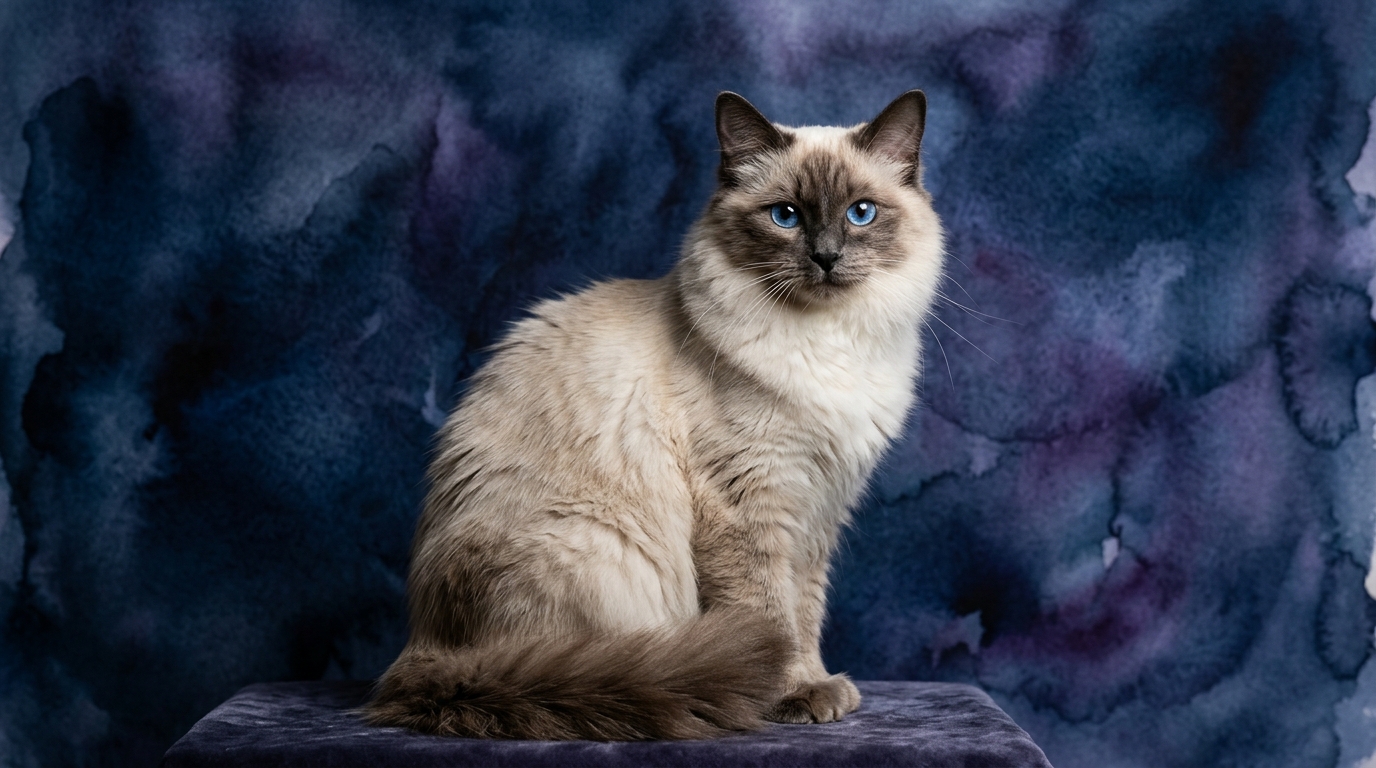
Balinese at a glance
| IQ Rank / Score | 21/25 |
|---|---|
| Trainability | ★★★★★ (5/5) |
| Social Intelligence | ★★★★★ (5/5) |
| Lifespan | 12-16 years |
| Shedding | Low to moderate |
| Exercise Needs | Moderate (20-40 min play/day) |
| Origin | USA (Siamese mutation) |
The Balinese Brain: A Symphony of Sounds and Smarts
Emerging from a spontaneous genetic mutation within the Siamese breed, the Balinese cat quickly established its own distinct identity, not merely through its elegant long coat, but profoundly through its unique cognitive blueprint. While visually captivating with their sapphire eyes and color-pointed patterns, it is their vocal intelligence that truly sets them apart. These cats are not just 'talkative'; they engage in intricate conversations, employing a rich lexicon of trills, chirps, and meows to convey everything from curiosity to profound affection, often with surprising clarity.
This advanced communication skill is a direct reflection of their exceptional social intelligence (rated 5/5). Balinese cats possess an almost uncanny ability to read human emotions, intentions, and even subtle changes in tone, often mirroring the mood of their household. This heightened awareness contributes to their remarkably fast training speed (5/5). Owners consistently marvel at how quickly a Balinese can learn complex commands, walk on a leash, or even perform tricks, responding eagerly to positive reinforcement and mental stimulation. They thrive on the mental exercise that training provides, viewing it as another form of engaging interaction.
Beyond their communicative prowess, Balinese cats excel in practical application, showcasing impressive problem-solving abilities (4/5). They are adept at navigating complex environments, figuring out how to open closed doors, manipulate puzzle toys to extract treats, or even devising clever strategies to gain attention. This cognitive agility is bolstered by a robust memory (4/5), allowing them to remember intricate routines, the location of hidden toys, and the consistent behaviors of their human companions over extended periods. This enduring memory contributes to their consistent responses to training and their ability to anticipate daily events.
The Silken Secret: What Their Coat Reveals About Their Nature
Perhaps one of the most intriguing physical traits of the Balinese, and one that subtly influences their overall demeanor, is their unique coat structure. Unlike most long-haired breeds, Balinese cats have no undercoat. This distinctive feature bestows upon their fur an incredibly soft, silk-like quality and, counterintuitively for a long-haired cat, means they shed significantly less than many other breeds, simplifying their grooming needs. This lack of an undercoat is not just a physical curiosity; it’s often associated with a slightly calmer, more composed disposition when compared to their energetic Siamese progenitors, allowing them to process information and interact with their surroundings with a refined grace.
While maintaining the deep affection and interactive nature synonymous with their lineage, the Balinese's slightly gentler temperament translates into an intelligence that is incredibly adaptable and receptive to social learning. Their instinctive drive (3/5) is moderately low, meaning they are less inclined towards intense predatory behaviors and more focused on engaging with their human family. This makes them less prone to destructive hunting behaviors indoors and more inclined to seek out companionship and intellectual stimulation. They are perfectly content as indoor pets, provided their sharp minds are kept busy with games, puzzles, and plenty of 'conversation' – a testament to their balanced blend of mental acumen and composed personality.
Unlocking Your Balinese's Brain: At-Home IQ Tests for Curious Owners
Ever wondered just how sharp your Balinese truly is? While formal scientific studies for cat intelligence are still evolving, you can conduct several simple, engaging tests right at home. These exercises are designed not just for fun, but to provide genuine insights into your cat's problem-solving skills, memory, and social awareness.
3 At-Home Tests to Measure Your Balinese's IQ
These tests are adapted from peer-reviewed ethology research. No equipment is needed beyond items you have at home. Run each test 5–10 times for reliable results.
The Myth: "The Balinese is just a Siamese with longer hair — no cognitive difference."
✅ While genetically linked, the Balinese possesses a subtly distinct cognitive and temperamental profile, often characterized by a slightly calmer disposition and a unique manifestation of vocal intelligence. These nuances, though subtle, significantly differentiate their personality and interaction style from their spirited Siamese relatives, demonstrating that a genetic mutation can influence more than just physical appearance.
Balinese vs. Similar Breeds
🧠 What's Your Cat's IQ Score?
Our full Pet IQ Lab assessment includes 12+ tests across 5 cognitive dimensions, calibrated for Balineses specifically.
Take the Full IQ Test →Frequently Asked Questions
How smart is a Balinese?
Our Pet IQ Lab framework scores cognition across five dimensions (max 25). The Balinese totals 21/25 — very high for a domestic cat. The full article breaks down each dimension with at-home tests.
Are Balineses easy to train?
Balineses learn new cues very quickly — often in 5-15 repetitions. They score 5/5 on Training Speed in our breed profile.
Are Balineses good with children and other pets?
Yes — their Social Intelligence rates 5/5 in our Pet IQ Lab framework. With early socialization and supervised play, most Balineses integrate well into families with respectful children and other pets.
Do Balineses need a lot of mental stimulation?
Absolutely. With Problem Solving 4/5 and Instinctive Drive 3/5, Balineses need daily mental work — puzzle feeders, scent games, training sessions, or interactive wand toys — to avoid boredom.
How much exercise does a Balinese need?
Balineses do well with 20-40 minutes of interactive play plus a few short training moments.
How good is a Balinese's memory?
Balineses score 4/5 on memory. They remember routines, hiding spots, and learned cues for months, sometimes years.
What is the typical lifespan of a Balinese?
Most Balineses live 12-16 years with good veterinary care, quality diet, and indoor living.
The Balinese cat offers a captivating blend of beauty, brains, and boundless communication, challenging the notion that elegance must compromise wit. Their unique vocal talents and surprising trainability make them truly exceptional companions, enriching homes with intelligent interaction and undeniable charm.