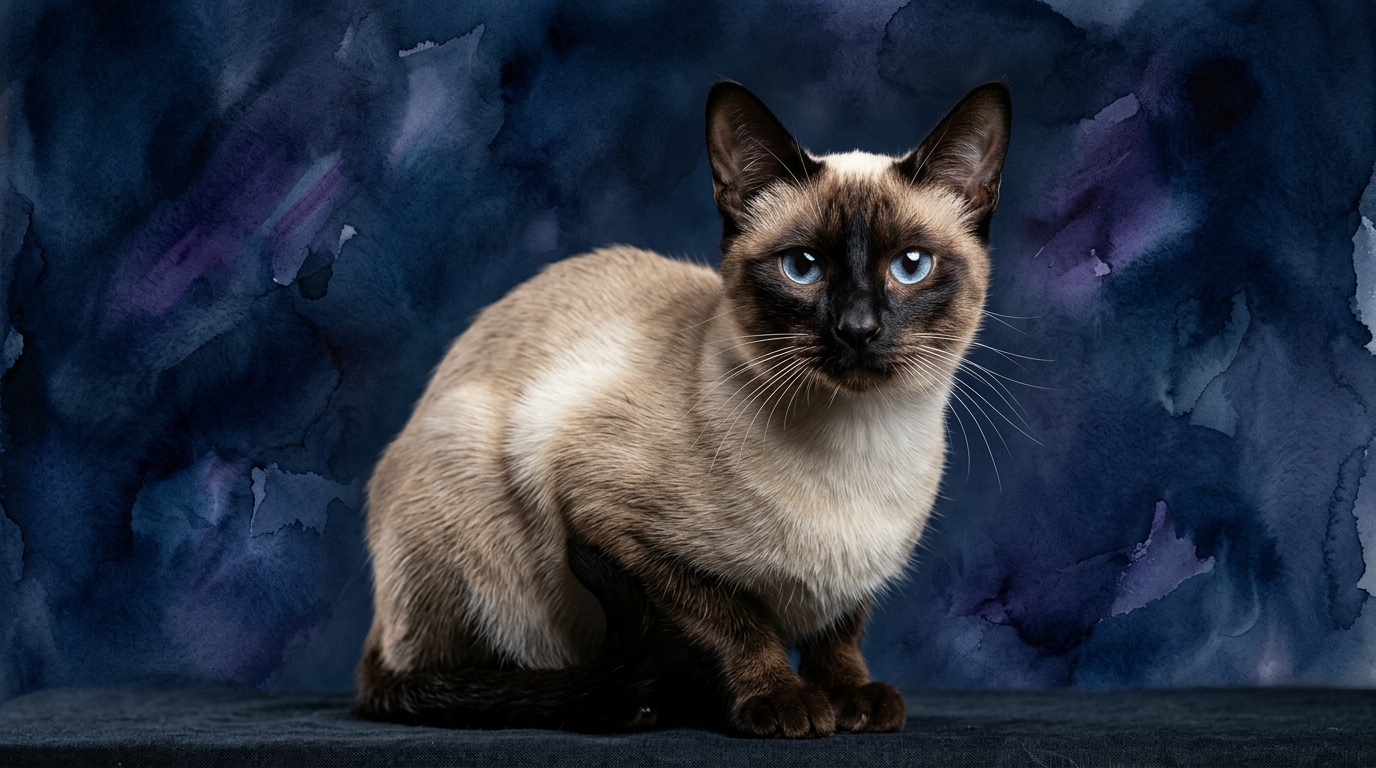
Siamese at a glance
| IQ Rank / Score | 23/25 |
|---|---|
| Trainability | ★★★★☆ (4/5) |
| Social Intelligence | ★★★★★ (5/5) |
| Lifespan | 12-16 years |
| Shedding | Low to moderate |
| Exercise Needs | Needs active play (45-60 min/day) |
| Origin | Thailand |
The Siamese Intellect: A Profile in Unique Cognitive Strengths
Originating from Thailand, these medium-sized felines present a captivating blend of elegance and exceptional cognitive abilities. While cats were not formally included in Coren's obedience scale, the Siamese carved out its own remarkable intellectual niche, demonstrating a sophisticated understanding of its world and its human companions. At The Cosmic Pet's Pet IQ Lab, we evaluate feline intelligence across several key dimensions, and the Siamese consistently impresses with a distinct profile: Problem Solving at 5/5, Training Speed at 4/5, Social Intelligence at 5/5, Instinctive Drive at 4/5, and Memory at a perfect 5/5.
The cornerstone of the Siamese's cognitive prowess lies in its vocal-social intelligence. These cats don't just 'talk' for the sake of it; their vocalizations are a highly developed form of communication, tailored specifically to interact with humans. Their ability to rapidly learn and adapt, combined with an insatiable curiosity and a deep need for social connection, sets them apart in the feline world. This isn't just about making noise; it's about making meaning.
Beyond their famous vocal repertoire, Siamese cats showcase an impressive capacity for memory and strategic problem-solving. They demonstrate an acute awareness of routines, remember past events, and can devise clever ways to achieve their goals, whether it's accessing a favorite toy or signaling a specific desire. Their instinctual drives, often channeled into interactive play and exploration, further fuel their intellectual engagement, turning every day into an opportunity for learning and connection.
Decoding the Siamese 'Dialect': A Masterclass in Vocal Social Intelligence
If you share your life with a Siamese, you're likely familiar with their extensive vocal range – a chorus of meows, chirps, and 'mews' that can sometimes feel like a full conversation. This isn't just random chatter; it's a finely tuned communication system, indicative of their profound social intelligence. The Siamese doesn't merely vocalize; it articulates, using a spectrum of sounds to convey specific intentions and emotional states.
Remarkably, research has shed light on the specificity of these sounds. Siamese cats have been documented using different meow tones for different requests — food, attention, play, and discomfort are all sonically distinct. What’s even more fascinating is that research suggests they develop individual 'dialects' with their owners. This means that over time, your Siamese might develop unique vocalizations understood only by you, creating an almost secret language between pet and parent.
This sophisticated 'vocabulary' is a clear indicator of their 5/5 Social Intelligence. It demonstrates a deep understanding of human-cat dynamics, an innate desire to connect, and an effective method for influencing their environment. They learn what works to get their needs met, and they adapt their vocal strategy based on your responses, turning every interaction into a nuanced exchange. For the curious pet owner, learning to distinguish these tones is like unlocking a new level of understanding with their feline companion.
Beyond the Meow: Problem Solving, Memory, and Trainability
While their vocal skills are legendary, the Siamese cat's intelligence extends far into other cognitive domains, particularly Problem Solving (5/5) and Memory (5/5). These cats are not content with passive observation; they actively engage with their environment, often seeking solutions to perceived challenges. This can manifest as strategically opening doors, figuring out how to retrieve a toy from a tight space, or even manipulating objects to gain access to forbidden areas, all demonstrating an impressive capacity for abstract thought and planning.
Their exceptional Memory (5/5) means a Siamese cat rarely forgets. They remember routines, the location of hidden treats, the sequence of events leading to a reward, and even past interactions with people or other pets. This robust memory underpins much of their learning capacity and contributes to their ability to form strong, lasting bonds with their families. If a Siamese cat knows a certain action leads to a desired outcome, they will remember it and apply that knowledge in future situations.
This combination of strong problem-solving skills and an excellent memory contributes directly to their high Training Speed (4/5). Siamese cats are often eager participants in training sessions, quickly grasping concepts like leash walking, coming when called, or even performing complex tricks. Their innate Instinctive Drive (4/5) for play and interaction can be skillfully channeled into positive reinforcement training, making them receptive and rewarding students. This isn't just about tricks; it's about building a deeper connection through shared activity and mental stimulation.
3 At-Home Tests to Measure Your Siamese's IQ
These tests are adapted from peer-reviewed ethology research. No equipment is needed beyond items you have at home. Run each test 5–10 times for reliable results.
The Myth: "Siamese are just noisy cats that demand attention without any real intelligence behind it."
✅ Far from being simple noise, the Siamese's vocalizations are a sophisticated 'vocabulary' used to communicate specific needs and desires. Their high social intelligence drives this communicative behavior, as they are actively engaging with their human companions to build bonds and express themselves, demonstrating a refined understanding of interaction.
Siamese vs. Similar Breeds
🧠 What's Your Cat's IQ Score?
Our full Pet IQ Lab assessment includes 12+ tests across 5 cognitive dimensions, calibrated for Siameses specifically.
Take the Full IQ Test →Frequently Asked Questions
How smart is a Siamese?
Our Pet IQ Lab framework scores cognition across five dimensions (max 25). The Siamese totals 23/25 — exceptionally high for a domestic cat. The full article breaks down each dimension with at-home tests.
Are Siameses easy to train?
Siameses are generally easy to train when you use consistent, reward-based sessions. They score 4/5 on Training Speed in our breed profile.
Are Siameses good with children and other pets?
Yes — their Social Intelligence rates 5/5 in our Pet IQ Lab framework. With early socialization and supervised play, most Siameses integrate well into families with respectful children and other pets.
Do Siameses need a lot of mental stimulation?
Absolutely. With Problem Solving 5/5 and Instinctive Drive 4/5, Siameses need daily mental work — puzzle feeders, scent games, training sessions, or interactive wand toys — to avoid boredom.
How much exercise does a Siamese need?
Siameses need active engagement. Plan for 45-60 minutes of play and climbing per day, plus mental stimulation.
How good is a Siamese's memory?
Siameses score 5/5 on memory. They remember routines, hiding spots, and learned cues for months, sometimes years.
What is the typical lifespan of a Siamese?
Most Siameses live 12-16 years with good veterinary care, quality diet, and indoor living.
Far from being just 'noisy,' the Siamese cat is a captivating study in advanced feline communication and cognitive prowess. Embracing their unique intelligence enriches the bond and reveals the truly conversational companion hidden beneath their striking sapphire gaze.