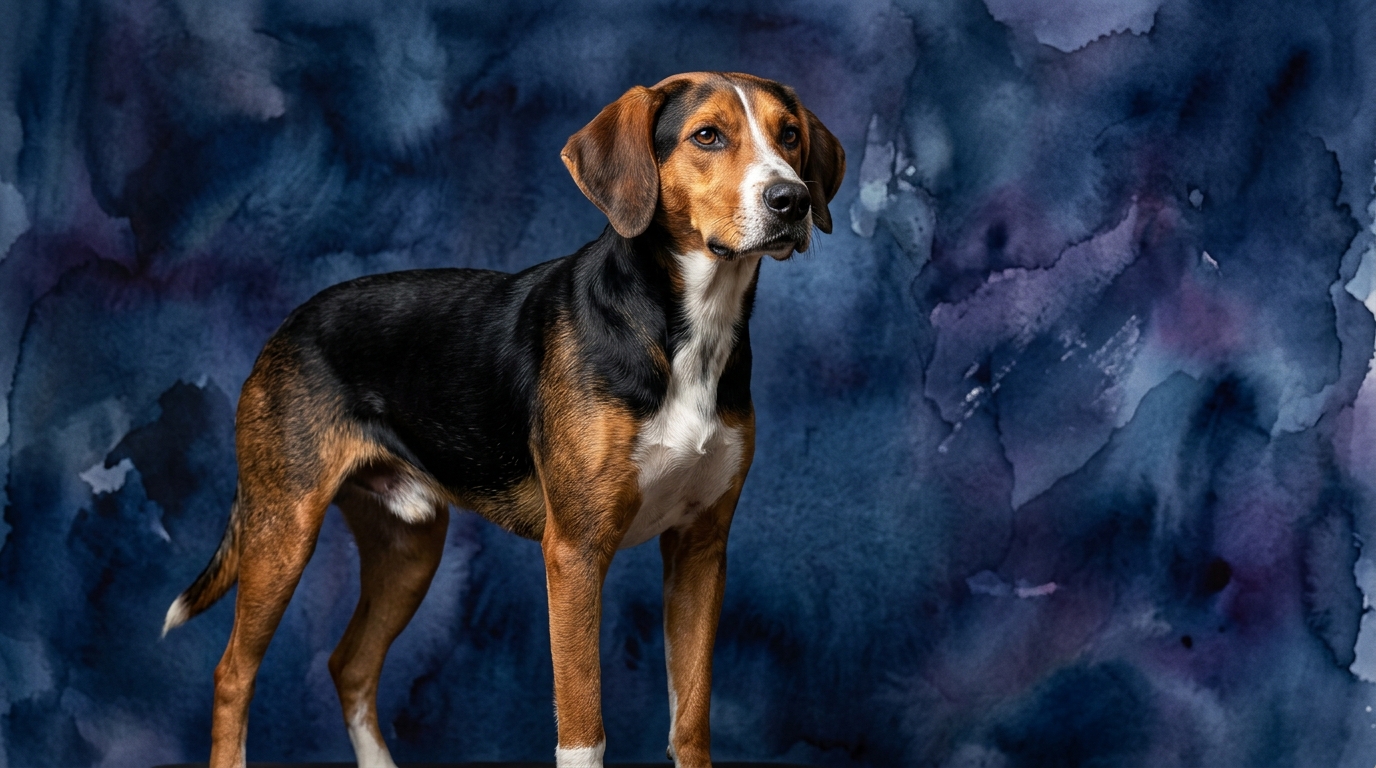

Side-by-Side IQ Profile: Shared Hound Acumen
Both the American Foxhound and the Bluetick Coonhound register a consistent 3 out of 5 across all five evaluated IQ dimensions, signifying a moderate yet specialized cognitive capacity deeply rooted in their scent-hunting heritage. Their problem-solving ability, rated at 3/5, indicates they can independently figure out complex scent trails and overcome environmental obstacles to achieve a goal, though they may not excel at abstract puzzles or human-centric tasks. This problem-solving is almost entirely directed towards their primary drive: tracking.
Training speed for both breeds also sits at 3/5, suggesting they are not the quickest learners of complex commands, often requiring consistent, patient, and engaging methods to solidify new behaviors. Their strong independent streak and focus on scent can often override a desire to please, making training a steady rather than rapid process. Social intelligence, at 3/5, means they are capable of forming strong bonds with their human families and often get along well with other dogs, especially within a pack structure, yet they might not be as finely attuned to subtle human emotional cues as some companion breeds.
Their instinctive drive, a crucial aspect for these working hounds, is rated at a potent 3/5. This score reflects a powerful, innate urge to hunt by scent, pursue quarry, and vocalize during the chase, which defines much of their behavior and cognitive application. Finally, memory, at 3/5, allows both breeds to recall specific scent patterns, hunting routes, and learned commands with reasonable accuracy, particularly those related to their core instincts, making them reliable in their specialized roles over time.
Where the American Foxhound Excels Cognitively
While sharing identical numerical scores, the American Foxhound often demonstrates its 3/5 cognitive abilities with a particular emphasis on endurance and sustained, single-minded pursuit. Their problem-solving in a hunting context leans towards efficient, long-distance tracking, where the challenge is less about intricate trail deciphering and more about maintaining a relentless pace across varied terrain. This requires a specific application of memory, allowing them to recall the general direction and progression of a scent over vast distances without getting bogged down by minor distractions.
The American Foxhound's instinctive drive, though rated 3/5, is often manifested as an almost singular focus on the chase, exhibiting a remarkable stamina that can outlast many other breeds. This drive fuels their ability to solve the 'problem' of finding and following a fox for hours. Their social intelligence, while moderate, often allows for cohesive work within a larger pack of hounds, where individual pursuit contributes to a collective effort, emphasizing a more independent yet coordinated group dynamic rather than intense one-on-one interaction with a human handler during the hunt.
Where the Bluetick Coonhound Excels Cognitively
The Bluetick Coonhound, with its matching 3/5 cognitive profile, often applies its intelligence with a distinct focus on intricate scent work and vocal communication, particularly in low-light conditions. Their problem-solving shines when deciphering cold, complex scent trails, often for raccoons, which requires a nuanced memory for subtle scent changes and the ability to differentiate between various overlapping odors. This form of problem-solving is less about sheer speed and more about meticulous, methodical deduction.
The Bluetick's instinctive drive, also at 3/5, is powerfully expressed through its characteristic 'bawl' or 'chop' while tracking, a crucial form of communication that guides handlers through dense underbrush or dark nights. This vocalization is an integral part of their hunting intelligence, signaling progress and location. Their social intelligence, while moderate, often includes a strong reliance on pack dynamics for 'treeing' quarry, where coordinated effort and clear vocal signals among hounds are paramount, suggesting a slightly more intertwined social cognitive application during the hunt compared to the more spread-out fox hunt.
Training: Navigating Independent Instincts
Neither the American Foxhound nor the Bluetick Coonhound is inherently 'easier' to train in a conventional sense, given their identical 3/5 training speed scores. Both breeds present challenges due to their profound scent drives and independent nature. American Foxhounds are often described as having a more aloof independence; once they latch onto a scent, their world narrows to that singular pursuit, making recall particularly challenging in an open environment. Their history of hunting largely unsupervised means they were bred to make their own decisions in the field, which translates to a dog that requires immense patience and consistent, high-value rewards to establish reliable responses.
Bluetick Coonhounds, while equally driven by scent, can sometimes display a slightly more handler-oriented focus when not actively tracking, making initial obedience training a touch more receptive in controlled environments. However, their powerful vocalizations and intense focus on a trail, especially at night, present their own set of training hurdles. Teaching a Bluetick to 'hush' or to disengage from a scent requires significant dedication. Both breeds necessitate an understanding of their deep-seated instincts; training isn't about breaking their spirit but channeling their natural drives into acceptable behaviors through positive reinforcement and environmental management.
Lifestyle Suitability: Active Engagement is Key
Neither the American Foxhound nor the Bluetick Coonhound is suited for a relaxed owner; both demand a highly active lifestyle. The American Foxhound is ideal for owners who can provide vast spaces for running and consistent, vigorous exercise that satisfies their incredible stamina. They thrive in homes with large, securely fenced yards or access to safe, open areas where they can stretch their legs. Their contentment comes from physical exertion and opportunities to engage their olfactory senses, even if it's just following interesting smells on a long walk. This breed suits an owner who enjoys long runs, cycling with their dog, or participating in scent work or endurance events.
The Bluetick Coonhound also requires significant activity but often benefits from more structured scent-based enrichment. Owners who enjoy hiking, exploring varied terrain, or participating in activities like tracking or coonhound trials will find a compatible companion in the Bluetick. While they need physical exercise, their cognitive engagement is deeply tied to their nose work. A Bluetick thrives when given 'jobs' that allow them to use their specialized problem-solving skills to follow a trail. Both breeds need owners committed to consistent mental stimulation that acknowledges and utilizes their strong instinctive drives, rather than trying to suppress them.
The Verdict: Choosing Your Scent Hound
The Verdict
Choose the American Foxhound if you seek a robust, independent companion for endurance activities, enjoying vast open spaces and appreciating a dog whose primary joy is the sustained, long-distance pursuit of scent.
Opt for the Bluetick Coonhound if you are drawn to a methodical tracker with a distinctive voice, valuing intricate scent work and a companion who thrives on deciphering complex trails, especially in varied environments.
🧠 Find Your Pet's IQ Score
Our Pet IQ Lab assessment covers 25+ tests across 5 cognitive dimensions — personalized to your breed.
Take the Full IQ Test →Frequently Asked Questions
Are American Foxhounds good family pets despite their strong instincts?
Yes, American Foxhounds can be affectionate family pets, especially if their exercise and scent-work needs are met. They are generally good with children and other dogs, but their independent nature means consistent training and supervision are essential to ensure a harmonious home environment.
Do Bluetick Coonhounds bark a lot, and can this be managed?
Bluetick Coonhounds are known for their distinctive 'bawl' or 'chop,' which is a natural part of their hunting communication. While this vocalization can be substantial, it can be managed through training focused on 'quiet' commands and ensuring they receive enough mental and physical stimulation to prevent boredom-induced barking.
Which breed is better for apartment living?
Neither breed is ideally suited for apartment living due to their high energy levels and strong vocalizations. Both American Foxhounds and Bluetick Coonhounds thrive with ample outdoor space, such as a large, securely fenced yard, and require significant daily exercise to prevent restlessness and destructive behaviors.