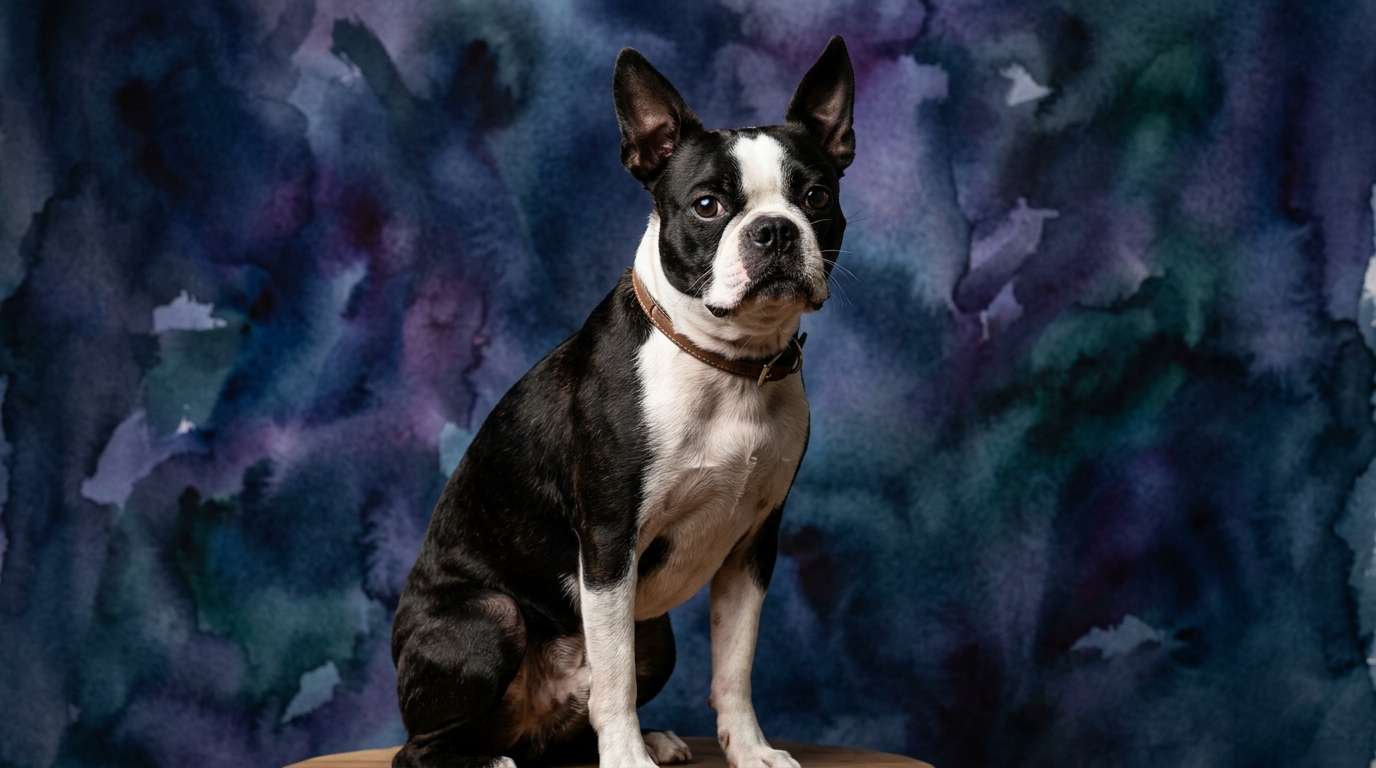

Side-by-Side IQ Profile: Boston Terrier vs. Bluetick Coonhound
The Cosmic Pet Pet IQ Lab assesses canine intelligence across five key dimensions, providing a granular look at each breed's cognitive strengths. For the Boston Terrier, a member of the Non-Sporting Group, their profile highlights a moderate Problem Solving ability (3/5), indicating they can navigate new situations with some guidance. Their Training Speed is also moderate (3/5), suggesting they learn new commands at a steady pace with consistent effort. A standout trait is their high Social Intelligence (4/5), signifying a keen understanding of human cues and a strong capacity for bonding. Their Instinctive Drive is lower (2/5), meaning they are less driven by primal urges like hunting or herding, making them primarily companion animals. Finally, their Memory is moderate (3/5), allowing them to retain learned behaviors and experiences effectively.
In contrast, the Bluetick Coonhound, a dedicated member of the Hound Group, presents a cognitive profile shaped by its working heritage. They share a moderate Problem Solving score (3/5), though their application of this skill often leans towards navigating complex scent trails rather than abstract puzzles. Their Training Speed is also moderate (3/5), but this can be influenced by their independent nature, requiring patient and engaging methods. The Bluetick Coonhound's Social Intelligence is moderate (3/5), indicating they form bonds and understand human interaction well, though perhaps with less overt expressiveness than a Boston Terrier. Their Instinctive Drive is notably higher (3/5), reflecting their powerful urge to track and follow scents. Like the Boston Terrier, their Memory is moderate (3/5), particularly for retaining scent patterns and the intricacies of their hunting grounds.
Where the Boston Terrier Excels Cognitively
The Boston Terrier's primary cognitive advantage lies in its exceptional Social Intelligence (4/5). This dimension reflects their profound ability to interpret human body language, vocal tones, and emotional states, making them remarkably attuned companions. They are adept at understanding household routines and anticipating their owner's needs or desires, often seeking interaction and comfort. This high social acumen fosters a deep, empathetic bond, allowing them to integrate seamlessly into family life and respond keenly to human interaction. Their cognitive strengths are geared towards companionship, thriving on the complex social dynamics of a human household.
Furthermore, the Boston Terrier's lower Instinctive Drive (2/5) contributes to their cognitive suitability for a companion role. Unlike breeds with strong hunting or herding urges, Boston Terriers are generally less distracted by external stimuli such as squirrels or distant scents. This allows them to focus more intently on their human companions and indoor environments, making them more present and engaged in domestic settings. Their problem-solving (3/5) and memory (3/5) are often applied to navigating social situations within the family unit, figuring out how to gain attention, or remembering where their favorite toy is stored, all within a human-centric context.
Where the Bluetick Coonhound Shines Cognitively
The Bluetick Coonhound's cognitive prowess is deeply intertwined with its powerful Instinctive Drive (3/5), which manifests as an unparalleled dedication to scent work. Their problem-solving ability (3/5) is uniquely applied to the intricate challenge of tracking, where they must interpret subtle scent cues, navigate varied terrain, and overcome environmental obstacles to follow a trail. This requires a focused, persistent form of intelligence, distinct from the social problem-solving of a Boston Terrier. Their moderate memory (3/5) is particularly strong for recalling scent patterns, terrain features, and the successful strategies used in previous tracking endeavors, making them incredibly effective in their specialized field.
Beyond just tracking, the Bluetick Coonhound's cognitive profile emphasizes endurance and singular focus. When engaged in scent work, their attention is almost singularly dedicated to the task at hand, demonstrating a form of cognitive stamina. While their social intelligence (3/5) is present, their natural inclination is to prioritize an intriguing scent over immediate human interaction once a trail is picked up. This reflects a cognitive design optimized for independent work in challenging outdoor environments, where self-reliance and an unwavering commitment to the task are paramount. Their intelligence is practical and purpose-driven, honed by generations of specialized work.
Training Dynamics: Which Breed is Easier and Why?
When considering ease of training, both breeds score a moderate 3/5 in Training Speed, but the underlying behavioral differences create distinct challenges and advantages. The Boston Terrier, with its high Social Intelligence (4/5) and lower Instinctive Drive (2/5), is often perceived as more eager to please and less prone to distraction. They thrive on positive reinforcement, praise, and social interaction, which acts as a powerful motivator. Their desire to be close to their humans means they are generally receptive to learning commands that facilitate a harmonious co-existence. While they can exhibit a charming stubborn streak, their focus remains largely on their human companion, making them generally responsive to consistent, reward-based training in a home environment.
The Bluetick Coonhound, despite the same 3/5 Training Speed, presents a different training landscape due to its robust Instinctive Drive (3/5) and independent nature. Bred to work independently, often out of sight and earshot, following a scent for miles, they possess a strong will and a tendency to prioritize their nose over human commands. This means that while they are capable of learning, their attention can be easily diverted by a compelling scent, making recall particularly challenging. Training a Bluetick Coonhound requires immense patience, creativity, and the use of high-value rewards to compete with the allure of a trail. Owners must understand that their moderate social intelligence (3/5) means they might not be as inherently driven to please as a Boston Terrier, and their training needs to acknowledge and channel their powerful natural instincts rather than suppress them.
Lifestyle Match: Active Owners vs. Relaxed Owners
The cognitive profiles of these two breeds naturally align with different owner lifestyles. The Boston Terrier, with its high Social Intelligence (4/5) and lower Instinctive Drive (2/5), is an ideal match for owners seeking a close, interactive companion that thrives on human presence. Their moderate exercise needs mean they are well-suited for urban living, apartments, or homes with smaller yards, provided they receive daily walks and engaging playtime. Owners who appreciate a dog that is keenly aware of their moods and readily participates in family activities, often preferring indoor companionship over extensive outdoor adventures, will find a Boston Terrier a fulfilling choice. They are excellent for relaxed owners who still commit to consistent mental stimulation and quality time.
Conversely, the Bluetick Coonhound is best suited for active owners who can provide ample outlets for its formidable Instinctive Drive (3/5) and considerable stamina. Their cognitive design is optimized for outdoor work and exploration, making them excellent companions for hikers, runners, or individuals interested in scent work and tracking sports. They require securely fenced yards due to their tendency to follow a compelling scent, and thrive in environments where they can engage their problem-solving (3/5) and memory (3/5) skills in a practical, outdoor context. Owners who understand and appreciate the independent, dedicated nature of a working hound, and are prepared for a dog that needs significant physical and mental engagement, will find the Bluetick Coonhound a rewarding partner for an active, outdoor-centric lifestyle.
The Verdict
Choose the Boston Terrier if you desire a highly socially intelligent, adaptable companion who thrives on close human interaction and fits well into a less physically demanding, often urban, lifestyle.
Opt for the Bluetick Coonhound if you are an active owner prepared to channel a powerful instinctive drive, providing extensive physical and mental challenges that engage their specialized tracking intelligence in an outdoor-oriented environment.
🧠 Find Your Pet's IQ Score
Our Pet IQ Lab assessment covers 25+ tests across 5 cognitive dimensions — personalized to your breed.
Take the Full IQ Test →Frequently Asked Questions
How does social intelligence impact daily life for these breeds?
A Boston Terrier's high social intelligence means they are often more attuned to human emotions and cues, making them highly responsive companions in a family setting. A Bluetick Coonhound, with moderate social intelligence, will form strong bonds but might display more independence, especially when their strong scent drive is engaged, often prioritizing a trail over immediate human interaction.
Can a Bluetick Coonhound be an apartment dog?
While a Bluetick Coonhound can adapt to apartment living, it's challenging due to their significant exercise requirements and strong instinctive drive. They need extensive daily physical activity and mental stimulation, preferably involving scent work, to prevent boredom and destructive behaviors. Without a large, securely fenced yard or dedicated outdoor activities, an apartment may not adequately meet their needs.
Are Boston Terriers good with children?
Boston Terriers, with their high social intelligence and generally amiable temperament, can be excellent family dogs and are often very good with children. Their playful nature and moderate energy levels make them suitable companions for respectful kids, though as with any breed, supervision is always recommended to ensure positive interactions.