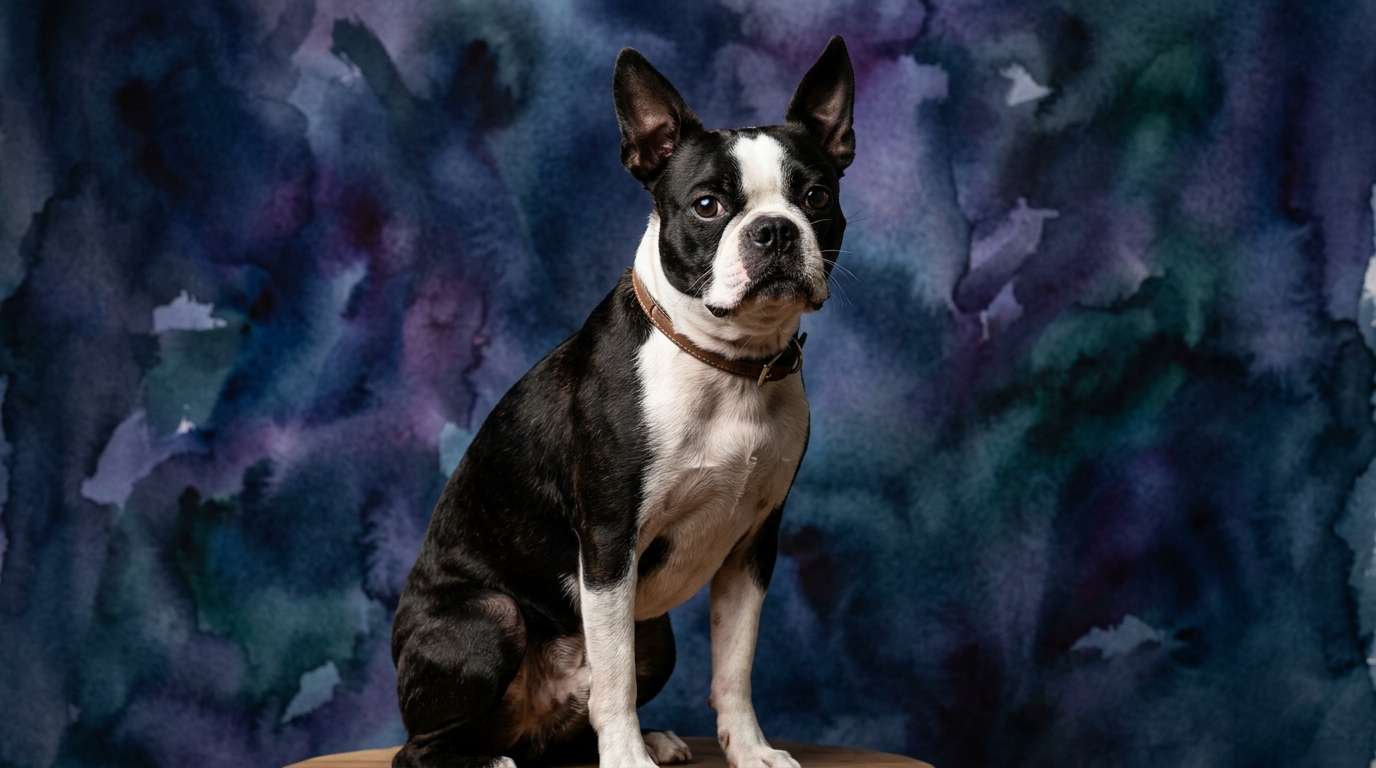

Side-by-Side Cognitive Profiles: Boston Terrier vs. Kooikerhondje
At The Cosmic Pet Pet IQ Lab, we evaluate canine cognition across five key dimensions, providing a granular view of each breed's mental landscape. While both the Boston Terrier and the Kooikerhondje share a '3/5' rating in Problem Solving, Training Speed, and Memory, their unique breed histories illuminate distinct approaches to these cognitive tasks. The Boston Terrier, a Non-Sporting companion, brings a different set of mental tools to the table compared to the Sporting Kooikerhondje.
The Boston Terrier’s cognitive blueprint is marked by a Problem Solving score of 3/5, indicating an ability to navigate familiar challenges and learn routines effectively, often relying on learned patterns rather than innovative solutions. Their Training Speed, also at 3/5, suggests they grasp new commands at a moderate pace, thriving with consistent, positive reinforcement. Where they truly stand out is in Social Intelligence, earning a remarkable 4/5. This reflects their acute sensitivity to human emotions and social cues, making them highly attuned to their family's dynamics. Their Instinctive Drive is a modest 2/5, meaning primal urges like hunting or herding are largely subdued. Finally, their Memory is solid at 3/5, enabling them to retain learned behaviors and recognize familiar faces and places over time.
In contrast, the Kooikerhondje, a Sporting breed, also scores 3/5 in Problem Solving, capable of tackling practical daily puzzles and understanding cause-and-effect within their environment. Their Training Speed, similarly 3/5, means they learn steadily, responding best to patient, clear instruction, often showing a focused eagerness to work. Their Social Intelligence is rated 3/5; they are perceptive and form deep bonds with their family but can be reserved or cautious with strangers, observing before engaging. A notable difference lies in their Instinctive Drive, which stands at 3/5, reflecting their heritage as waterfowl decoy dogs with a natural inclination for tasks like retrieving and scent work. Their Memory, like the Boston’s, is a reliable 3/5, allowing for good retention of training and past experiences.
Where the Boston Terrier Shines Cognitively
The Boston Terrier’s most pronounced cognitive strength lies in its exceptional Social Intelligence, scoring a 4/5 compared to the Kooikerhondje’s 3/5. This elevated capacity allows them to interpret human non-verbal communication with remarkable precision, picking up on subtle shifts in tone, facial expressions, and body language. They don't just react to commands; they often anticipate their owner's moods and desires, making them incredibly empathetic and responsive companions. For instance, a Boston Terrier might intuitively offer comfort when their owner is upset or adjust their play intensity based on the family's energy levels, demonstrating a nuanced understanding of social context. This keen social awareness contributes to their adaptability in various home environments and their ability to integrate seamlessly into diverse family structures, often becoming the emotional barometer of the household. Their capacity for deep social connection means they thrive on interaction and reciprocate affection readily, making them perceptive partners in daily life.
Where the Kooikerhondje Holds a Cognitive Edge
The Kooikerhondje's cognitive advantage is most evident in its Instinctive Drive, rated 3/5, which surpasses the Boston Terrier's 2/5. This moderate drive stems directly from their historical role as waterfowl decoy dogs, requiring them to engage with their environment in a purposeful, task-oriented manner. This isn't merely about chasing; it's about a natural curiosity and motivation to explore, investigate, and perform specific functions. For example, a Kooikerhondje might exhibit a stronger inclination for scent work, tracking games, or retrieving objects, demonstrating a focused engagement that goes beyond simple play. This intrinsic motivation means they often seek out mental and physical challenges, showing a natural aptitude for activities that tap into their working heritage. Their drive can be channeled into impressive performances in dog sports, providing an outlet for their inherent desire to 'work' and solve environmental puzzles, making them self-starters in certain exploratory contexts.
Training Dynamics: Boston Terrier vs. Kooikerhondje
When it comes to ease of training, both breeds share a 3/5 Training Speed, suggesting neither is inherently 'easier' in terms of raw learning pace, but their cognitive differences dictate distinct training approaches and experiences. The Boston Terrier's elevated Social Intelligence plays a significant role here; their desire to please and their sensitivity to human cues often make them highly responsive to positive reinforcement and praise. They enjoy the interaction of training sessions and are generally eager to cooperate, which can make initial training feel straightforward for an owner. However, their moderate problem-solving and memory, combined with an occasional independent streak, means consistency is paramount. They might test boundaries, requiring patient repetition rather than assuming a command is mastered after a few tries.
The Kooikerhondje, with its 3/5 Instinctive Drive, often approaches training with a focused, task-oriented mindset. Their working dog background means they can be very attentive to instruction when engaged, particularly if the training taps into their natural drives like retrieving or scent work. This focus can lead to efficient learning of specific tasks. However, their 3/5 Social Intelligence also means they can be more reserved, especially with new trainers or in unfamiliar environments, potentially requiring more time to build trust and feel comfortable before fully engaging. They are sensitive dogs, and harsh corrections can be counterproductive, leading to withdrawal. Therefore, while both learn at a similar speed, the Boston Terrier might be more overtly willing to engage due to its social acumen, while the Kooikerhondje might show deeper, more sustained focus on the task once it commits, provided the training method is gentle and engaging.
Matching Breeds to Lifestyles: Active vs. Relaxed Owners
Understanding the cognitive profiles of these breeds provides clear guidance on which might best suit an active or relaxed lifestyle. The Boston Terrier, with its lower 2/5 Instinctive Drive and significant 4/5 Social Intelligence, generally makes an excellent companion for more relaxed owners. They thrive on human companionship and are often content with moderate indoor play, short walks, and being a constant presence by their owner's side. Their moderate energy levels and reduced need for intense outdoor activity mean they adapt well to apartment living or quieter households. What they demand most is social interaction and mental engagement through companionship rather than strenuous physical challenges. They are the ideal choice for someone seeking a perceptive, affectionate presence that doesn't require extensive outdoor adventures.
Conversely, the Kooikerhondje's 3/5 Instinctive Drive and Sporting heritage make it a better match for active owners. While not hyperactive, they possess a natural inclination for purposeful activity and benefit significantly from regular mental and physical stimulation. Owners who enjoy dog sports like agility, obedience, or scent work, or who are committed to long daily walks and engaging training sessions, will find the Kooikerhondje to be a willing and capable partner. Their moderate drive means they need an outlet for their intelligence and natural curiosity; without it, they might become bored or develop undesirable behaviors. They are suited for individuals or families prepared to integrate their dog into an active routine, providing opportunities for both physical exertion and mentally stimulating tasks.
The Verdict
Choose a Boston Terrier if you prioritize a highly socially attuned companion who thrives on close human interaction and doesn't require extensive outdoor activities, appreciating a dog that can keenly read your emotional cues.
Opt for a Kooikerhondje if you are an active owner prepared to engage in regular mental and physical activities, appreciating a dog with a moderate working drive and a keen interest in task-oriented training or dog sports.
🧠 Find Your Pet's IQ Score
Our Pet IQ Lab assessment covers 25+ tests across 5 cognitive dimensions — personalized to your breed.
Take the Full IQ Test →Frequently Asked Questions
Are Boston Terriers good at learning tricks?
Yes, their moderate training speed combined with a strong desire for social interaction makes them receptive to learning tricks, especially when positive reinforcement and engagement are used. They enjoy the attention and mental stimulation involved in mastering new behaviors.
Do Kooikerhondjes need a lot of mental stimulation?
Absolutely. Originating as waterfowl decoys, Kooikerhondjes possess a moderate instinctive drive and a keen mind that benefits from regular mental challenges. Puzzle toys, scent work, and consistent training help prevent boredom and channel their natural curiosity constructively.
How do these breeds react to new people or environments?
Boston Terriers, with their elevated social intelligence, typically adapt quickly and are generally welcoming to new people and environments, often seeking interaction. Kooikerhondjes, while devoted to their family, can be more reserved or cautious with strangers and in unfamiliar settings, requiring patient introductions to feel comfortable.