
Side-by-Side Cognitive Profiles
At The Cosmic Pet Pet IQ Lab, we evaluate canine intelligence across five key dimensions, and for the Briard and Ibizan Hound, these scores paint distinct pictures. The Briard, a Herding breed, ranks commendably at #30 on the Coren scale, while the Ibizan Hound, a sighthound, holds rank #53, suggesting differing cognitive priorities.
The Briard's profile showcases robust mental faculties: Problem Solving (4/5): This breed's history as a versatile herder often necessitated independent decision-making in the field, such as redirecting livestock or protecting the flock. This translates to a strong capacity for analyzing novel situations and devising effective solutions, often showing initiative rather than waiting for direct instruction. Training Speed (4/5): Their eagerness to work and inherent desire to please their handler, combined with their capacity for understanding complex commands, means Briards typically grasp new behaviors and routines with relative swiftness. They are attentive learners who thrive on consistent, positive reinforcement. Social Intelligence (3/5): While capable of forming deep bonds with their family, the Briard's social intelligence is primarily directed towards their immediate 'flock' – their human family and other household animals. They can be reserved or discerning with strangers, prioritizing the safety and cohesion of their inner circle over broad social engagement. Instinctive Drive (3/5): The Briard's instinctive drive is strongly rooted in its herding heritage. This manifests as a desire to gather, protect, and control movement, which can sometimes extend to family members or even objects. While not as intense as some specialized herding breeds, it's a persistent underlying motivation. Memory (4/5): A Briard's excellent memory serves them well in their herding duties, allowing them to recall complex routes, specific commands, and the spatial arrangement of their environment. This also contributes to their trainability, as they retain learned behaviors and past experiences readily.
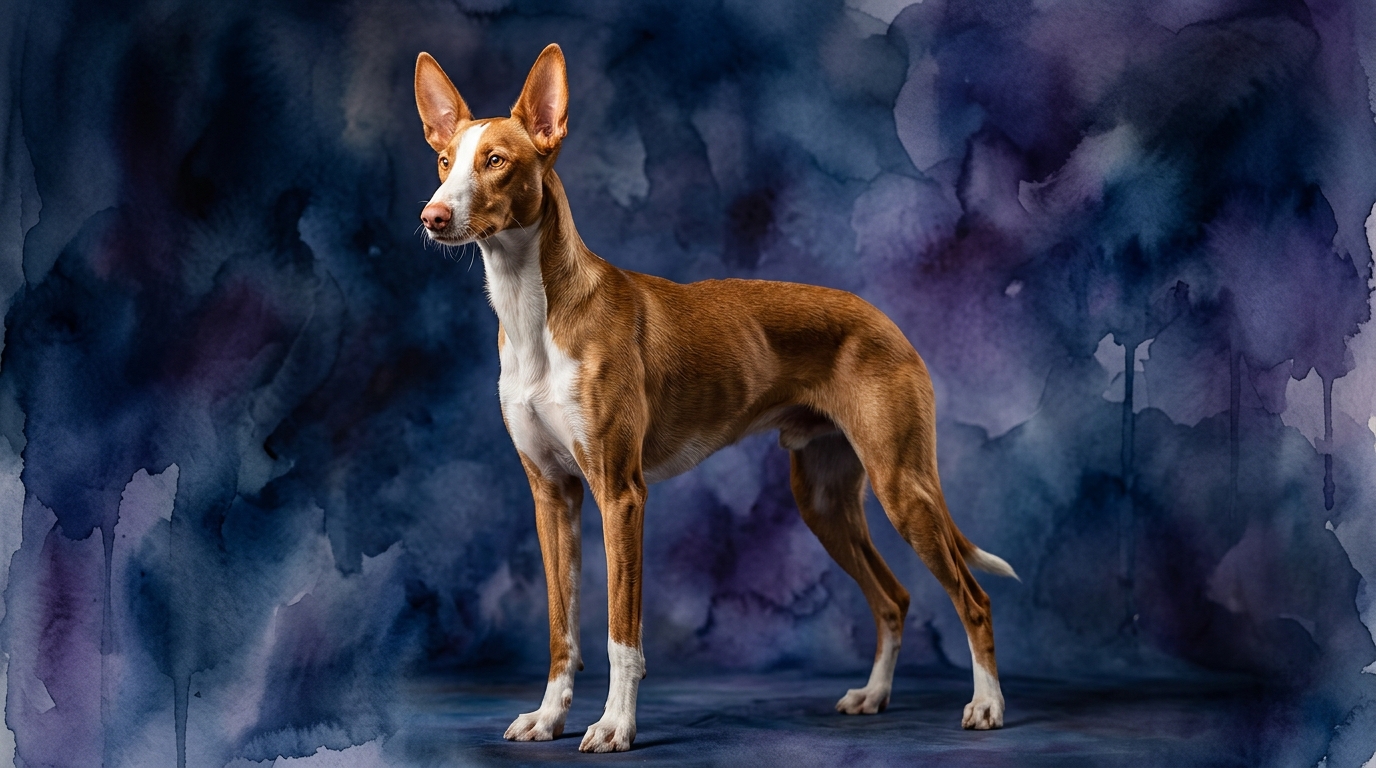
The Ibizan Hound’s cognitive strengths are tailored to its sighthound purpose: Problem Solving (3/5): The Ibizan Hound's problem-solving skills are finely tuned for its sighthound heritage: spotting, pursuing, and capturing prey, often requiring independent thought in varied terrain. While they can solve problems, their approach is often driven by immediate sensory input and instinctual pursuit rather than abstract reasoning or complex multi-step planning. Training Speed (3/5): Ibizan Hounds are capable learners, but their training speed is often tempered by their independent nature and strong prey drive. They respond best to engaging, positive methods and can quickly learn what's expected, but their motivation can be highly situational, sometimes prioritizing an interesting scent or movement over a command. Social Intelligence (3/5): Ibizan Hounds generally display a gentle and affectionate social intelligence within their trusted family unit. They can be sensitive and form close bonds. However, their social interactions outside this circle often reflect a sighthound's characteristic reserve; they are typically polite but not overly demonstrative with strangers. Instinctive Drive (3/5): The core of the Ibizan Hound's instinctive drive is the hunt. Their powerful visual acuity and explosive speed are geared towards spotting and chasing prey. This drive is a persistent force, requiring careful management and appropriate outlets in a domestic setting. Memory (3/5): Ibizan Hounds possess a functional memory that allows them to learn routines and remember specific locations or individuals. Their memory is effective for their primary purpose, recalling prey routes or familiar paths, but perhaps not as geared towards retaining a vast repertoire of complex, arbitrary commands as a working herding dog might.
Where the Briard Wins Cognitively
The Briard's cognitive strengths distinctly shine in areas demanding proactive decision-making and intricate learning. Their superior Problem Solving score of 4/5 reflects a breed that doesn't just react but often anticipates and acts with purpose, a direct legacy of their herding role where they had to manage livestock independently. This manifests as an ability to navigate complex household routines, figure out how to open child-proof latches, or devise clever ways to retrieve a toy from an inaccessible spot without constant human prompting. Coupled with a Training Speed of 4/5, Briards demonstrate a marked aptitude for rapidly acquiring new skills and commands, often needing fewer repetitions to cement a behavior. This cognitive agility makes them particularly adept at advanced obedience, agility, or even search and rescue, where quick learning and retention are paramount. Their Memory score of 4/5 further underpins this, allowing them to recall a vast repertoire of commands, remember past experiences, and understand complex sequences, building upon previous lessons more effectively than many other breeds.
Where the Ibizan Hound Wins Cognitively
While the Ibizan Hound's numerical scores might appear modest in a direct comparison, their cognitive profile represents a specialized brilliance, particularly in independent action and sensory processing, which could be framed as a contextual 'win.' Their Problem Solving (3/5) and Instinctive Drive (3/5) are exquisitely honed for the precise task of hunting by sight, often requiring split-second decisions in pursuit without human guidance. This isn't about solving an abstract puzzle in a human-centric way, but about dynamically assessing terrain, predicting prey movement, and executing a chase strategy using their acute visual and auditory processing. Their cognitive strength lies in their remarkable ability to focus intensely when their hunting drive is engaged, allowing them to filter out environmental distractions and concentrate on a moving target with singular intensity. This intense, focused drive, while challenging in training, is a cognitive advantage in scenarios demanding rapid, autonomous responses based on environmental cues. They excel in environments where their keen senses and quick reflexes are paramount, demonstrating a different kind of problem-solving—one rooted in instinctual efficiency and immediate environmental interaction rather than sequential logic or human-directed tasks. Their cognitive independence means they can operate effectively without constant oversight, a trait many owners value when seeking a companion that retains a certain self-sufficiency.
Which Is Easier to Train and Why
When considering ease of training, the Briard generally presents a more straightforward path. Their higher Training Speed (4/5) and strong desire to work cooperatively with their human partners are significant advantages. Briards often seek to understand what is expected of them and find satisfaction in performing tasks correctly, making them highly responsive to positive reinforcement methods. Their superior memory (4/5) means they retain commands and routines quickly, building a reliable behavioral repertoire. Real behavioral differences include their inherent 'herding' mentality, which, while needing appropriate channeling, lends itself to following direction and maintaining focus on a task. They often thrive on having a job to do and appreciate clear, consistent guidance.
In contrast, the Ibizan Hound's training journey is often characterized by its independence and pronounced instinctive drive (3/5). While capable of learning, their attention can be more fleeting, easily diverted by an interesting scent or a distant movement. This isn't a lack of understanding, but rather a strong internal motivation that often outweighs the desire to comply with a human command in the moment. Their problem-solving (3/5) is geared towards autonomous hunting, not necessarily collaborative learning, meaning owners need to be exceptionally patient, creative, and consistent, often working to make training more engaging than the allure of the natural world. Their sighthound nature means they are less inclined to perform repetitive tasks purely for human approval and are more motivated by what directly appeals to their senses or prey drive.
Matching Cognitive Profiles to Lifestyles
For active owners seeking a true partner in various endeavors, the Briard's cognitive profile aligns exceptionally well. Their higher problem-solving and training speed make them excellent candidates for dog sports like agility, obedience, rally, or even search and rescue, where mental engagement is as crucial as physical exertion. An active owner who enjoys structuring their dog's day with learning opportunities and collaborative tasks will find the Briard thrives on this mental stimulation. Their moderate instinctive drive means it's manageable within structured activities, rather than overwhelming, allowing them to focus on the task at hand with their handler.
Conversely, while the Ibizan Hound is undeniably an active breed physically, their cognitive independence and pronounced instinctive drive make them better suited for active owners who appreciate a dog with a strong sense of self and who can provide outlets for their sighthound nature. This means secure, off-leash running opportunities in expansive, fenced areas, or participation in lure coursing, where their natural hunting instincts can be safely expressed. A 'relaxed' owner, in the sense of one seeking a low-maintenance mental companion, might find the Ibizan Hound's independent spirit and need for specific, high-energy outlets challenging. Both breeds require physical activity, but the *type* of mental engagement they demand and reward differs significantly. The Briard seeks shared purpose and collaborative problem-solving; the Ibizan seeks fulfilling its innate drives through independent exploration and pursuit.
The Verdict
Choose the Briard if you desire a highly trainable, cooperative companion eager to learn complex tasks and participate actively in structured activities, thriving on collaborative mental engagement.
Opt for the Ibizan Hound if you appreciate a keenly independent spirit, possessing specialized hunting instincts and a need for specific outlets for their physical and sensory drives, valuing a self-sufficient companion.
🧠 Find Your Pet's IQ Score
Our Pet IQ Lab assessment covers 25+ tests across 5 cognitive dimensions — personalized to your breed.
Take the Full IQ Test →Frequently Asked Questions
Do Briards need a lot of mental stimulation?
Yes, Briards definitely benefit from consistent mental engagement. Their problem-solving abilities and strong memory mean they thrive on learning new commands, playing puzzle games, and participating in structured activities to prevent boredom and channel their working intelligence.
Are Ibizan Hounds difficult to train because of their independence?
Ibizan Hounds can present unique training challenges due to their independent nature and strong prey drive. While they are capable of learning, their motivation is often situational, requiring patient, positive reinforcement and making training highly engaging to compete with their natural instincts.
Which breed is better for a first-time dog owner?
For a first-time dog owner, the Briard might be a more manageable choice due to its higher trainability and desire to cooperate, making the learning process smoother for both dog and owner. The Ibizan Hound's independence and powerful instincts often require a more experienced hand.