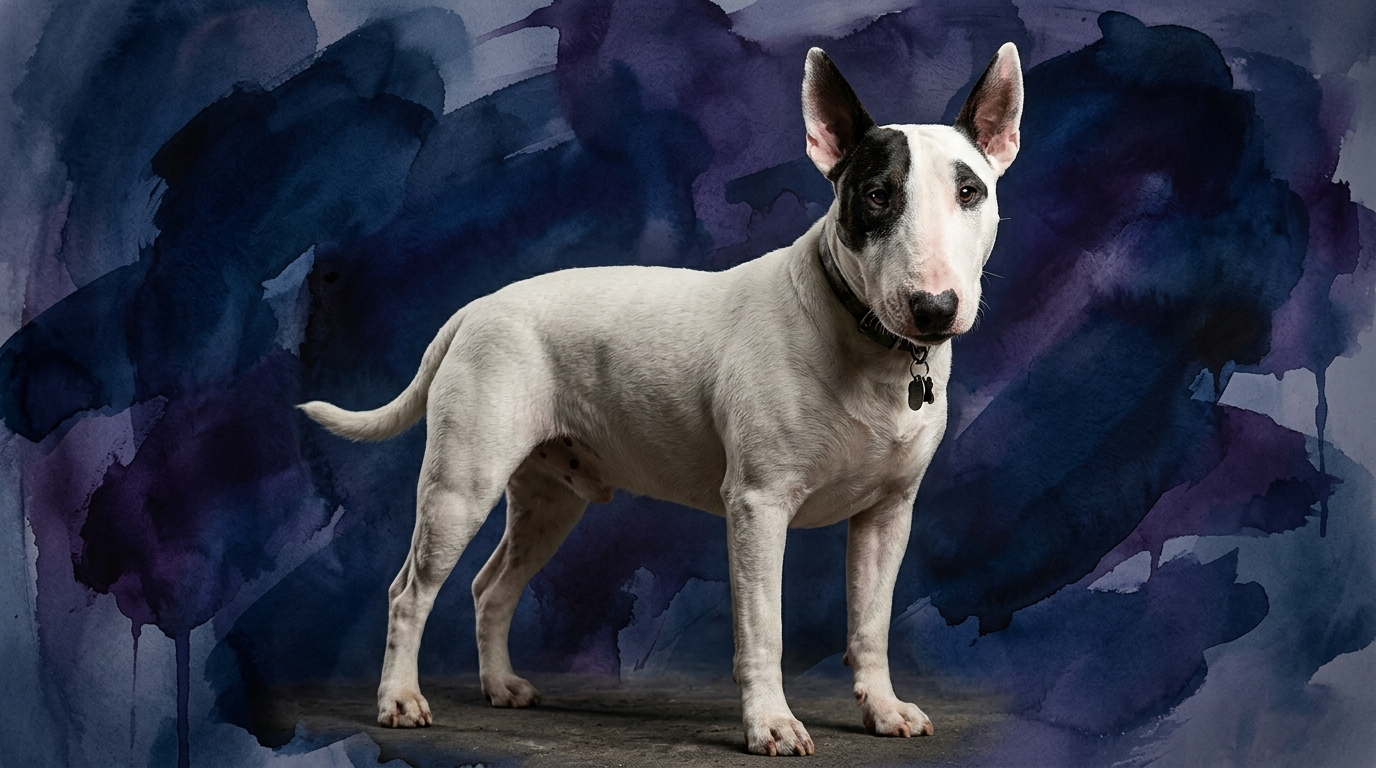

Side-by-Side IQ Profile: Bull Terrier vs. Brussels Griffon
**Bull Terrier (Coren rank #66)**: This robust breed demonstrates a moderate capacity (3/5) for navigating novel challenges, often employing a tenacious, hands-on approach. They are not quick to abandon a puzzle, preferring to physically interact with an object or situation until a solution emerges, rather than relying on abstract reasoning, resulting in practical, direct solutions. Their training speed is also 3/5, meaning learning new commands and routines takes moderate repetition; their independent nature and occasional stubbornness require patient, consistent, and engaging methods to maintain focus. Bull Terriers possess a moderate understanding (3/5) of human cues and social dynamics, forming strong bonds and reading familiar individuals well, though they may not always be attuned to subtle emotional shifts. Their instinctive drives are moderately present (3/5), manifesting as a desire to chase, dig, and investigate, which requires appropriate outlets and management. Finally, Bull Terriers show a moderate ability (3/5) to retain information over time, remembering commands, routines, and experiences consistently, though reinforcement aids retention for less frequently practiced tasks.
**Brussels Griffon (Not Coren-ranked)**: These compact companions also exhibit a moderate aptitude (3/5) for solving problems, often relying on observation and their close bond with humans. They might attempt various strategies, including vocalization or looking to their owners for guidance, before independently arriving at a solution; their smaller stature means problem-solving often involves finesse over brute force. Their training speed is 3/5, indicating they learn at a moderate pace, thriving on positive reinforcement and consistent training. While eager to please, their sensitivity and short attention spans can make sessions challenging, requiring them to be kept brief, fun, and highly rewarding. Brussels Griffons possess moderate social intelligence (3/5), often quite attuned to the moods and intentions of their primary caregivers, forming deep, affectionate bonds and interpreting familiar human emotions intensely within their immediate family. Their instinctive drives are moderately developed (3/5), manifesting as keen curiosity, a desire to explore small spaces, and a tendency to 'alert' their owners to perceived novelties. Brussels Griffons also demonstrate a moderate memory (3/5), capable of remembering routines, commands, and people, with strong emotional connections often reinforcing these memories for reliable recall in familiar contexts.
Where the Bull Terrier Wins Cognitively
Despite identical numerical scores, the Bull Terrier's cognitive application shines in scenarios demanding physical tenacity and independent resolve. Their problem-solving 3/5, combined with their instinctive drive, means they are often more persistent in tackling physical puzzles or navigating complex environments that require sustained effort, such as retrieving an object from under a heavy obstacle. While a Brussels Griffon might seek human assistance, a Bull Terrier is more inclined to physically manipulate their surroundings until a solution is found. Their robust build and moderate memory allow them to retain complex physical sequences for tasks like agility courses, where consistent, forceful execution is key. Furthermore, in situations requiring a degree of independence from direct human instruction, their moderate social intelligence allows them to proceed confidently based on prior learning, rather than constantly seeking affirmation. This self-reliance can be a cognitive advantage in tasks that require a dog to work slightly apart from their handler, such as scent work or navigating a defined search area without constant cues.
Where the Brussels Griffon Wins Cognitively
Conversely, the Brussels Griffon's cognitive strengths, though also rated 3/5, manifest differently, often leveraging their close human bond and keen observational skills. Their problem-solving 3/5 often involves a more nuanced approach, where they might observe human actions closely and attempt to mimic or adapt strategies, particularly in a home environment. For instance, they might more quickly learn to open a specific cupboard by watching an owner, rather than through trial-and-error physical force. Their moderate social intelligence, while focused on a smaller circle, can make them exceptionally quick to pick up on subtle human emotional shifts or unspoken routines, allowing them to anticipate needs or comfort their owners effectively. This acute sensitivity to their environment and human companions means their memory often strongly links to emotional experiences, reinforcing positive or negative associations with remarkable clarity. In training, while their speed is 3/5, their desire for closeness and validation can make them highly attentive to their handler’s non-verbal cues, potentially giving them an edge in learning complex sequences that rely on subtle body language rather than overt commands.
Which is Easier to Train and Why
Both breeds hold a 3/5 rating for training speed, yet the *experience* of training them can vary significantly due to their inherent temperaments. The Bull Terrier, with its moderate instinctive drive and independent nature, can present a challenge requiring firm consistency and creative motivation. Their terrier stubbornness means they might understand a command but choose not to comply if they see no immediate benefit or are distracted by something more interesting, such as a scent or a moving object. Training a Bull Terrier demands patience, a strong, fair leader, and methods that make learning feel like a game, leveraging their moderate problem-solving skills to keep them engaged. They respond well to clear boundaries and positive reinforcement, but trainers must be prepared for moments of willful disregard.
The Brussels Griffon, while also rated 3/5 in training speed, tends to be more sensitive and eager to please their chosen human, which can make them *seem* easier to train for some tasks. However, their moderate social intelligence, focused intensely on their owner, can also lead to a dependence where they struggle without constant guidance. Their short attention span and potential for distraction, especially if they are feeling overwhelmed or bored, mean training sessions must be kept brief, fun, and highly rewarding to maintain their focus. They are less likely to outright defy a command but might become disengaged or anxious if the training is too repetitive or harsh. Their moderate memory ensures they retain what they learn, but consistent, gentle reinforcement is key to building reliable behaviors, especially considering their propensity for 'selective hearing' when something more socially interesting arises.
Which Suits Active Owners vs. Relaxed Owners
The cognitive profiles of both breeds offer insights into their suitability for different lifestyles. The Bull Terrier, with its moderately strong instinctive drive and tenacious approach to problem-solving, is generally better suited for active owners. These dogs thrive when given structured activities that engage both their bodies and minds, such as agility, advanced obedience, or extensive scent work. Their moderate memory and problem-solving skills allow them to excel in tasks requiring sustained effort and concentration, making them excellent companions for owners who enjoy consistent training and outdoor adventures. A relaxed owner might find the Bull Terrier's energy and need for mental stimulation overwhelming, potentially leading to boredom-induced behaviors if not adequately channeled.
The Brussels Griffon, conversely, with its moderate social intelligence and a problem-solving style that often involves human observation, generally fits well with more relaxed owners who desire a close companion. While they possess moderate instinctive drives and enjoy short bursts of play, their primary contentment often comes from being near their human family and participating in household routines. Their moderate memory and social attunement mean they learn household rules and routines efficiently, making them adaptable to a quieter, more predictable environment. An active owner might find the Brussels Griffon less inclined towards strenuous, prolonged activities, preferring instead to be a constant, observant presence during daily life, enjoying short walks and interactive play rather than long hikes or intense sports.
The Verdict
Choose a Bull Terrier if you are an active, experienced owner who enjoys engaging in consistent, structured training and physical activities, appreciating a dog with independent tenacity and robust problem-solving skills.
Opt for a Brussels Griffon if you seek a devoted, observant companion for a more relaxed lifestyle, valuing a dog that thrives on close social interaction and adapts well to a calm home environment.
🧠 Find Your Pet's IQ Score
Our Pet IQ Lab assessment covers 25+ tests across 5 cognitive dimensions — personalized to your breed.
Take the Full IQ Test →Frequently Asked Questions
Do Bull Terriers and Brussels Griffons learn at the same speed?
While both breeds are rated 3/5 for training speed, the *manner* in which they learn differs. Bull Terriers require consistent, firm guidance to overcome their independent streak, whereas Brussels Griffons benefit from short, engaging sessions that cater to their sensitivity and desire for human connection.
How do their problem-solving styles differ with identical 3/5 scores?
A Bull Terrier typically approaches problems with physical persistence and a hands-on method, often working independently. A Brussels Griffon, while capable, often relies more on observation, social referencing, and seeking guidance from their human companions to solve novel challenges.
Which breed is more adaptable to new environments based on their cognitive profile?
The Brussels Griffon's moderate social intelligence and focus on their human family can make them highly adaptable to new environments as long as their primary caregiver is present. Bull Terriers, with their moderate memory and independent streak, can also adapt, but may require more structured introduction and consistent routines to feel secure in unfamiliar surroundings.