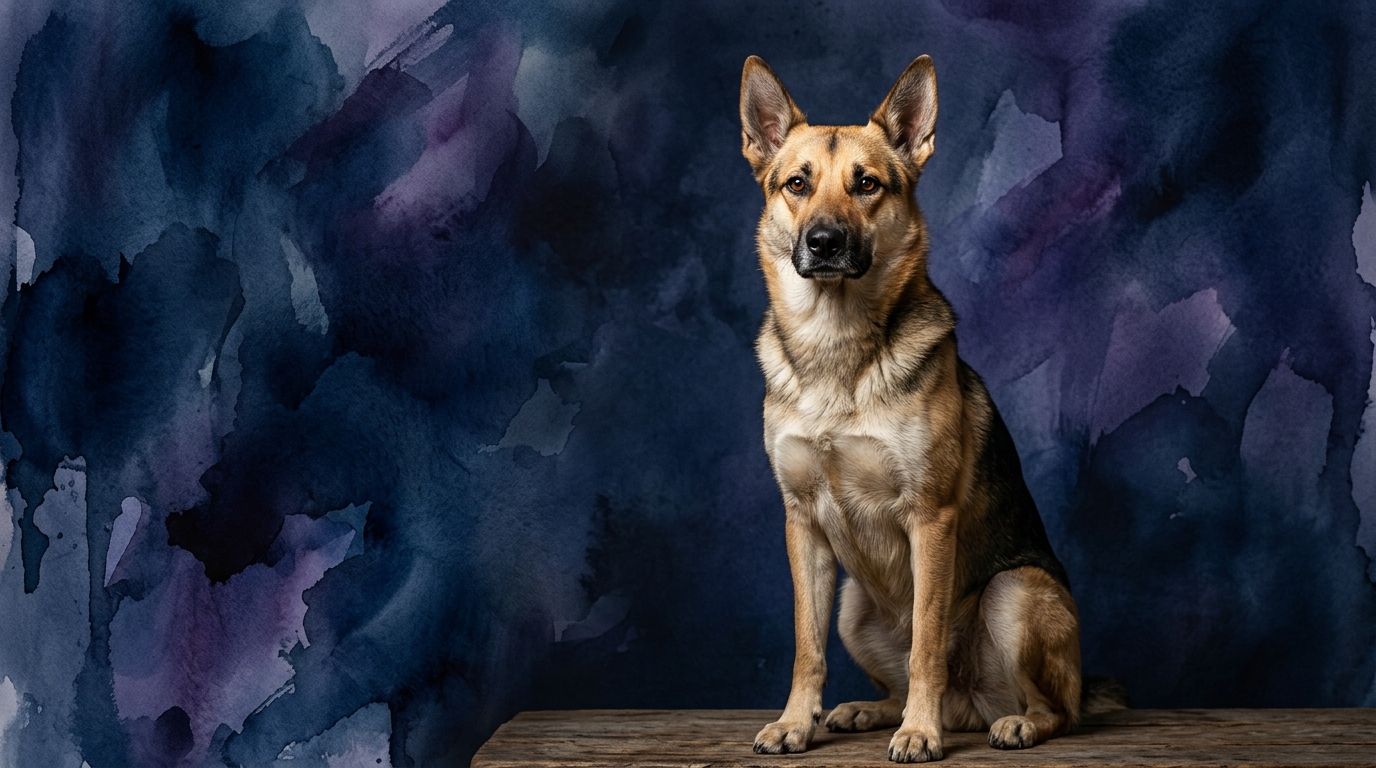

Side-by-Side Cognitive Profiles
The Canaan Dog, a Herding breed with a Coren rank of #43, exhibits a cognitive makeup reflecting its ancient origins and semi-feral past. They score 3/5 in problem Solving, indicating a capacity for practical solutions often derived from observation and self-sufficiency. Their training Speed is 3/5, suggesting a moderate pace of learning, while social Intelligence sits at 3/5, pointing to a discerning nature in their interactions. An instinctive Drive of 3/5 highlights their inherent herding and guarding tendencies, but it's their memory, rated at 4/5, that truly stands out, allowing for excellent retention of experiences and routines.
In contrast, the Rhodesian Ridgeback, a Hound breed with a Coren rank of #52, presents a cognitive profile shaped by its heritage as a hunter of large game. Their problem Solving capability is rated 3/5, often manifesting in strategic pursuit and overcoming physical challenges. Training Speed is also 3/5, reflecting a need for patient, consistent methods, while social Intelligence is 3/5, indicating a strong bond with their chosen family but a reserved demeanor with strangers. Their instinctive Drive is 3/5, powerful and focused on tracking and pursuit, and their memory stands at 3/5, sufficient for recall but perhaps less nuanced than the Canaan Dog’s.
Where the Canaan Dog Excels Cognitively
The Canaan Dog's superior memory, rated 4/5 compared to the Ridgeback's 3/5, is a significant cognitive advantage. This enhanced recall means a Canaan Dog is more likely to remember complex sequences of commands, the boundaries of their territory, and the nuances of past interactions, leading to more consistent behavior over time. For instance, a Canaan might more readily generalize a learned command to new environments or remember a specific 'no-go' area after fewer repetitions, demonstrating a deeper imprinting of information.
Beyond raw memory, the Canaan Dog's herding background infuses their problem-solving and social intelligence with a unique flavor. Their 3/5 problem-solving often involves understanding spatial relationships and anticipating movement, crucial for controlling livestock. This translates into an ability to figure out puzzles involving barriers or to navigate complex environments by observing and strategizing, rather than simply brute-forcing. Their social intelligence, while not overtly effusive, allows them to 'read' their human companions with a subtle perceptiveness, often picking up on cues that a less observant breed might miss.
Where the Rhodesian Ridgeback Shines Cognitively
While the Rhodesian Ridgeback shares 3/5 scores across several cognitive dimensions, their specific manifestation of problem Solving and instinctive Drive is where their unique strengths lie. Their problem-solving isn't about herding patterns but about the relentless pursuit and strategic outmaneuvering of prey. This translates into a remarkable persistence in figuring out how to reach a desired object or location, even if it requires a multi-step process or overcoming physical obstacles. They possess a robust mental fortitude when engaged in a task they deem important, often displaying ingenuity born from their hunting heritage.
The Ridgeback's instinctive Drive, also 3/5, is a powerful force of focused determination. This isn't just a generic drive; it's a profound, unwavering commitment to a scent or a goal once engaged. While a Canaan might observe and react, a Ridgeback will push through, demonstrating a cognitive endurance and single-mindedness that is invaluable for tasks requiring sustained effort and an unshakeable focus. Their social intelligence (3/5) is characterized by fierce loyalty to their family unit, making them astute at discerning their trusted companions and protective of them, even if they are reserved with outsiders.
Training Dynamics: Independence Meets Purpose
Both breeds score 3/5 in training Speed, suggesting neither is inherently 'easy' nor 'difficult' to train, but their underlying motivations and cognitive strengths dictate different approaches. The Canaan Dog, with its superior memory (4/5) and inherent desire to please its chosen pack leader, can be highly responsive to consistent positive reinforcement. While independent, they are observant and often retain commands well once learned. Their training requires patience, clear communication, and a strong, trusting bond, leveraging their memory to build reliable habits and their social intelligence to understand expectations.
The Rhodesian Ridgeback, sharing a 3/5 training Speed, presents a different set of challenges rooted in its powerful instinctive Drive (3/5) and independent problem-solving. Training a Ridgeback demands creativity, consistency, and a deep understanding of their hound nature. They need to be convinced that following a command is more rewarding than pursuing their own interests. Their training often benefits from incorporating their natural drive into activities like scent work or agility, turning 'work' into an engaging game that satisfies their need for mental and physical exertion. Without this engagement, their independent streak can lead to selective hearing.
Matching Breeds to Lifestyles: Active vs. Relaxed Owners
For owners seeking an active companion, both breeds offer robust energy levels, but with distinct expressions. The Rhodesian Ridgeback, with its powerful build and hunting heritage, thrives with extensive physical activity, including long runs, hiking, or dog sports. Their cognitive need for challenge often aligns with active owners who can provide consistent, engaging outdoor adventures that tap into their tracking and endurance capabilities. A Ridgeback without sufficient physical and mental outlets can become bored and destructive, channeling their impressive problem-solving into less desirable pursuits.
The Canaan Dog also requires regular exercise and mental stimulation, but their needs can be met with a slightly different emphasis. While they enjoy vigorous play and secure off-leash areas, their herding and guarding instincts mean they also benefit greatly from having a 'job' or purpose, even if it’s just patrolling the yard or learning complex tricks. Owners who appreciate a companion that is watchful, observant, and subtly engaged with their environment, rather than constantly seeking high-intensity physical output, might find the Canaan Dog a better fit. They are adaptable but thrive on routine and a sense of belonging within their family unit.
The Verdict
Choose a Canaan Dog if you appreciate an observant, independent companion with excellent memory who thrives on consistent leadership and a sense of purpose within a stable routine. They are ideal for owners who can provide mental engagement and value a dog's subtle perceptiveness.
Opt for a Rhodesian Ridgeback if you lead a very active lifestyle, enjoy vigorous outdoor adventures, and are prepared for a persistent, independent hound who needs firm, consistent training and plenty of physical and mental challenges to prevent boredom.
🧠 Find Your Pet's IQ Score
Our Pet IQ Lab assessment covers 25+ tests across 5 cognitive dimensions — personalized to your breed.
Take the Full IQ Test →Frequently Asked Questions
Are Canaan Dogs better at remembering commands than Rhodesian Ridgebacks?
Based on their memory scores (Canaan Dog 4/5, Rhodesian Ridgeback 3/5), Canaan Dogs generally exhibit a stronger capacity for remembering commands, routines, and past experiences. This can make them more consistent in applying learned behaviors over time, though both breeds require consistent reinforcement.
Which breed is more independent, the Canaan Dog or the Rhodesian Ridgeback?
Both breeds possess a notable degree of independence stemming from their historical roles; the Canaan Dog as a self-sufficient herder and guardian, and the Rhodesian Ridgeback as an independent hunter. While both can be strong-willed, the Ridgeback's deep-seated hunting drive often translates into a more focused, independent pursuit of interests, requiring more persuasive training.
Do Canaan Dogs and Rhodesian Ridgebacks have similar problem-solving abilities?
Both breeds score 3/5 in problem Solving, but its manifestation differs. Canaan Dogs often use observational skills and spatial reasoning for problems related to herding or navigating their environment, while Rhodesian Ridgebacks tend to apply their problem-solving to persistent pursuit and overcoming physical obstacles in the context of hunting or retrieving.