
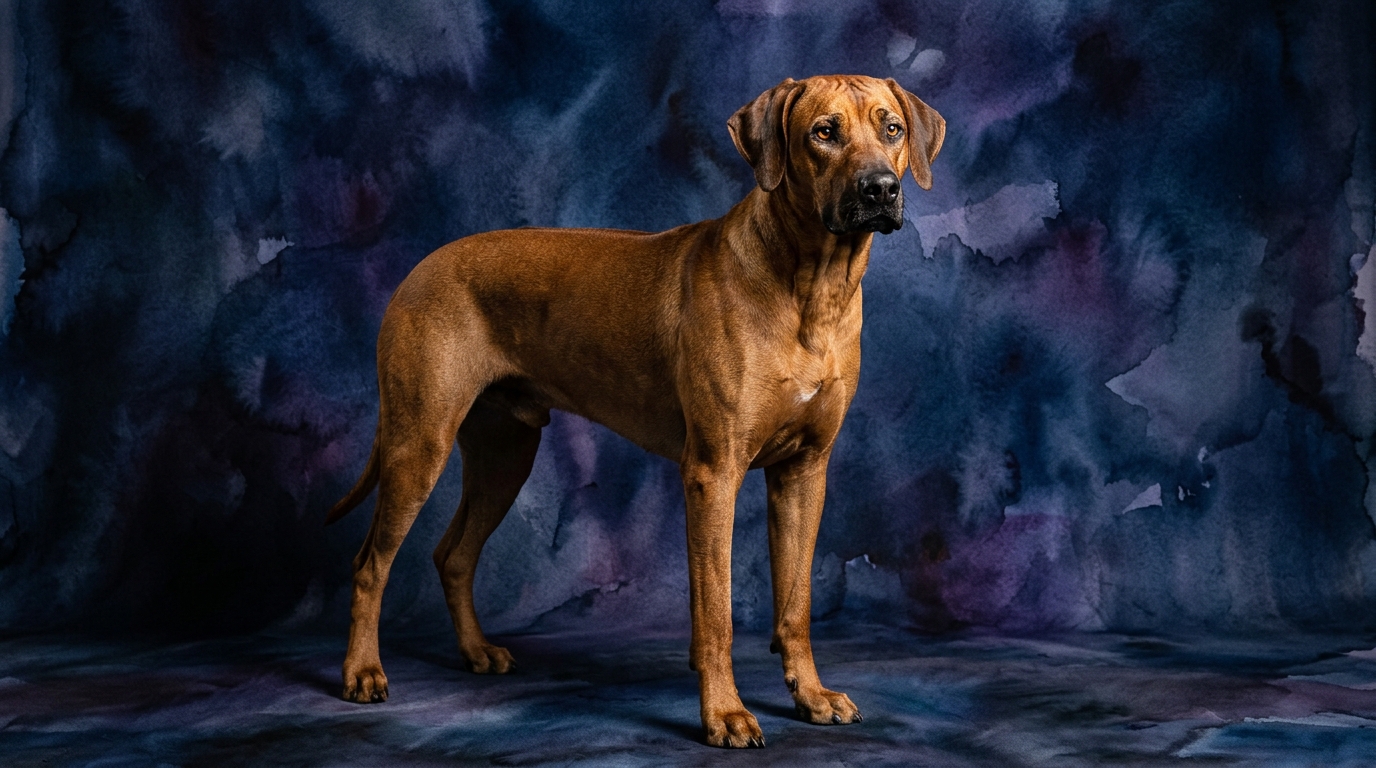
Side-by-Side Cognitive Profiles: Dogue de Bordeaux vs. Rhodesian Ridgeback
While both the Dogue de Bordeaux and the Rhodesian Ridgeback receive identical ratings across our five key IQ dimensions, understanding their breed-specific manifestations is crucial. These scores (3/5 for problem-solving, training speed, social intelligence, instinctive drive, and memory) indicate a moderate capacity, but the application and typical expression of these traits diverge significantly based on their historical roles and inherent temperaments. It's not just about the score, but how the dog uses its cognitive abilities in its world.
The Dogue de Bordeaux, a member of the Working group, possesses a problem-solving capacity (3/5) often applied to assessing its immediate environment for perceived threats or understanding household routines. Their solutions tend to be direct and focused on the well-being of their family, exhibiting a practical, home-centric approach to challenges. Their training speed (3/5) is moderate, often requiring consistent, patient repetition, as their motivation can sometimes be swayed by comfort or a desire to conserve energy, necessitating engaging and rewarding methods. Social intelligence (3/5) in the Dogue de Bordeaux demonstrates a moderate understanding of human emotional states and social cues, particularly within their close family circle, forming deep bonds and interpreting familiar gestures effectively. They exhibit a moderate but pronounced instinctive drive (3/5) primarily focused on guarding, manifesting as watchful behavior and a strong sense of territoriality. Memory (3/5) allows them to retain learned commands and experiences moderately well, aiding in consistent behavior reinforcement over time.
The Rhodesian Ridgeback, a Hound breed with a Coren rank of #52, displays a resourceful approach to problem-solving (3/5), particularly when motivated by a task or a perceived goal, like tracking a scent. Their solutions can involve independent thought and navigating obstacles with determination. Their training speed (3/5) is moderate, but often requires a handler who understands their independent and sometimes strong-willed nature; their drive for exploration can sometimes override immediate obedience. Social intelligence (3/5) in the Ridgeback shows a moderate ability to read human and canine social signals, adapting their behavior to different social contexts. They can be discerning with strangers but fiercely loyal to their chosen pack. They possess a moderate to strong instinctive drive (3/5), especially a prey drive and persistent tracking instinct, rooted in their history as lion hunters. This drive makes them highly focused on scents and movement. Memory (3/5) exhibits moderate recall for training and experiences, particularly those linked to positive reinforcement or their innate drives, allowing them to remember complex routes or scent trails.
Where the Dogue de Bordeaux Shows Cognitive Strengths
The Dogue de Bordeaux often demonstrates a nuanced cognitive edge in areas related to protective assessment and deep familial bonding. Their problem-solving, while rated 3/5, frequently manifests as a highly context-specific ability to discern normal household occurrences from potential threats. This isn't just a generic guarding instinct; it's a sophisticated assessment of their environment, filtering out non-issues and responding appropriately to genuine concerns, often with a calm, watchful presence rather than immediate aggression. Their social intelligence, also 3/5, shines in their capacity for profound empathy and understanding of their human family's emotional states, allowing them to offer comforting presence or subtle warnings. This cognitive strength lies in their ability to form deep, reciprocal social bonds that influence their decision-making and protective behaviors, making them adept at understanding and responding to the specific social dynamics of their family unit.
Where the Rhodesian Ridgeback Shows Cognitive Strengths
Conversely, the Rhodesian Ridgeback often showcases a distinct cognitive advantage in tasks demanding independent thought, sustained focus, and environmental adaptability, hallmarks of its hunting lineage. While also rated 3/5 for problem-solving, their strength lies in their capacity for autonomous decision-making when pursuing a goal, such as following a complex scent trail across varied terrain without direct human intervention. This requires not just memory (3/5) of the trail but an ongoing evaluation of environmental cues and strategic choices. Their instinctive drive (3/5) is not merely a 'prey drive' but a sophisticated capacity for sustained, goal-oriented pursuit, involving focus and resilience. This translates into a cognitive ability to ignore distractions and remain committed to a task for extended periods, making them exceptional at activities like scent work or agility where independent navigation and sustained effort are paramount. Their Coren rank of #52, while not a top-tier score, hints at this adaptive intelligence, allowing them to quickly learn and adjust to new hunting strategies or environmental challenges.
Training Dynamics: Which Breed is Easier and Why?
When assessing ease of training, despite both breeds sharing a 3/5 rating for training speed, their underlying behavioral differences create distinct challenges and opportunities. The Dogue de Bordeaux, a breed often content with comfort and companionship, can sometimes exhibit a stubborn streak or a preference for relaxation over rigorous training. Their moderate problem-solving and memory mean they *can* learn, but their motivation often needs to be tied directly to positive reinforcement, comfort, or strengthening their bond with their handler. Consistency and patience are paramount, as they may take longer to generalize commands across different environments. In contrast, the Rhodesian Ridgeback's independent spirit and strong instinctive drive, particularly its prey drive, can present a different kind of training hurdle. While capable of learning at a moderate pace, their attention can be easily diverted by interesting scents or movements. Training a Ridgeback often requires a firm, fair, and engaging approach that channels their natural drives into desired behaviors, rather than suppressing them. They respond well to challenges and activities that stimulate their innate tracking and problem-solving abilities. Therefore, while both require dedication, the Dogue de Bordeaux's training might feel like a patient negotiation for cooperation, whereas the Rhodesian Ridgeback's training often involves redirecting and harnessing powerful natural instincts.
Matching Breeds to Lifestyles: Active vs. Relaxed Owners
Considering their historical roles and typical energy levels, these breeds cater to very different owner lifestyles. The Dogue de Bordeaux, originating as a guardian and companion, generally suits more relaxed owners. While they benefit from regular, moderate exercise to maintain health and prevent boredom, they are not typically high-energy dogs requiring extensive daily runs or intense physical demands. Their contentment often stems from being close to their family, a short walk, and a comfortable spot to observe their domain. Their moderate instinctive drive is primarily focused on guarding, not relentless activity. Conversely, the Rhodesian Ridgeback is undoubtedly better suited for active owners. Bred to track and hold large game in challenging terrains, they possess significant stamina, endurance, and a robust need for both physical and mental stimulation. Owners who enjoy long hikes, running, cycling, or engaging in dog sports like agility, lure coursing, or advanced obedience will find the Ridgeback a willing and capable partner. Their strong instinctive drive and problem-solving abilities thrive when given outlets for their natural talents, preventing boredom and potential destructive behaviors that can arise from insufficient activity.
The Verdict
Choose the Dogue de Bordeaux if you seek a loyal, protective companion whose cognitive strengths lie in deep family bonding, calm environmental assessment, and a relatively relaxed demeanor, fitting into a moderately active household.
Opt for the Rhodesian Ridgeback if you are an active individual or family prepared to channel significant energy and a strong independent streak, valuing a companion whose intelligence excels in focused tasks, endurance, and autonomous problem-solving.
🧠 Find Your Pet's IQ Score
Our Pet IQ Lab assessment covers 25+ tests across 5 cognitive dimensions — personalized to your breed.
Take the Full IQ Test →Frequently Asked Questions
Do their identical IQ scores mean they are equally easy to train?
No, identical IQ scores for training speed (3/5) indicate a similar *capacity* to learn, but not necessarily identical ease. Their distinct temperaments, motivations, and instinctive drives mean the *approach* to training and the *challenges* encountered will differ significantly.
How does a Coren rank of #52 for the Ridgeback compare to the Dogue de Bordeaux's unranked status?
The Coren rank places the Rhodesian Ridgeback in the "Average Working/Obedience Intelligence" category, meaning they understand new commands in 25-40 repetitions and obey first commands 50% of the time or more. The Dogue de Bordeaux's unranked status doesn't mean less intelligent, but rather that it wasn't included or didn't meet the specific criteria for ranking in Coren's study, which focused on working and obedience intelligence.
Can a Dogue de Bordeaux be as active as a Rhodesian Ridgeback?
Generally, no. While a Dogue de Bordeaux needs regular exercise to maintain health, its stamina and desire for sustained, intense activity are significantly lower than a Rhodesian Ridgeback's. Attempting to make a Dogue de Bordeaux as active as a Ridgeback could lead to physical strain or disinterest for the Dogue.