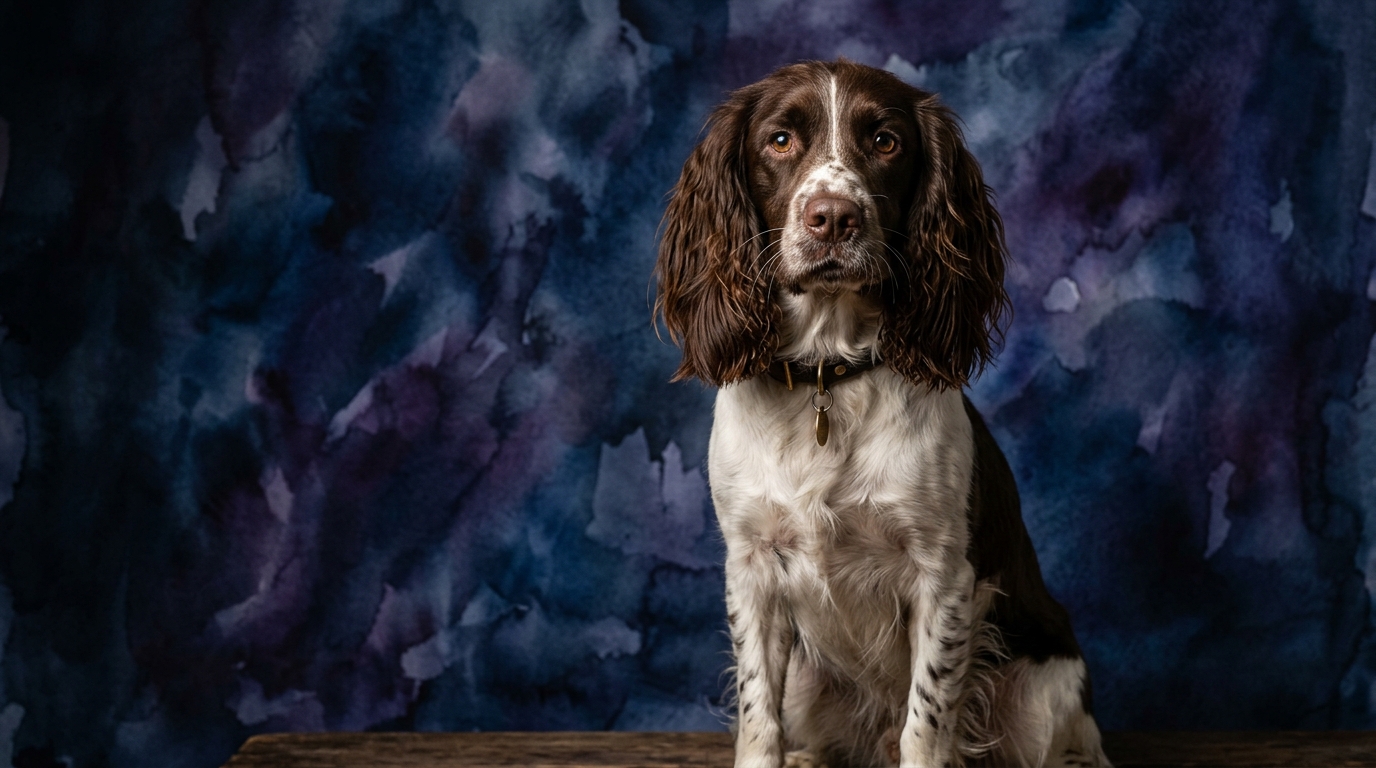

Side-by-Side Cognitive Profiles: Springer Spaniel vs. Miniature Poodle
The English Springer Spaniel, a member of the Sporting Group with a Coren rank of #13, presents a robust and balanced cognitive profile tailored for their historical role. Their Problem Solving is rated at 4/5, indicating a strong capability to navigate real-world challenges, such as figuring out how to retrieve game from difficult terrain or bypassing minor obstacles during a scent trail. This is a practical, adaptable intelligence. Their Training Speed is an exceptional 5/5, reflecting a breed eager to learn and quick to absorb new commands, making them highly responsive partners in various tasks. Social Intelligence, at 4/5, means they are keenly attuned to human cues and thrive on collaborative interaction, forming strong, responsive bonds with their handlers. An outstanding Instinctive Drive of 5/5 underscores their tireless energy and profound motivation for activities like retrieving, tracking, and scent work, driven by an innate desire to work. Finally, their Memory, at 4/5, ensures they retain learned behaviors, complex sequences, and routines effectively, contributing to their reliability in the field and at home.
In contrast, the Miniature Poodle, from the Non-Sporting Group and holding an impressive Coren rank of #2, showcases a cognitive structure geared towards abstract thought and intricate learning. Their Problem Solving scores an outstanding 5/5, demonstrating an exceptional ability to reason through complex puzzles, strategize for desired outcomes, and understand multi-step commands. Their Training Speed also stands at 5/5, signifying an extraordinary capacity for rapid learning and the ability to grasp new concepts with minimal repetition. While their Social Intelligence is 3/5, this often translates to a discerning nature, forming deep bonds with their primary caregivers but potentially taking more time to warm to strangers, rather than a broad, immediate friendliness. Their Instinctive Drive is 3/5, meaning while they are athletic and enjoy activity, their drive is less about sustained, traditional hunting work and more about general play, mental engagement, and agility. Their Memory, an exceptional 5/5, allows them to retain vast vocabularies of commands, intricate routines, and specific experiences over long periods, leading to remarkable consistency in learned behaviors.
Where the English Springer Spaniel Excels Cognitively
The English Springer Spaniel's cognitive strengths are most evident in their practical application of intelligence, particularly when working in tandem with a human. Their 5/5 Instinctive Drive gives them an unparalleled advantage in tasks requiring sustained focus on scent, tireless retrieving, or navigating varied outdoor environments. This drive isn't just about energy; it's a cognitive engine that directs their problem-solving skills towards achieving a specific, often instinct-driven, goal. For instance, a Springer will meticulously work out how to access a hidden retrieve item, leveraging their 4/5 Problem Solving in a highly contextual, real-world manner.
Furthermore, their 4/5 Social Intelligence plays a crucial role in their collaborative superiority. They are adept at reading handler body language and vocal cues, often anticipating instructions before they are fully given. This makes them exceptionally responsive partners in dynamic situations, such as navigating an agility course or tracking a scent trail, where seamless communication is paramount. Their intelligence is deeply intertwined with their desire to cooperate and fulfill a shared objective, making them superb team players in tasks that require both physical prowess and cognitive collaboration.
Where the Miniature Poodle Shows Cognitive Superiority
The Miniature Poodle's cognitive advantages shine in areas requiring abstract reasoning, complex information processing, and exceptional retention. Their 5/5 Problem Solving allows them to excel in tasks that demand more than simple learned responses; they can genuinely 'figure things out.' This manifests in their ability to master intricate puzzle toys, learn multi-step commands, or even devise novel solutions to obtain a desired object, often requiring a degree of conceptual understanding beyond rote memorization. They are not just following commands; they are processing information and making decisions.
Complementing this is their 5/5 Memory, which enables them to store and recall vast amounts of information with remarkable precision and longevity. This is critical for excelling in advanced obedience, competitive dog sports like agility or rally, and learning a wide array of tricks that require complex sequences. While a Springer might remember a specific retrieve location, a Poodle might remember an entire sequence of 20 different commands and execute them flawlessly. Their intellectual capacity allows them to absorb and retain intricate patterns and rules, leading to consistent and sophisticated performance. This combination of superior problem-solving and memory enables them to tackle intellectual challenges that might overwhelm other breeds, making them highly adaptable to diverse learning environments.
Training Dynamics: Which Breed is Easier to Train and Why?
Both the English Springer Spaniel and the Miniature Poodle share an impressive 5/5 rating for Training Speed, indicating that both breeds learn new commands quickly. However, the 'ease' of training can differ based on the type of training and the owner's approach. The English Springer Spaniel's rapid learning is often fueled by their high Instinctive Drive (5/5) and strong Social Intelligence (4/5). They are eager to please and find immense satisfaction in working alongside their human, particularly in tasks that tap into their natural retrieving and scenting instincts. Training a Springer often feels like a collaborative effort, with their enthusiasm and desire to participate driving their quick acquisition of skills. They respond exceptionally well to positive reinforcement and find the 'job' itself highly motivating, leading to efficient learning of practical obedience and field commands.
The Miniature Poodle's 5/5 Training Speed, combined with their 5/5 Problem Solving and 5/5 Memory, means they are not just fast learners but also capable of profound conceptual understanding and retention. They excel at intricate, multi-layered training, often requiring fewer repetitions to grasp complex concepts and retaining them over very long periods. A Poodle might challenge a trainer to keep up with their capacity for learning new, increasingly difficult tasks. While they may not have the same intense 'working' drive as a Springer, their motivation often comes from intellectual engagement and the satisfaction of mastering a new skill. Therefore, while both are easy to train, the Springer excels in collaborative, instinct-driven tasks, while the Poodle thrives on intricate, mentally stimulating challenges that leverage their superior abstract reasoning and memory.
Matching Breeds to Lifestyles: Active vs. Relaxed Owners
The choice between these two breeds significantly depends on an owner's lifestyle and their capacity to meet specific cognitive and physical needs. The English Springer Spaniel, with its 5/5 Instinctive Drive, is unequivocally suited for active owners. These dogs require substantial daily physical exercise, structured play, and opportunities to engage their powerful nose and retrieving instincts. Owners must be prepared to provide vigorous activities such as long hikes, extensive fetch sessions, scent work, or participation in dog sports like agility or flyball. A Springer thrives when given a purpose and a consistent outlet for their boundless energy and working drive; without this, their intelligence and energy can lead to boredom and potentially destructive behaviors. They are ideal for individuals or families who embrace an outdoorsy, highly engaged lifestyle.
The Miniature Poodle, while athletic and enjoying activity, has a 3/5 Instinctive Drive, meaning their needs are different. They enjoy regular walks, playtime, and dog sports, but their primary requirement isn't necessarily intense, sustained physical 'work' in the same vein as a Springer. Instead, they thrive on consistent mental stimulation through puzzle toys, learning new tricks, and engaging in obedience or rally training. A 'relaxed' owner who can provide consistent, varied mental enrichment alongside moderate physical activity might find a Miniature Poodle a good fit. They are adaptable to apartment living provided their mental needs are met, and they enjoy being a close companion, often content with quality time and intellectual engagement rather than endless miles of running. They suit owners who appreciate consistent, engaging interaction but perhaps have less time for demanding outdoor excursions.
The Verdict
Choose an English Springer Spaniel if you seek a tireless, collaborative partner for outdoor adventures, field work, or an active family life, and can provide ample physical exercise and engage their strong retrieving and scenting instincts.
Choose a Miniature Poodle if you appreciate a highly adaptable, mentally agile companion capable of mastering complex training, excelling in dog sports, and thriving on consistent mental stimulation, even if physical activity is moderate.
🧠 Find Your Pet's IQ Score
Our Pet IQ Lab assessment covers 25+ tests across 5 cognitive dimensions — personalized to your breed.
Take the Full IQ Test →Frequently Asked Questions
Is the Miniature Poodle's 3/5 Social Intelligence a concern for family life?
The Miniature Poodle's 3/5 Social Intelligence doesn't imply a lack of affection for their family. It suggests they might be more discerning, forming deep bonds with their primary caregivers and potentially taking more time to warm up to strangers, rather than being broadly and immediately friendly. With proper socialization, they integrate well into family dynamics, often showing a loyal and devoted nature.
Can an English Springer Spaniel adapt to apartment living?
An English Springer Spaniel can potentially adapt to apartment living, but it requires an exceptionally committed owner. Their 5/5 Instinctive Drive demands significant daily exercise and mental stimulation, meaning multiple long walks, vigorous play sessions, and engaging activities like scent work are crucial to prevent boredom and frustration. Without sufficient outlets, an apartment setting can quickly become inadequate for their needs.
Which breed is generally better for first-time dog owners?
Both breeds have a 5/5 Training Speed, making them responsive learners. However, the English Springer Spaniel's intense 5/5 Instinctive Drive and higher energy levels might be more challenging for a first-time owner to manage without prior experience. The Miniature Poodle, while still requiring consistent mental stimulation, has a more moderate 3/5 Instinctive Drive, which might make their overall management slightly more forgiving for a novice owner, provided mental engagement is prioritized.