
Side-by-Side Cognitive Profiles
The Flat-Coated Retriever, ranking #17 on the Coren scale, presents a cognitive profile characterized by strong learning and retention. Their Problem Solving is rated 4/5, indicating a methodical approach to novel challenges, often figuring out how to achieve a goal with thoughtful engagement. Training Speed is also 4/5, suggesting they grasp new commands efficiently, often requiring fewer repetitions. Social Intelligence stands at 3/5, showing they are adept at reading familiar social cues within their established pack but may be less nuanced with strangers. Their Instinctive Drive is 3/5, primarily channeled into cooperative retrieving activities. Crucially, their Memory is a perfect 5/5, underpinning their ability to retain a vast repertoire of learned behaviors over extended periods, making them exceptionally consistent.
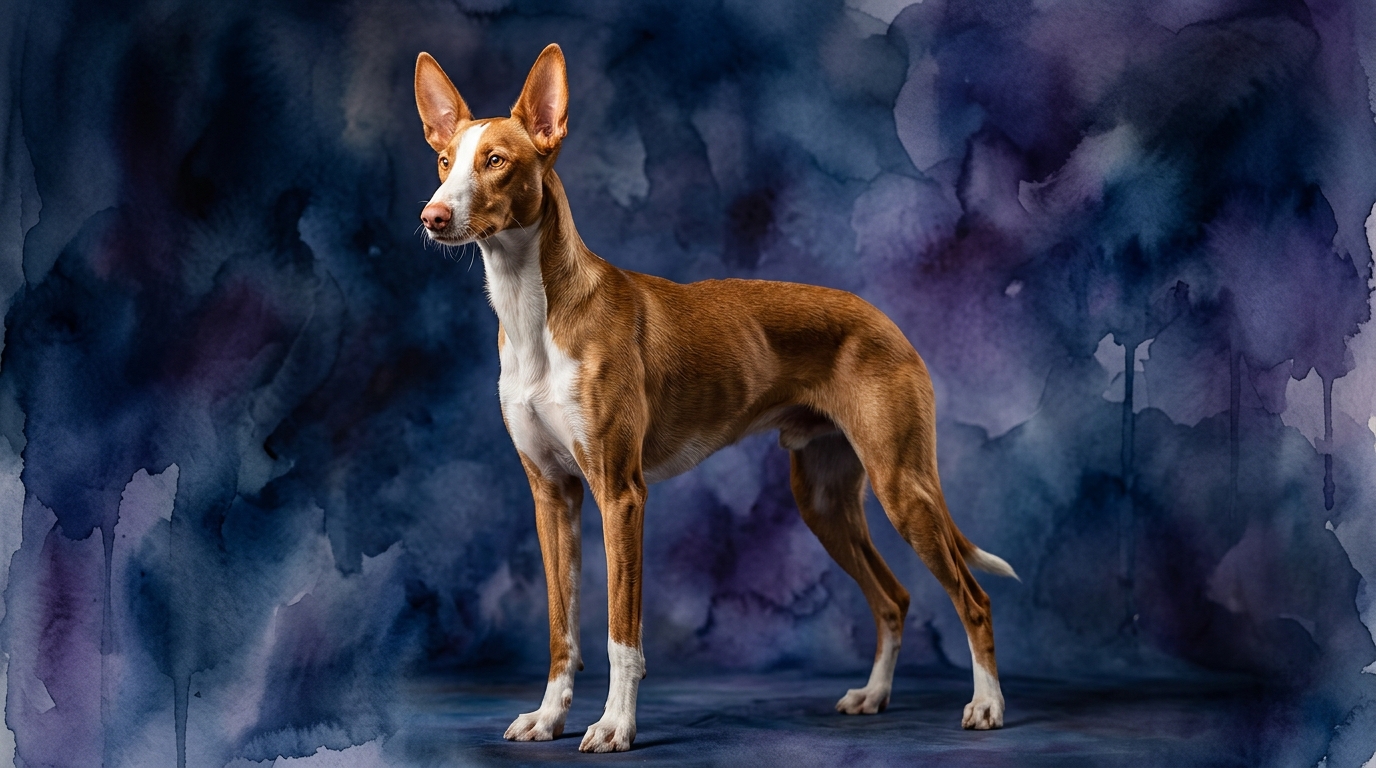
In contrast, the Ibizan Hound, with a Coren rank of #53, possesses a cognitive architecture optimized for independent hunting. Their Problem Solving is 3/5, often relying on their physical prowess and keen senses to navigate obstacles or locate targets, favoring direct action over intricate manipulation. Training Speed is 3/5, meaning they learn at a moderate pace, often requiring more patience and varied reinforcement due to their independent nature. Social Intelligence, like the Flat-Coat, is 3/5; they form deep bonds with their family but can be reserved with outsiders. Their Instinctive Drive, also 3/5, is powerfully geared towards sight-hunting, manifesting as an intense chase drive triggered by movement. Their Memory is 3/5, sufficient for routines and familiar commands, but perhaps less enduring or steadfast when pitted against a strong instinctual impulse.
Where Flat-Coated Retrievers Cognitively Excel
The Flat-Coated Retriever clearly distinguishes itself through its superior problem-solving acumen and remarkable memory. A Flat-Coat is more likely to methodically deduce how to open a puzzle feeder or retrieve a toy from an inaccessible spot, demonstrating a thoughtful approach rather than relying solely on trial and error. This cognitive flexibility means they can adapt learned solutions to slightly varied situations. Their memory, rated at a perfect 5/5, is a significant advantage; they retain training cues, household rules, and even complex sequences of behaviors for extensive periods. This deep recall means that once a Flat-Coat learns something, it tends to stick, requiring less frequent reinforcement to maintain proficiency. This cognitive strength makes them exceptionally reliable companions in structured environments and activities where consistent recall and learned behaviors are paramount. For instance, in advanced obedience or competitive retrieving, their ability to remember intricate patterns and commands gives them a distinct edge, allowing them to perform with precision and minimal prompting, reflecting a stable and accessible knowledge base.
Where Ibizan Hounds Cognitively Excel
While the Ibizan Hound's scores might appear lower, their cognitive strengths are simply channeled differently, particularly in areas related to their ancestral purpose. Their instinctive drive, rated 3/5 but focused on sighthound traits, means they possess an unparalleled ability to process visual information rapidly and react with explosive speed and precision. This isn't just a physical trait; it's a cognitive one, involving quick assessment of movement, trajectory prediction, and immediate decision-making in pursuit. They excel at independent thought when tracking a moving target, making split-second judgments without human instruction, a form of problem-solving specific to their hunting heritage. This cognitive independence, while sometimes a challenge in obedience, allows them to operate effectively in dynamic, unpredictable environments. Their keen observational skills, particularly for distant movements, are a testament to a specialized form of intelligence that prioritizes sensory input and swift, self-directed action over human-directed cooperation, making them masters of their visual domain.
Training Dynamics: Flat-Coat vs. Ibizan Hound
The Flat-Coated Retriever is generally easier to train due to a combination of factors reflected in their IQ profile. Their 4/5 training speed, coupled with a 5/5 memory, means they typically absorb and retain new commands with remarkable efficiency. They possess a strong desire to collaborate and please their human companions, a behavioral trait that significantly enhances their responsiveness in training sessions. For example, a Flat-Coat often only needs a few repetitions to understand a “sit” or “stay” command, and once learned, they will remember it reliably for years. Their problem-solving ability also aids training, as they can often generalize learned behaviors to new contexts. In contrast, the Ibizan Hound, with a 3/5 training speed and 3/5 memory, requires a more patient and nuanced approach. Their independent sighthound nature means they are less inherently driven to please and more inclined to follow their own sensory interests. While they can learn, their recall might be less consistent, especially if a compelling visual stimulus (like a squirrel) overrides a learned command. Training an Ibizan often involves more creative motivation and understanding that their focus can be fleeting, requiring frequent engagement and making training a continuous, rewarding challenge rather than a quick mastery. Their instinct to chase is deeply ingrained, often proving a stronger motivator than human direction, demanding specialized training techniques to ensure reliable recall in open spaces.
Lifestyle Match: Active vs. Relaxed Owners
For active owners, both breeds offer engagement, but with different nuances. The Flat-Coated Retriever thrives on structured activities that involve mental and physical exertion, such as retrieving games, agility, or obedience trials. Their desire to work alongside their owner makes them excellent partners for long hikes, runs, or any activity where cooperation is key. They need consistent mental stimulation to prevent boredom, making them a match for owners who enjoy teaching new tricks or engaging in dog sports. For an owner seeking a canine athlete with a strong independent streak, the Ibizan Hound could be a compelling choice. They require significant physical exercise, particularly opportunities to run at full speed in a secure area, satisfying their powerful chase drive. Their ideal owner understands their need for bursts of intense activity and appreciates their self-directed nature during these outings. However, neither breed is truly suited for a relaxed owner who prefers minimal activity. Both require substantial daily exercise and mental engagement. A Flat-Coat might adapt slightly better to an owner with varied activity levels, as long as mental stimulation is provided, but an Ibizan Hound’s need for explosive sprints is non-negotiable for their well-being, making them a better fit for consistently active individuals who can provide a safe outlet for their sighthound instincts.
The Verdict
Opt for a Flat-Coated Retriever if you seek a highly trainable, cooperative companion eager to engage in structured activities and capable of consistent recall, thriving on shared tasks and deep memory.
Select an Ibizan Hound if you appreciate an independent, visually-driven athlete who excels in open spaces and requires an owner who understands their distinct sighthound instincts and need for intense, self-directed exercise.
🧠 Find Your Pet's IQ Score
Our Pet IQ Lab assessment covers 25+ tests across 5 cognitive dimensions — personalized to your breed.
Take the Full IQ Test →Frequently Asked Questions
Are Flat-Coated Retrievers prone to wandering off?
While Flat-Coats have a moderate instinctive drive, their strong memory and desire to please generally mean they are less prone to wandering than breeds with higher independent drives, especially with consistent recall training. They prefer to stay close to their human family and respond well to guidance.
Do Ibizan Hounds need a large yard?
Ibizan Hounds benefit immensely from access to a securely fenced area where they can run at full speed, but the size is less critical than the security and opportunity for bursts of activity. Daily intense exercise, often outside a yard, is more important than a perpetually large space.
How do their Coren ranks translate to daily life?
The Flat-Coated Retriever's rank of #17 means they typically learn new commands quickly and consistently obey known ones, making them generally easier to live with in a structured home. The Ibizan Hound's rank of #53 suggests they may require more patience and repetition in training, and their obedience might be more selective, especially when their instincts are engaged.