
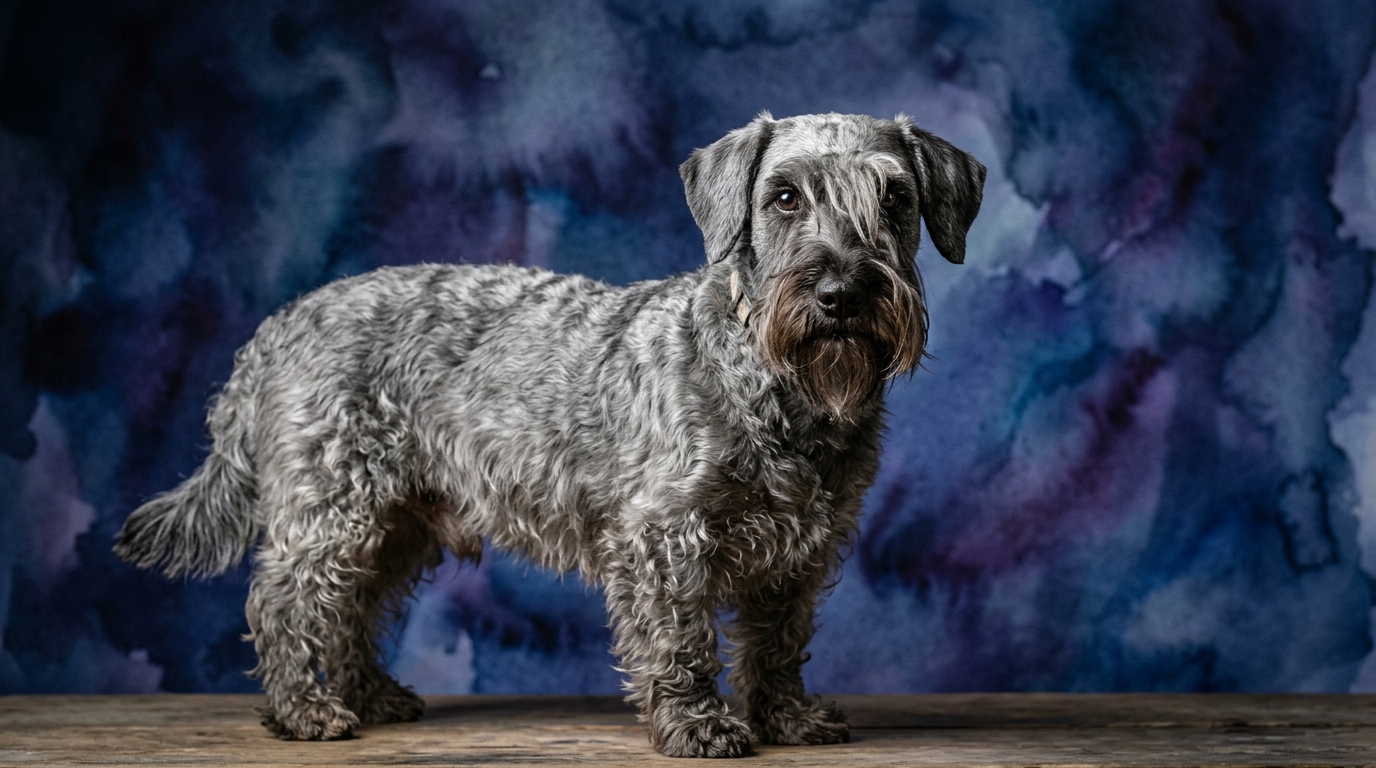
Side-by-Side Cognitive Profiles: GSP vs. Cesky Terrier
The German Shorthaired Pointer (GSP), a Sporting breed ranked #17 by Coren, demonstrates a formidable cognitive toolkit tailored for its working heritage. Its Problem Solving is rated 5/5, indicating an exceptional capacity for figuring out complex tasks, such as navigating intricate scent trails or adapting strategies on the fly during a retrieve. Training Speed is 4/5, meaning GSPs grasp new commands and routines with impressive swiftness, often requiring only a few repetitions. Social Intelligence, also 4/5, highlights their aptitude for reading human cues and forming strong cooperative partnerships. Their Instinctive Drive is a powerful 5/5, fueling relentless energy and focus on hunting, pointing, and retrieving. Memory is solid at 4/5, ensuring retention of learned behaviors and complex patterns over time.
In contrast, the Cesky Terrier, a Terrier breed not specifically ranked by Coren, presents a different set of cognitive strengths. Its Problem Solving is rated 3/5, signifying an ability to tackle straightforward challenges like finding a hidden treat, though with a more methodical and less improvisational approach. Training Speed is 3/5, meaning they learn at a moderate pace, benefiting from consistent repetition and positive reinforcement, often requiring more engagement to counter their independent spirit. Social Intelligence is 3/5; they form strong bonds but might be less overtly expressive or attuned to subtle emotional shifts than more cooperative breeds. Instinctive Drive is 3/5, reflecting a moderate terrier inclination for digging, chasing small prey, and guarding, present but less all-consuming than a GSP's specialized drive. Memory is 3/5, allowing them to retain consistently reinforced commands, though less frequently practiced skills might fade without regular refreshers.
Where the German Shorthaired Pointer Excels Cognitively
The GSP's cognitive superiority is most evident in its exceptional Problem Solving (5/5) and potent Instinctive Drive (5/5). These dogs are not merely followers; they are active strategists in dynamic environments. Consider a GSP tracking a game bird through varied terrain; it continuously assesses wind direction, scent intensity, and obstacles, making real-time decisions to pinpoint its target. This level of complex, multi-variable processing far exceeds the demands of simpler tasks and showcases a deep capacity for independent thought in pursuit of a goal.
Furthermore, their superior Training Speed (4/5) amplifies this advantage, enabling rapid internalization of new hunting techniques or advanced obedience cues. They quickly forge associations between actions and outcomes, making sophisticated chain behaviors, such as retrieving a specific item from a group or performing complex field maneuvers, achievable with remarkable efficiency. This rapid learning curve allows GSPs to progress to advanced skill sets much quicker than breeds with a more moderate cognitive processing pace.
Where the Cesky Terrier Demonstrates Unique Cognitive Strengths
While the Cesky Terrier may not match the GSP's raw processing speed or specialized drive, its cognitive profile shines through a unique blend of resilience and independence. Its 3/5 Instinctive Drive, though moderate, is perfectly calibrated for its original role: tenacious but measured vermin control. Unlike a GSP's expansive, far-ranging hunt, a Cesky's task often involved working in confined spaces, demanding persistent focus on a single target without needing to cover vast distances or engage in complex cooperative strategies.
Their Problem Solving (3/5) manifests as a practical, persistent approach. A Cesky might not devise an elaborate plan to open a complex puzzle, but it will systematically try different angles and techniques until it succeeds or deems the effort unwarranted. This methodical, trial-and-error approach, combined with their moderate Social Intelligence (3/5), means they are less inclined to rely solely on human direction and more apt to trust their own judgment in certain situations, an invaluable trait for independent tasks where immediate human oversight is impractical.
Ease of Training: GSP vs. Cesky Terrier
The German Shorthaired Pointer is generally a more straightforward training prospect due to its 4/5 Training Speed and 4/5 Social Intelligence. Their inherent desire to cooperate with their handler, coupled with rapid comprehension, means they often grasp new commands in just a few repetitions. GSPs find satisfaction in working alongside humans, which translates into an attentive and responsive student. For example, teaching a GSP a complex 'stay' command amidst distractions often progresses quickly because they are internally motivated to maintain focus on their person and enjoy the collaborative effort.
In contrast, the Cesky Terrier, with its 3/5 Training Speed and 3/5 Social Intelligence, offers a more independent training experience. While capable of learning, their terrier nature means they require more patience, unwavering consistency, and motivation tailored to their preferences. They are less inclined to offer immediate compliance simply to please; instead, they weigh the immediate reward or perceived value of the task. Training a Cesky might involve more creative reinforcement strategies and shorter, more engaging sessions to hold their attention, as their focus can wander if the task isn't stimulating or immediately rewarding. Their inherent self-reliance means they might question a command if it doesn't align with their immediate instincts, demanding a handler who understands how to build trust and make training a worthwhile endeavor from the dog's perspective.
Which Suits Active Owners vs. Relaxed Owners
The German Shorthaired Pointer is unequivocally suited for active owners. With a 5/5 Instinctive Drive and substantial energy reserves, a GSP requires daily, vigorous physical and mental exercise. Owners who enjoy activities like running, hiking, biking, or participating in dog sports such as agility, field trials, or dock diving will find a GSP to be an enthusiastic and capable partner. A GSP thrives when given a job to do, whether it's retrieving, scent work, or simply long, exploratory walks where their superior Problem Solving (5/5) and Memory (4/5) can be engaged. An owner who cannot consistently meet these high exercise demands might find their GSP developing undesirable behaviors born of boredom and unspent energy, such as excessive chewing, digging, or barking.
The Cesky Terrier, while not a complete couch potato, is a better fit for owners seeking a more moderately active companion. Their 3/5 Instinctive Drive means they appreciate regular walks, playtime in a securely fenced yard, and engaging indoor activities, but they do not demand the same intensity or duration of exercise as a GSP. Owners who enjoy daily strolls, puzzle toys, and consistent, shorter training sessions will find the Cesky's needs align well with a less rigorous lifestyle. Their moderate Social Intelligence (3/5) means they are content with quality time with their family without needing constant, high-energy interaction, making them suitable for individuals or families with a more relaxed pace but still committed to daily engagement and mental stimulation.
The Verdict
Select a German Shorthaired Pointer if you lead a highly active lifestyle, desire a cooperative and quick-learning partner for dog sports or hunting, and can commit to extensive daily physical and mental stimulation.
Opt for a Cesky Terrier if you prefer a more independent, moderately active companion who enjoys consistent engagement without demanding intense physical output, and you appreciate a dog with a persistent, methodical approach to life.
🧠 Find Your Pet's IQ Score
Our Pet IQ Lab assessment covers 25+ tests across 5 cognitive dimensions — personalized to your breed.
Take the Full IQ Test →Frequently Asked Questions
How does a GSP's Coren ranking of #17 relate to its IQ scores?
Coren's ranking primarily reflects 'working and obedience intelligence,' which aligns with the GSP's high training speed and social intelligence scores. Its #17 position indicates it learns new commands quickly and consistently obeys them, reflecting its cooperative nature and capacity for rapid skill acquisition.
Why is the Cesky Terrier not Coren-ranked, and what does this imply about its intelligence?
The Cesky Terrier is a rarer breed, meaning it likely wasn't included in the extensive survey Coren conducted. Its absence from the ranking does not imply a lack of intelligence, but rather that its specific cognitive strengths, such as its independent problem-solving and moderate instinctive drive, are simply measured differently by our IQ lab parameters rather than being directly comparable to Coren's obedience-focused metric.
Do these IQ scores mean a Cesky Terrier cannot excel in training or activities?
Absolutely not. The IQ scores are relative indicators of typical breed tendencies. A Cesky Terrier can certainly excel in training and activities with consistent, engaging methods, though it may require more patience and creativity from the trainer compared to a breed like the GSP, whose natural inclination is to quickly learn and cooperate.