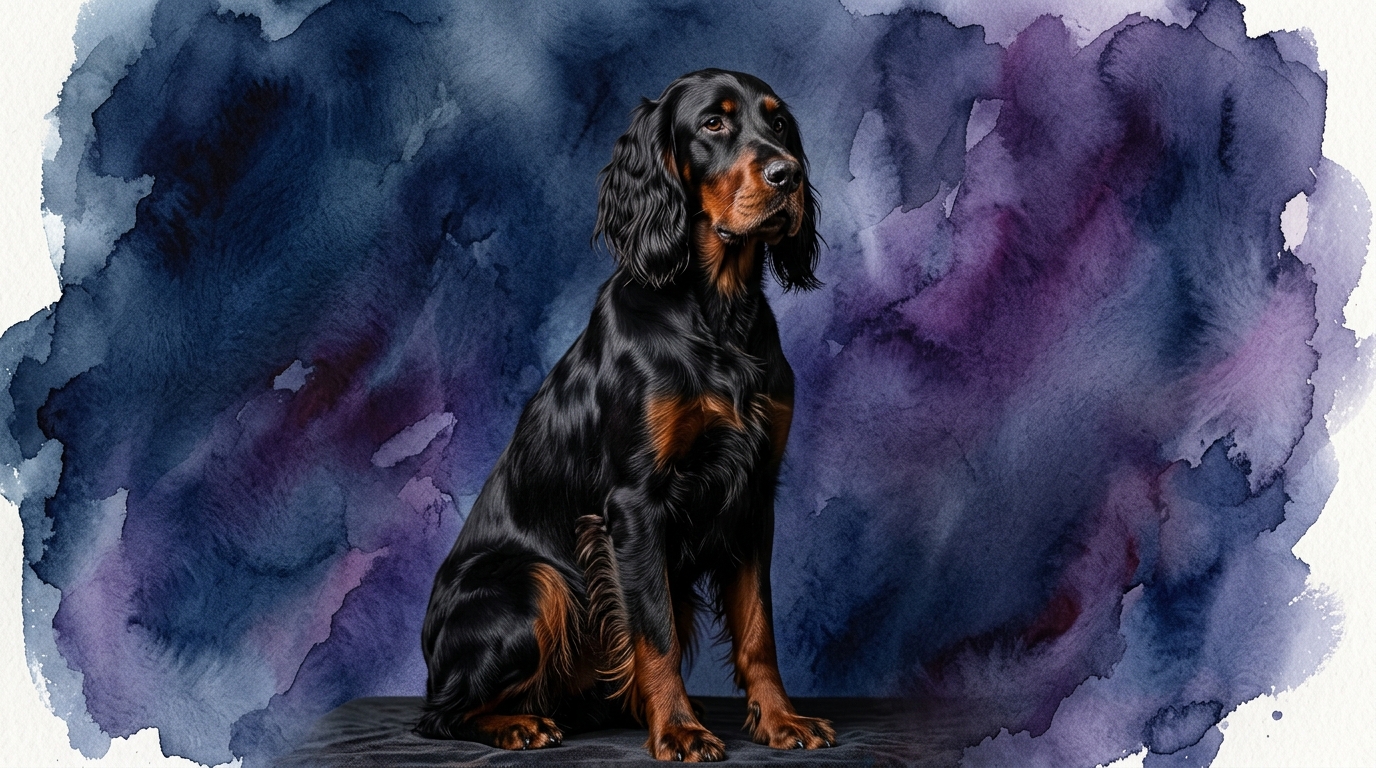

Side-by-Side IQ Profile: Gordon Setter vs. Redbone Coonhound
The Gordon Setter, a striking Scottish gundog, demonstrates a refined intellect perfectly suited for its role in upland bird hunting. Its Problem Solving ability, rated 4/5, reflects a capacity for strategic thinking in the field, adept at navigating varied terrain and adapting to bird movements to effectively point and retrieve. Training Speed, also 4/5, highlights its eagerness and aptitude for learning complex commands and routines, often thriving on consistent, positive reinforcement. Social Intelligence, at 3/5, indicates a keen awareness of human cues and a strong desire to collaborate, though they retain an independent streak common to working dogs. Their Instinctive Drive, 3/5, is a well-channeled hunting instinct focused on scenting, pointing, and retrieving game birds, balanced by a strong desire to work with their handler. Finally, Memory, 4/5, allows them to retain intricate learned behaviors, recall scent patterns, and remember field experiences, making them highly effective and consistent partners.
The Redbone Coonhound, a quintessential American hound, possesses a robust and specialized intelligence honed for tracking and treeing raccoons. Its Problem Solving score of 3/5 primarily manifests in its exceptional ability to untangle complex scent trails, navigating obstacles and varied environments to pursue quarry with relentless determination. Training Speed, rated 3/5, suggests a moderate learning pace; while capable of understanding commands, their powerful, independent scent drive often requires consistent, patient, and highly motivated training to integrate new behaviors. Social Intelligence, 3/5, points to a generally affectionate and loyal nature within their family unit, though their focus can quickly shift to an intriguing scent, temporarily overriding social engagement. Their Instinctive Drive, 3/5, is a profound and singular focus on tracking and treeing, driven by an ancient hunting impulse that defines their very being. Memory, 3/5, is notably strong for scent patterns and established hunting routes, enabling them to recall specific trails and successful hunting locations, though perhaps less geared towards abstract or varied tasks compared to the Setter.
Where the Gordon Setter Wins Cognitively
The Gordon Setter’s cognitive strengths shine particularly in scenarios demanding adaptability, strategic decision-making, and collaborative problem-solving. Their pointing instinct isn't merely a reflex; it requires complex processing to locate game, 'lock up' on scent, and hold position until the handler arrives, demonstrating sophisticated inhibitory control and focus. Unlike hounds that independently pursue, the Setter's intelligence is geared towards a partnership, interpreting subtle handler signals while simultaneously processing environmental cues. This leads to superior performance in tasks requiring nuanced adjustments, such as navigating tricky cover, quartering a field efficiently, or performing intricate retrieving tasks under diverse conditions. Their higher scores in problem-solving and training speed translate into a more versatile learner, capable of excelling in a wider array of dog sports and obedience challenges beyond their primary hunting role, where quick understanding and varied application of skills are paramount.
Where the Redbone Coonhound Wins Cognitively
The Redbone Coonhound's cognitive prowess is unequivocally superior in the realm of olfaction and sustained, independent pursuit. While the Gordon Setter excels at collaboration, the Redbone Coonhound's intelligence is a masterclass in autonomous, scent-driven problem-solving. Their ability to discriminate between a 'cold' trail and a 'hot' one, to follow a faint scent across varied terrain, over water, and through dense undergrowth for hours, is a testament to extraordinary cognitive endurance and specialized memory. This isn't just instinct; it involves complex mental mapping, prioritizing scent information, and persistent decision-making to overcome environmental challenges. Their baying, a communication of their progress, further demonstrates a unique form of 'reporting' on their problem-solving journey. Where a Setter might seek handler direction, a Redbone's mind is singularly focused on unraveling the scent puzzle, exhibiting an unwavering, almost meditative, dedication to a task that few other breeds can match in intensity or duration.
Which is Easier to Train and Why
When it comes to ease of training, the Gordon Setter generally presents a more straightforward path. Their higher Training Speed (4/5) and stronger Social Intelligence (3/5, geared towards collaboration) mean they are often more eager to please and quicker to grasp new commands. They respond well to positive reinforcement and enjoy the mental engagement of learning, viewing training as a shared activity. Their instinctive drive, while present, is typically more amenable to being channeled and refined through consistent instruction. Conversely, the Redbone Coonhound, with a Training Speed of 3/5 and a profound Instinctive Drive (3/5, for scent), can be more challenging. Their independent nature, stemming from centuries of working alone on a trail, means their primary motivation often lies in following a scent, not necessarily obeying a human command at that instant. Training a Redbone requires exceptional patience, consistency, and a deep understanding of their motivations, often needing to make training feel like a 'game' that taps into their natural drives rather than directly counteracting them. While intelligent, their interpretation of 'problem-solving' is often 'how do I get to that scent?' rather than 'how do I perform this trick for my human?'
Which Suits Active Owners vs. Relaxed Owners
Both breeds require active owners, but their activity needs manifest differently, reflecting their cognitive profiles. The Gordon Setter thrives with owners who can provide consistent mental and physical stimulation. They excel in structured activities like obedience, agility, field trials, or long, engaging hikes that allow them to use their intellect for problem-solving and their bodies for sustained exercise. A Gordon Setter needs an owner who enjoys interactive play and training sessions, fostering their collaborative spirit and preventing boredom, which can lead to destructive behaviors. A relaxed owner who cannot commit to daily mental and physical engagement would find a Gordon Setter prone to restlessness. The Redbone Coonhound, while tolerant of periods of rest, absolutely demands owners capable of facilitating extensive physical exertion, particularly involving their nose. This means long, vigorous walks, runs, or dedicated scent work. Their cognitive strength lies in endurance and tracking, and without opportunities to 'work' their powerful scenting abilities, they can become frustrated, vocal, or destructive. An owner who prefers casual, short strolls would be overwhelmed by a Redbone's need to explore and follow every intriguing scent; they need an owner as relentless in providing outlet as the hound is in pursuit.
The Verdict
Choose the Gordon Setter if you seek a versatile, intelligent companion eager for collaborative learning, excelling in diverse dog sports, and thriving on consistent mental and physical challenges alongside their human partner.
Opt for the Redbone Coonhound if you are a dedicated, active owner passionate about scent work, prepared to provide extensive opportunities for tracking, and appreciate a dog whose specialized intelligence is singularly focused on the thrilling pursuit of a trail.
🧠 Find Your Pet's IQ Score
Our Pet IQ Lab assessment covers 25+ tests across 5 cognitive dimensions — personalized to your breed.
Take the Full IQ Test →Frequently Asked Questions
Are Gordon Setters good family dogs, especially with children?
Gordon Setters can be wonderful family dogs, known for being loyal and affectionate with their human 'pack.' Their social intelligence allows them to adapt well to family dynamics, and they are generally patient and playful with children, though supervision is always advised.
Do Redbone Coonhounds bark excessively or bay a lot?
Redbone Coonhounds are known for their distinctive baying, which is a key part of their communication during tracking. While not necessarily excessive barkers indoors if well-exercised, their baying instinct is strong, and they will vocalize enthusiastically when on a scent or sometimes when bored or lonely.
What type of specific exercise is most beneficial for these two breeds?
For a Gordon Setter, activities like upland hunting, agility, obedience trials, or long hikes with opportunities for off-leash exploration are ideal. For a Redbone Coonhound, extensive scent work, tracking games, coonhunting, or long-distance running in secure areas are paramount to satisfy their strong instinctive drive.