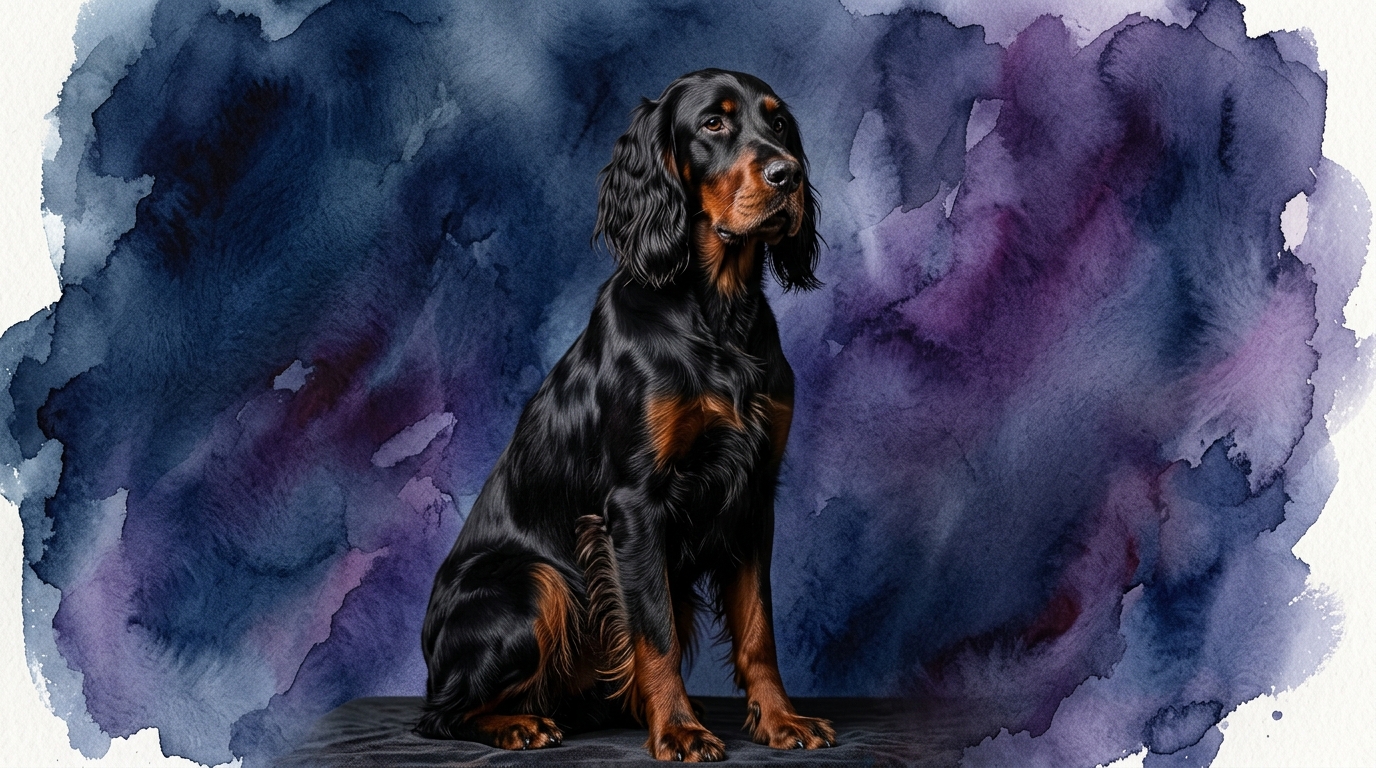
Gordon Setter at a glance
| IQ Rank / Score | #39 |
|---|---|
| Trainability | ★★★☆☆ (3/5) |
| Social Intelligence | ★★★★☆ (4/5) |
| Lifespan | 10-12 years |
| Shedding | Moderate to high |
| Exercise Needs | High (60+ min/day + training) |
| Origin | Scotland |
The Gordon Setter's Unique Cognitive Blueprint: Purposeful Sensory Processing and Cooperative Field Strategy
At the heart of the Gordon Setter's intelligence lies a highly specialized cognitive blueprint focused on purposeful sensory processing and cooperative field strategy. Unlike many independent hunters, the Gordon Setter's genius isn't merely in finding game, but in a multi-faceted process of locating, signaling, and holding the game in partnership with its human handler. This requires an intricate interplay of a keen olfactory sense, exceptional visual acuity for terrain and bird movement, and a profound understanding of human cues and intentions, making their 'setting' behavior a complex cognitive act rather than a simple instinct.
Their intelligence is characterized by a persistent, methodical approach to tasks, underpinned by an innate desire to work alongside their chosen person. They excel in environments where their keen nose and strategic thinking can be utilized, demonstrating remarkable focus and endurance. This isn't the flashy, rapid-fire problem-solving of a herding dog, but rather a deliberate, sustained engagement, where patience and precision are paramount. Their ability to process subtle environmental cues and communicate their findings non-verbally through their classic 'point' showcases a sophisticated level of situational awareness and partner-oriented communication unique to setter breeds.
A Legacy of Steadfastness: The Historical Evolution of Gordon Setter Intelligence
Delving into the history of the Gordon Setter reveals a surprising fact about their cognitive evolution: early Gordon Setters were significantly slower and heavier than their modern counterparts, often described as 'big, clunky dogs.' Bred by the 4th Duke of Richmond and Gordon in the rugged Scottish Highlands, these dogs were specifically developed for endurance and methodical tracking across vast, challenging landscapes, rather than the rapid, agile work seen in many contemporary field lines. This historical emphasis on prolonged, deliberate work directly shaped their cognitive profile, fostering traits like relentless persistence, sustained focus, and careful decision-making over speed.
This heritage means that a Gordon Setter's intelligence is deeply rooted in patience and thoroughness. They were not designed for quick sprints and immediate reactions but for systematic, unwavering engagement with a task over long periods. This historical context illuminates why modern Gordons, despite their athletic build, often approach training and problem-solving with a thoughtful, sometimes seemingly deliberate pace. Their minds are wired for endurance and detailed observation, a testament to generations of selective breeding for a specific, demanding role in the Scottish wilderness.
Unpacking the Gordon Setter IQ: A Deep Dive into Cognitive Strengths
The Gordon Setter's cognitive profile, as indicated by our IQ scores, paints a picture of a discerning and devoted companion. Their problem-solving (3/5) is characterized by a methodical rather than impulsive approach; they tend to think through challenges, often using persistence and learned strategies. This is evident in their ability to systematically work a field for game or figure out a new puzzle feeder at home. While not the fastest to pick up new tricks from scratch (trainingSpeed 3/5), they are certainly capable, especially when motivated by their beloved handler and consistent positive reinforcement. Their learning curve is steady, solidifying commands effectively over time.
Where the Gordon truly shines is in their instinctive drive (5/5) and social intelligence (4/5). Their powerful hunting instincts are ingrained, manifesting in keen scenting, intense focus on movement, and their iconic 'point.' This drive is not just for hunting; it fuels their curiosity and desire for engaging activities. Their social intelligence is profound; they are incredibly attuned to their family members' moods and intentions, forming deep, almost telepathic bonds. This sensitivity makes them excellent communicators within their family unit, often anticipating needs or reacting empathetically to human emotions. Their memory (4/5) is also a significant asset, allowing them to retain complex commands, remember specific scent trails, and recall the faces of friends and family with remarkable accuracy over long periods.
Beyond the Myth: The Truth About Gordon Setter Trainability
A prevalent myth surrounding Gordon Setter intelligence is the claim that they are stubborn or difficult to train. This misconception often arises from their strong prey drive and thoughtful, sometimes independent nature in the field, which can be mistaken for defiance in a domestic setting. Because they are not mindless followers, their deliberate approach to commands, especially when distractions are present, can be misinterpreted as resistance. They evaluate situations and often prefer to act on their own strong internal motivations, especially if a task doesn't immediately align with their understanding or an appealing reward isn't present.
The truth is that Gordon Setters are highly intelligent and possess a deep desire to please their chosen person, but they demand a partnership approach to training. They respond best to consistency, patience, and overwhelmingly positive reinforcement that respects their inherent instincts and thoughtful personality. What some perceive as stubbornness is often a manifestation of their deep consideration of a task, their strong independent working drive, or a need for clearer communication from their handler. With the right techniques and an understanding of their breed-specific motivations, Gordon Setters are incredibly capable and rewarding training partners, excelling in obedience, agility, and especially field work.
The Instinctive Drive: A Force of Nature in the Gordon Setter's Mind
The Gordon Setter’s instinctive drive, scoring a perfect 5 out of 5, is arguably their most defining cognitive attribute. This powerful internal compass guides their every interaction with the world, manifesting in an unparalleled desire to scent, track, and 'set' game. It's not merely an impulse; it’s a sophisticated, multi-layered cognitive program that includes an acute awareness of air currents, terrain, and the specific nuances of a bird's scent. This drive compels them to engage fully with their environment, making them tireless workers in the field and highly curious, active individuals in the home.
For owners, understanding and channeling this potent instinctive drive is key to a well-adjusted Gordon. Without appropriate outlets, this mental energy can lead to frustration and undesirable behaviors. Providing opportunities for scent work, long hikes, and even structured 'find it' games in the yard are crucial for satisfying their innate cognitive needs. This drive also underpins their focus and persistence, allowing them to concentrate intensely on a task once they are engaged, making them formidable competitors in various dog sports that tap into their natural abilities.
Social Bonds and Emotional Acuity: The Heart of a Gordon Setter
Scoring a 4 out of 5 in social intelligence, the Gordon Setter is a breed deeply invested in its human connections. They are renowned for forming intensely loyal and affectionate bonds with their family, often displaying a 'velcro dog' tendency that speaks volumes about their need for companionship and their ability to read human emotions. This high social intelligence makes them exceptionally sensitive to their owner's moods, capable of offering comfort or mirroring happiness. They thrive on inclusion in family activities and suffer if left isolated for extended periods, as their cognitive framework is built around partnership.
While devoted to their inner circle, their social intelligence also dictates a certain reserve with strangers. This is not shyness, but rather a discerning nature; they assess new individuals carefully, deciding who is worthy of their trust and affection. This makes them discerning judges of character and often excellent, though not overly vocal, watchdogs. Their ability to integrate seamlessly into a loving family unit, understanding dynamics and responding empathetically, highlights a complex emotional intelligence that goes far beyond simple obedience.
A Mind to Remember: Gordon Setter Memory in Action
With a memory score of 4 out of 5, the Gordon Setter demonstrates an impressive capacity for retaining information crucial to both their working heritage and their daily lives. This strong memory is vital in the field, enabling them to remember complex scent patterns, the locations of previous game finds, and the specific terrain features of a hunting ground. This isn't just rote recall; it's a sophisticated spatial and olfactory memory that allows them to build a detailed mental map of their environment and past experiences.
In a domestic setting, their memory manifests in their ability to quickly learn and retain commands, household routines, and the names of family members and friends. They remember where toys are kept, their favorite walking routes, and even past interactions with other dogs or people. This reliable memory contributes significantly to their trainability and their ability to navigate their world confidently, reinforcing their role as thoughtful and capable companions who learn from and adapt to their experiences.
Nurturing Genius: Practical Tips for a Brilliant Gordon Setter
Nurturing the Gordon Setter’s unique blend of intelligence requires a thoughtful and consistent approach. Given their high instinctive drive and social intelligence, training must always be a positive, engaging experience that reinforces the partnership between dog and handler. Focus on positive reinforcement methods, using high-value treats, praise, and play, as they are sensitive and can shut down with harsh corrections. Early socialization is crucial to help them develop confidence and appropriately channel their discerning social nature.
Crucially, mental stimulation is as important as physical exercise for this breed. Incorporate scent games, puzzle toys, and structured training sessions that challenge their problem-solving abilities and tap into their natural instincts. Agility, obedience, tracking, and even competitive scent work are excellent ways to engage their brilliant minds. Understanding their methodical learning style and deep devotion means patience, consistency, and celebrating every success will unlock the full potential of your intelligent and loyal Gordon Setter.
3 At-Home Tests to Measure Your Gordon Setter's IQ
These tests are adapted from peer-reviewed ethology research. No equipment is needed beyond items you have at home. Run each test 5–10 times for reliable results.
The Myth: "Gordon Setters are stubborn or difficult to train."
✅ Gordon Setters are highly intelligent and eager to please their chosen person, but they respond best to positive reinforcement, consistency, and a partnership approach to training that respects their strong instincts and thoughtful personality. Their 'stubbornness' often reflects a deep consideration of the task or a strong internal drive rather than a lack of cognitive ability.
Gordon Setter vs. Similar Breeds
🧠 What's Your Dog's IQ Score?
Our full Pet IQ Lab assessment includes 12+ tests across 5 cognitive dimensions, calibrated for Gordon Setters specifically.
Take the Full IQ Test →Frequently Asked Questions
How smart is a Gordon Setter?
Our Pet IQ Lab framework scores cognition across five dimensions (max 25). The Gordon Setter totals 18/25 — high for a domestic dog. The full article breaks down each dimension with at-home tests.
Are Gordon Setters easy to train?
Gordon Setters can learn most cues, but expect to repeat lessons and keep sessions short. They score 3/5 on Training Speed in our breed profile.
Are Gordon Setters good with children and other pets?
Yes — their Social Intelligence rates 4/5 in our Pet IQ Lab framework. With early socialization and supervised play, most Gordon Setters integrate well into families with respectful children and other pets.
Do Gordon Setters need a lot of mental stimulation?
Absolutely. With Problem Solving 4/5 and Instinctive Drive 4/5, Gordon Setters need daily mental work — puzzle feeders, scent games, training sessions, or nose-work — to avoid boredom.
How much exercise does a Gordon Setter need?
Gordon Setters need active engagement. Plan for 45-60 minutes of exercise and training per day, plus mental stimulation.
How good is a Gordon Setter's memory?
Gordon Setters score 3/5 on memory. They remember high-value associations well; less-used cues fade without refresher sessions.
What is the typical lifespan of a Gordon Setter?
Typical lifespan is 10-12 years for a large dog like the Gordon Setter.
The Gordon Setter's intelligence is a magnificent tapestry woven from instinct, devotion, and keen observation, offering a truly unique partnership for those who understand and appreciate their distinctive cognitive gifts. By embracing their historical purpose and catering to their deep social and instinctive drives, owners can unlock the full brilliance of this regal Scottish setter.