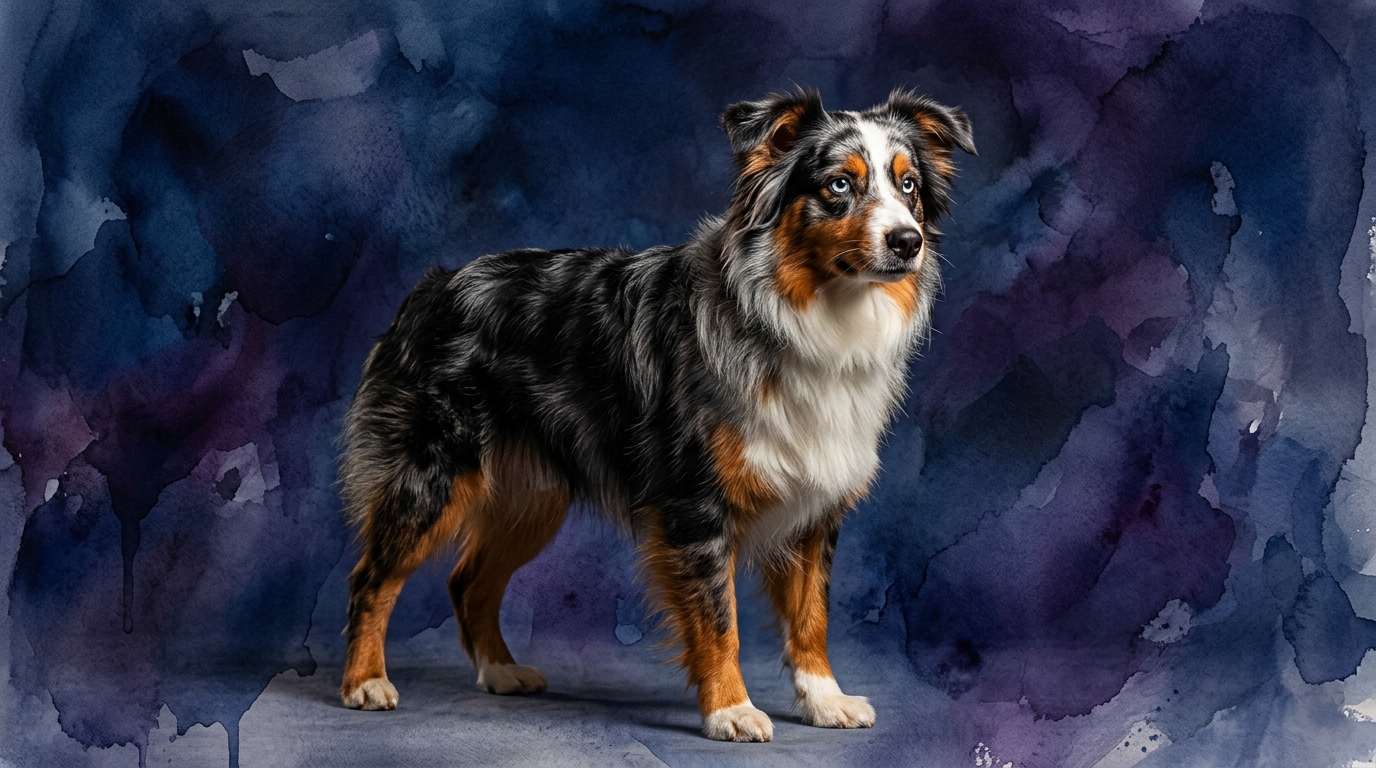

Side-by-Side Cognitive Profile: Miniature American Shepherd vs. Russian Toy
At first glance, the cognitive profiles of the Miniature American Shepherd and the Russian Toy appear remarkably similar within The Cosmic Pet Pet IQ Lab framework, with both breeds scoring 3/5 across all five dimensions: problem-solving, training speed, social intelligence, instinctive drive, and memory. This numerical parity, however, does not imply an identical expression of these capacities; instead, it highlights a similar *level* of cognitive ability applied through very different lenses.
For the Miniature American Shepherd, a score of 3/5 in problem-solving often translates to a practical acumen in navigating complex environments or strategizing to manage perceived 'flocks' – be it livestock or family members. Their 3/5 training speed reflects an eagerness to learn and apply commands in a structured, task-oriented manner, while their social intelligence (3/5) is frequently geared towards understanding group dynamics and cooperative work. The instinctive drive (3/5) is clearly rooted in their herding heritage, manifesting as a desire to gather and control, and their memory (3/5) supports the recall of intricate sequences and learned behaviors crucial for their working roles.
The Russian Toy, conversely, applies its identical 3/5 scores in ways more suited to its companion role. Their problem-solving (3/5) might focus on figuring out how to get attention, manipulate toys, or navigate the intricacies of a human household. A 3/5 training speed suggests they are moderately quick to pick up house rules and tricks, often motivated by treats and affection, though their attention span might be shorter. Their social intelligence (3/5) shines in their ability to read human emotions and adapt their behavior to foster close bonds. The instinctive drive (3/5) for a Russian Toy is less about herding and more about companionship, play, and perhaps a keen awareness of their surroundings. Finally, their memory (3/5) is effective for recalling routines, specific people, and the location of favored comforts or hidden treats.
Where the Miniature American Shepherd's Cognition Excels
The Miniature American Shepherd's cognitive strengths are profoundly shaped by its lineage as a herding dog, even if scaled down in size. Their 3/5 problem-solving ability, while numerically matched by the Russian Toy, manifests with a distinct practical edge in situations requiring spatial reasoning and independent decision-making. These dogs excel at tasks that involve understanding boundaries, anticipating movement, and executing multi-step commands, skills honed over generations to manage livestock effectively. This means they are often adept at complex agility courses, competitive obedience, or even simply navigating a busy household with an innate sense of order.
Their instinctive drive, also rated 3/5, is a powerful cognitive asset for owners who can provide appropriate outlets. This drive isn't merely a physical urge; it's a mental framework that encourages purpose-driven behavior. A Miniature American Shepherd processes information with an inherent desire to work and contribute, making them highly receptive to training that channels this energy into constructive activities. This intrinsic motivation allows them to sustain focus on tasks that might seem tedious to a less driven breed, and they often derive deep satisfaction from completing a 'job,' whether it's retrieving a specific toy or performing a complex routine.
Where the Russian Toy's Cognition Shines Brightest
The Russian Toy, despite its numerical parity in IQ scores, showcases its cognitive strengths in areas perfectly tailored for its role as a devoted companion. Their 3/5 social intelligence is particularly nuanced, allowing them to form exceptionally strong emotional bonds and exhibit a remarkable sensitivity to human moods and subtle cues. This isn't just about recognizing a command; it's about understanding the unspoken language of their human companions, often anticipating needs or offering comfort without direct instruction. They are masters at reading a room and adjusting their demeanor, making them highly adaptable social creatures within a family setting.
Furthermore, their problem-solving ability (3/5) often manifests as a clever resourcefulness in a domestic context. A Russian Toy might quickly figure out how to manipulate a blanket for optimal comfort, strategize the best way to get a favored toy from under furniture, or even 'problem-solve' how to gain extra attention from their owners through charming antics. This isn't the broad, outdoor problem-solving of a herding dog, but rather a keen, focused intelligence applied to their immediate personal environment and social interactions. Their memory (3/5) also plays a crucial role here, allowing them to recall specific routines, preferred people, and past interactions that have yielded positive results, reinforcing their clever approaches to daily life.
Training Dynamics: Nuances in Learning
Both the Miniature American Shepherd and the Russian Toy score 3/5 in training speed, indicating a moderate capacity for learning, but the *approach* and *challenges* in training them differ significantly due to their inherent temperaments and drives. The Miniature American Shepherd, with its herding background, often possesses a strong desire to please and a clear work ethic. They tend to respond well to consistent, positive reinforcement methods and thrive in structured training environments where they are given clear tasks. Their focus can be intense, allowing them to absorb complex sequences and commands efficiently. However, their herding instinct means they might attempt to 'manage' children, other pets, or even moving cars if not adequately channeled through appropriate outlets like dog sports or specific training exercises.
The Russian Toy, while equally capable of learning at a 3/5 pace, often presents different training considerations. Their spirited and sometimes independent nature means that while they can grasp commands quickly, maintaining their focus might require more engaging and varied techniques. Consistency is paramount, as is making training fun and rewarding, often with high-value treats or engaging play. Their smaller size means physical management during training is less demanding, but their cleverness can sometimes be used to 'train' their owners if boundaries aren't firm. They might be quicker to learn tricks that yield immediate rewards but could be more prone to selective hearing if a more interesting distraction arises. Their inherent companion drive means they often learn best when training strengthens their bond with their human, rather than focusing solely on a 'job'.
Lifestyle Match: Active Companions vs. Relaxed Devotion
The choice between a Miniature American Shepherd and a Russian Toy hinges significantly on an owner's lifestyle and their capacity to meet a dog's specific needs, even with identical cognitive scores. The Miniature American Shepherd, despite its 'miniature' designation, is fundamentally a working breed with a 3/5 instinctive drive that demands both physical and mental engagement. These dogs thrive with active owners who enjoy activities like hiking, running, agility, obedience, or even just extensive daily walks and structured playtime. They need a 'job' or a consistent outlet for their energy and problem-solving skills, otherwise, their intelligence and drive can manifest as boredom-induced behaviors like excessive barking, destructive chewing, or attempting to herd household members. They are ideal for families committed to providing substantial daily interaction and enrichment.
Conversely, the Russian Toy's 3/5 instinctive drive is geared towards companionship and interaction rather than intense physical labor. This makes them wonderfully adaptable to a wider range of lifestyles, including those of more relaxed or apartment-dwelling owners. While they certainly enjoy daily walks, playtime, and mental stimulation through toys and training, their exercise requirements are modest compared to the herding breed. They are content to snuggle on a lap, observe household activities, and participate in short bursts of play. Their small size and deep social intelligence (3/5) make them perfect for owners seeking a devoted, portable companion who excels at forming close bonds without demanding an extremely active outdoor regimen, provided they receive consistent social interaction and mental engagement within the home.
The Verdict: Choosing Your Canine Companion
The Verdict
Choose the Miniature American Shepherd if you are an active individual or family seeking an engaged, purpose-driven companion for dog sports, outdoor adventures, or a highly interactive role that provides consistent mental and physical challenges.
Opt for the Russian Toy if you desire a charming, devoted, and adaptable companion who thrives on close human interaction, is content with moderate exercise, and excels at forming deep emotional bonds within a varied home environment.
🧠 Find Your Pet's IQ Score
Our Pet IQ Lab assessment covers 25+ tests across 5 cognitive dimensions — personalized to your breed.
Take the Full IQ Test →Frequently Asked Questions
Do identical IQ scores mean these breeds are exactly alike in intelligence?
No, identical scores indicate a similar capacity for cognitive functions, but the application and manifestation of these abilities differ greatly based on a breed's history and physical traits. A Miniature American Shepherd might apply its problem-solving to herding tasks, while a Russian Toy uses its problem-solving to navigate a complex home environment.
Can a Miniature American Shepherd live in an apartment?
While possible, a Miniature American Shepherd requires significant daily mental and physical exercise to thrive, regardless of living space. Without a 'job' or ample activity, their herding instincts can lead to undesirable behaviors. Owners must be committed to providing structured outlets for their energy.
Are Russian Toys prone to 'small dog syndrome'?
Like many small breeds, Russian Toys can develop 'small dog syndrome' if not properly socialized and trained. Their spirited nature benefits from consistent boundaries and exposure to various people and environments from a young age, helping them build confidence and polite manners.