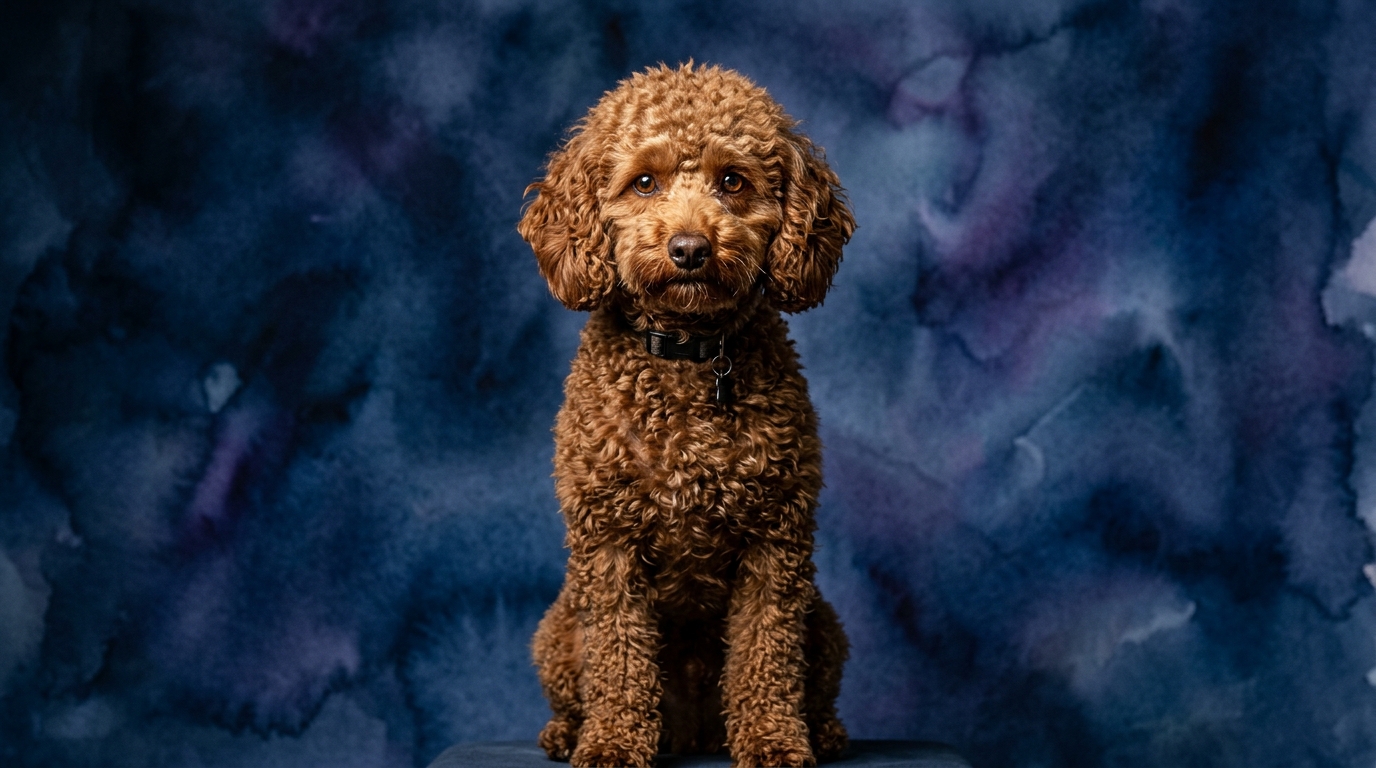

Side-by-Side Cognitive Profiles
The Cosmic Pet Pet IQ Lab employs a five-dimensional framework to assess canine intelligence, offering a nuanced view beyond simple rankings. Let's examine how the Miniature Poodle and Irish Water Spaniel stack up in each cognitive domain.
The **Miniature Poodle** consistently demonstrates exceptional cognitive prowess across several key areas. Its Problem Solving is rated 5/5, indicating a remarkable capacity to analyze novel situations, devise solutions, and adapt strategies effectively. This manifests in behaviors like figuring out complex puzzle toys or understanding multi-step sequences without extensive prior exposure. Training Speed, also at 5/5, highlights this breed's rapid acquisition of new commands and concepts, often requiring very few repetitions to cement learning. Social Intelligence scores 3/5, suggesting a moderate ability to interpret human cues; they are attentive companions but might not always be deeply attuned to the most subtle emotional shifts, often focusing on the task at hand or their own independent pursuits. Instincive Drive sits at 3/5, indicating a balanced level of innate motivations; while they possess a historical retrieving background, their drive is generally adaptable and not overwhelmingly focused on a single type of work. Finally, Memory is an outstanding 5/5, meaning learned behaviors, routines, and even specific locations are retained with remarkable longevity, making training exceptionally durable.
The **Irish Water Spaniel**, a breed historically dedicated to retrieving from water, presents a strong, practical intelligence profile. Its Problem Solving is rated 4/5, signifying a robust ability to navigate challenges and find solutions, particularly when those challenges relate to their working instincts, such as locating fallen game in dense cover or navigating complex aquatic environments. Training Speed is 4/5, reflecting a good capacity for learning new tasks and commands, though they might require more consistent reinforcement and engaging methods compared to the Poodle. Social Intelligence, like the Poodle, scores 3/5; they connect well with their human partners but often maintain a degree of independence, especially when engrossed in an activity. Instincive Drive is also 3/5, but within this breed, it is distinctly channeled towards retrieving and water work, making them highly motivated by these specific tasks. Memory is rated 4/5, indicating a solid ability to recall training and past experiences, ensuring that once a skill is learned, it is retained effectively for practical application.
Where the Miniature Poodle Excels Cognitively
The Miniature Poodle's primary cognitive advantage lies in its superior abstract problem-solving and learning efficiency. With a perfect 5/5 in both Problem Solving and Training Speed, this breed processes information and grasps new concepts with extraordinary swiftness. Owners frequently observe Poodles generalizing learned behaviors from one context to another without explicit reteaching, a testament to their capacity for abstract thought. For instance, a Poodle taught to retrieve a specific toy by name might quickly generalize that command to other objects, demonstrating an understanding of the underlying concept rather than just rote memorization. This rapid cognitive processing allows them to excel in complex obedience, agility, and trick training, often surprising owners with their ability to anticipate commands or understand multi-stage instructions. Their 5/5 memory further solidifies this edge, ensuring that once a skill is mastered, it remains ingrained, requiring minimal refreshers over time.
Where the Irish Water Spaniel Shines Cognitively
The Irish Water Spaniel's cognitive strengths are deeply rooted in its functional purpose, particularly its robust practical problem-solving and focused drive. While its Problem Solving is rated 4/5, it excels in applying its intellect to real-world, often physically demanding tasks. An IWS might not solve a puzzle box as quickly as a Poodle, but its superior capacity for navigating challenging outdoor environments, assessing water currents, or meticulously quartering a field to locate a scent demonstrates a different, equally valuable form of intelligence. Their 3/5 instinctive drive, while moderate overall, is precisely channeled towards retrieving and water work, providing an inherent motivation that fuels their learning and task completion in these specific domains. This focused drive, combined with good memory (4/5), means they can develop highly specialized skills, becoming exceptionally proficient and reliable partners in their chosen activities, often displaying remarkable perseverance when faced with obstacles related to their work.
Ease of Training: Poodle's Efficiency vs. Spaniel's Purpose
When it comes to ease of training, the Miniature Poodle generally holds an advantage due to its perfect 5/5 Training Speed and 5/5 Memory. Owners of Poodles often report that their dogs pick up new commands with remarkable speed, sometimes after only a few repetitions, and retain that information over the long term. This efficiency means training sessions can be shorter, more varied, and progress quickly to advanced concepts, leading to less frustration for the owner and a wider repertoire of learned behaviors for the dog. Their problem-solving ability also helps them understand the 'why' behind a command, leading to more willing compliance and adaptability in new situations.
The Irish Water Spaniel, with a solid 4/5 in both Training Speed and Memory, is certainly capable of learning complex tasks, but typically requires a more consistent and engaging approach. Their training often benefits from incorporating their natural retrieving and water instincts, making learning feel purposeful and rewarding. While they are not slow learners, they may require more repetitions than a Poodle and thrive on positive reinforcement that clearly communicates the value of the desired behavior. Their moderate social intelligence and independent streak mean that training must be stimulating enough to hold their attention; a bored IWS might be less inclined to comply if the activity lacks intrinsic motivation or clear utility. Therefore, while both breeds are trainable, the Poodle offers a path of greater cognitive efficiency, while the IWS benefits from a training approach that leverages its inherent working drives.
Suitability for Active vs. Relaxed Owners
The question of whether a breed suits active or relaxed owners hinges on its physical and mental stimulation requirements. For **active owners**, both breeds can be excellent choices, though they cater to different types of activity. The Irish Water Spaniel, with its sporting background and love for water, thrives on vigorous outdoor exercise, long hikes, swimming, and field work. Owners who enjoy hunting, canine sports like dock diving or retrieving trials, or simply extensive outdoor adventures will find an IWS an eager and robust companion. Their physical stamina and focused drive make them ideal partners for demanding, purposeful activities.
The Miniature Poodle also suits active owners, but often those who prioritize mental engagement alongside physical exercise. While capable of good physical activity, their exceptional problem-solving and training speed mean they excel in activities like agility, obedience, rally, or canine freestyle, which demand intricate learning and precise execution. Owners who enjoy teaching complex tricks, participating in dog sports that challenge cognitive abilities, or engaging in regular puzzle-solving sessions will find the Poodle a highly rewarding partner. For **relaxed owners**, the Miniature Poodle is generally more adaptable, provided their substantial mental stimulation needs are met. A Poodle might tolerate a less physically demanding routine if compensated with ample brain games and training sessions. The Irish Water Spaniel, however, generally requires a more consistently active lifestyle to prevent boredom and the channeling of its energetic, task-oriented nature into less desirable behaviors. A 'relaxed' owner for an IWS would still need to commit to significant daily exercise and mental engagement to ensure the dog's well-being and prevent potential frustration.
The Verdict
Choose the Miniature Poodle if you seek a remarkably quick-witted, highly adaptable companion eager to master complex commands and excel in formal obedience or intricate trick training, thriving on mental challenges.
Opt for the Irish Water Spaniel if you desire a robust, task-oriented partner who excels in physical work, particularly involving water and retrieving, and thrives when given a purposeful role and consistent outdoor activity.
🧠 Find Your Pet's IQ Score
Our Pet IQ Lab assessment covers 25+ tests across 5 cognitive dimensions — personalized to your breed.
Take the Full IQ Test →Frequently Asked Questions
Is the Miniature Poodle truly smarter than the Irish Water Spaniel?
The Cosmic Pet Pet IQ Lab data suggests the Miniature Poodle has higher scores in problem-solving, training speed, and memory, making it generally more efficient at acquiring and retaining new information. However, the Irish Water Spaniel demonstrates a strong, practical intelligence tailored to its working heritage, excelling in task-specific applications.
Do both breeds require a lot of mental stimulation?
Yes, both breeds benefit significantly from mental stimulation. The Miniature Poodle requires it to satisfy its high problem-solving and memory capabilities, often through training and puzzle toys. The Irish Water Spaniel needs mental engagement that often integrates its strong instinctive drive for retrieving and outdoor work to prevent boredom and promote well-being.
Which breed is better for a first-time dog owner?
The Miniature Poodle's exceptional training speed and memory can make it a more forgiving choice for a first-time owner, as it learns quickly and retains information well. The Irish Water Spaniel, while trainable, may require more consistent and engaging methods, and its strong working drive might be more suited to owners with some experience in channeling canine energy and purpose.