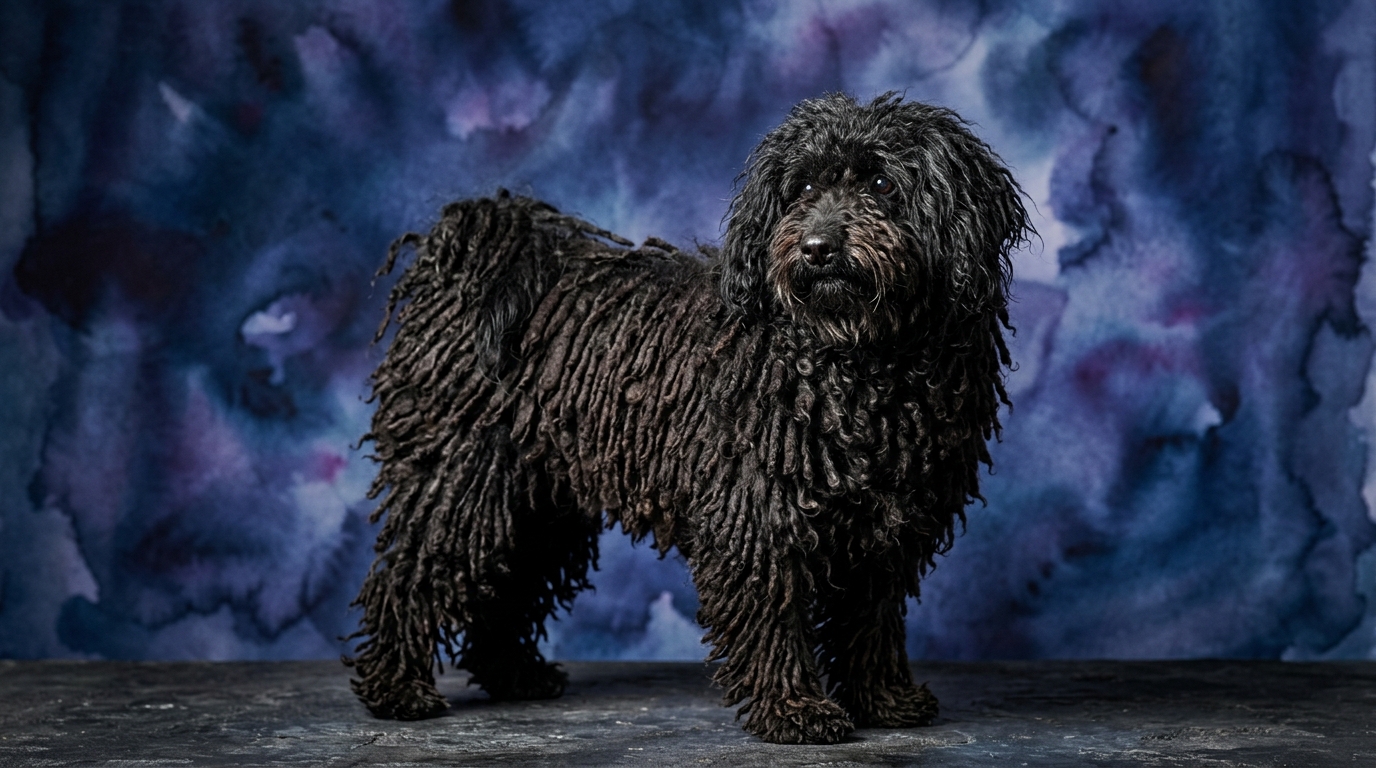

Unpacking the IQ Profiles: Puli vs. English Setter
At first glance, the Cosmic Pet Pet IQ Lab data suggests a near-identical cognitive blueprint for the Puli and the English Setter, with both breeds scoring 4/5 in Problem Solving, Training Speed, and Memory, and 3/5 in Social Intelligence and Instinctive Drive. However, these identical scores mask profound differences in how these breeds apply their mental faculties, shaped by their divergent histories as Herding and Sporting dogs respectively. Understanding these nuances requires looking beyond the numbers to the specific contexts in which their intelligence shines.
For the **Puli**, a Coren rank #25 Herding dog, their Problem Solving (4/5) is deeply rooted in managing livestock. This means strategizing to gather scattered sheep, anticipating their movements, and navigating complex outdoor environments to keep the flock cohesive. Their solutions often involve independent decision-making, subtle body language, and strategic barking to control animals, rather than direct human instruction. This requires a flexible and adaptive mind, constantly assessing and reacting to dynamic situations. Their Training Speed (4/5) reflects a quick grasp of new commands, but this learning often comes with an independent streak; they absorb information swiftly but may then apply it in their own Puli-approved manner, sometimes seeking to 'improve' on the instruction. Social Intelligence (3/5) for a Puli is often centered on their immediate human 'flock,' displaying a keen awareness of family dynamics and a tendency to be reserved with outsiders, focusing their understanding on those they deem part of their inner circle. Instinctive Drive (3/5) is undeniably herding-focused, manifesting as a strong urge to gather, patrol, and control, which influences much of their cognitive processing. Finally, their Memory (4/5) is excellent for routines, spatial layouts, and remembering specific tasks or individuals within their perceived territory, crucial for their historical role.
The **English Setter**, a Coren rank #37 Sporting dog, approaches intelligence from a different angle. Their Problem Solving (4/5) is finely tuned for the hunt: locating hidden game, navigating dense cover, and efficiently retrieving fallen birds. Their mental agility is geared towards processing sensory input, particularly scent, and making rapid, effective decisions in the field. This involves adapting to changing wind conditions and terrain to pinpoint game. Their Training Speed (4/5) is also high, reflecting their historical need to quickly learn and execute complex commands from a handler during a hunt. They are typically eager to please, making them highly responsive to positive reinforcement and consistent guidance. Social Intelligence (3/5) for the English Setter often translates to an amiable and polite demeanor with people, but their deepest social understanding is frequently reserved for their primary hunting partner, with whom they form a strong, cooperative bond built on subtle communication and shared goals. Their Instinctive Drive (3/5) is powerfully oriented towards scenting, tracking, and pointing game, a drive that profoundly shapes their focus and motivation. Their Memory (4/5) is exceptional for remembering specific terrain, scent patterns, and the location of game, allowing them to operate effectively and efficiently in vast outdoor spaces.
Where the Puli's Cognition Excels
The Puli exhibits a unique cognitive strength in autonomous, strategic problem-solving, particularly in dynamic, unsupervised environments. While both breeds score 4/5 in this dimension, the Puli’s herding heritage means they often excel at making independent judgments without constant human direction. Imagine a Puli managing a flock of sheep on a vast pasture; they must assess the situation, anticipate the animals' movements, and implement a strategy to keep them together, often involving complex spatial reasoning and quick adaptation to unforeseen variables. This requires a sophisticated level of abstract planning and the ability to execute multi-step solutions based on their own assessment. Their cognitive process is less about following a direct command and more about interpreting a broad objective and devising the best path to achieve it. This independent thought process, coupled with their robust memory, allows them to recall effective strategies and apply them to new, similar challenges, making them particularly adept at tasks requiring self-reliance and inventive solutions.
Where the English Setter's Cognition Shines
The English Setter’s cognitive strengths lie in their unparalleled sensory processing and collaborative intelligence, specifically within the context of their sporting role. While the Puli's problem-solving is about independent management, the Setter's (4/5) is about highly refined detection and cooperative execution. Their olfactory capabilities are a cornerstone of their intelligence, allowing them to process complex scent information with incredible precision, pinpointing game birds even in challenging conditions. This isn't just a physical sense; it's a cognitive act of interpretation and mapping the environment through scent. Furthermore, their social intelligence (3/5), while rated the same as the Puli, manifests differently: it's geared towards a deep, almost telepathic understanding of their human hunting partner. They learn to read subtle body language and vocal cues, working in seamless concert to achieve a shared goal. This collaborative problem-solving, combining their sensory prowess with a strong desire to cooperate, gives them an edge in tasks requiring sustained focus, environmental interpretation, and synchronized teamwork.
Training Dynamics: Puli's Independence vs. Setter's Cooperation
When it comes to training, both breeds possess a high training speed (4/5), meaning they pick up commands quickly. However, the 'why' behind their learning and subsequent compliance differs significantly. The Puli, with its strong herding instinct (3/5) and historical role as an independent worker, tends to learn fast but may also evaluate the necessity or efficiency of a command. They might interpret a command and then decide if their own, slightly modified approach would be better. This independence means Puli training requires an owner who is consistent, clear, and able to motivate by making the Puli feel like an engaged partner rather than a mere follower. Challenges can arise if their inherent drive to 'herd' conflicts with an owner's expectations, necessitating careful redirection and consistent boundary setting. Their cognitive approach is often to understand the 'spirit' of the command and then apply it with a degree of autonomy.
The English Setter, on the other hand, also learns rapidly (4/5) but typically with a more cooperative spirit. Their sporting heritage emphasizes working closely with a human handler, making them generally eager to please and responsive to direction. They thrive on positive reinforcement and praise, viewing training as a shared activity. However, their strong instinctive drive (3/5) to scent and pursue can be a significant distraction. While they may understand a command perfectly, a captivating scent or a moving object can momentarily override their learned responses, particularly in an uncontrolled outdoor environment. Training an English Setter, therefore, requires patience and a focus on maintaining attention amidst environmental stimuli, channeling their natural drives rather than suppressing them. Their cognitive approach is often to execute the command precisely, especially when it aligns with their desire to work with their human.
Lifestyle Match: Active Engagement vs. Outdoor Exploration
Both the Puli and the English Setter are best suited for active owners, but the nature of that activity differs, reflecting their cognitive profiles. The Puli, a Herding dog, thrives on mental engagement and tasks that tap into their problem-solving abilities and independent thinking. Owners who can provide regular 'jobs' – whether it's agility, competitive obedience, or even complex puzzle toys and supervised 'herding' of family members or objects – will find their Puli fulfilled. Their physical exercise needs are substantial, but equally important is intellectual stimulation to prevent boredom and channel their strong instincts. A relaxed owner who cannot commit to engaging their Puli's mind and body will likely find themselves with a dog that invents its own (potentially destructive) 'work'.
The English Setter, as a Sporting dog, requires extensive physical exercise, particularly in environments where they can engage their powerful scenting instincts. Long runs, hikes, and opportunities for off-leash exploration in safe, open areas are crucial for their well-being. While they can be calm and affectionate indoors, their need to 'hunt' and explore outdoors is paramount. Owners who are avid hikers, runners, or enjoy field activities will find the English Setter an ideal companion. A relaxed owner who cannot provide ample opportunities for their Setter to stretch their legs and engage their nose will likely encounter a restless and potentially frustrated dog, regardless of their amiable disposition. Their cognitive focus on sensory input and outdoor exploration demands a lifestyle that accommodates these fundamental drives.
The Verdict
Choose the Puli if you seek an independent, strategic thinker who thrives on mental challenges and forms deep, protective bonds, and you are prepared to channel their inherent herding drive with consistent guidance.
Choose the English Setter if you are an active individual or family valuing a cooperative partner for outdoor adventures, appreciative of exceptional sensory intelligence, and capable of providing ample opportunities for physical exercise and scent work.
🧠 Find Your Pet's IQ Score
Our Pet IQ Lab assessment covers 25+ tests across 5 cognitive dimensions — personalized to your breed.
Take the Full IQ Test →Frequently Asked Questions
Do Pulis and English Setters have similar energy levels?
Both breeds possess significant energy levels, but they manifest differently. Pulis require mental stimulation alongside physical activity, often enjoying structured tasks. English Setters need extensive physical exercise, especially opportunities for running and scent exploration in open spaces.
Is one breed more prone to separation anxiety?
Neither breed is inherently more prone to separation anxiety than the other, but individual temperament and early training play a larger role. Both breeds form strong bonds with their families, and if not properly socialized or if left alone for extended periods without adequate mental and physical stimulation, either could develop separation-related stress.
Are Pulis or English Setters better with children?
Both can be excellent family dogs with proper socialization and training. Pulis, with their herding instinct, might try to 'herd' children, which needs careful management. English Setters are generally amiable and gentle, often enjoying playtime, making them a good fit for active families.