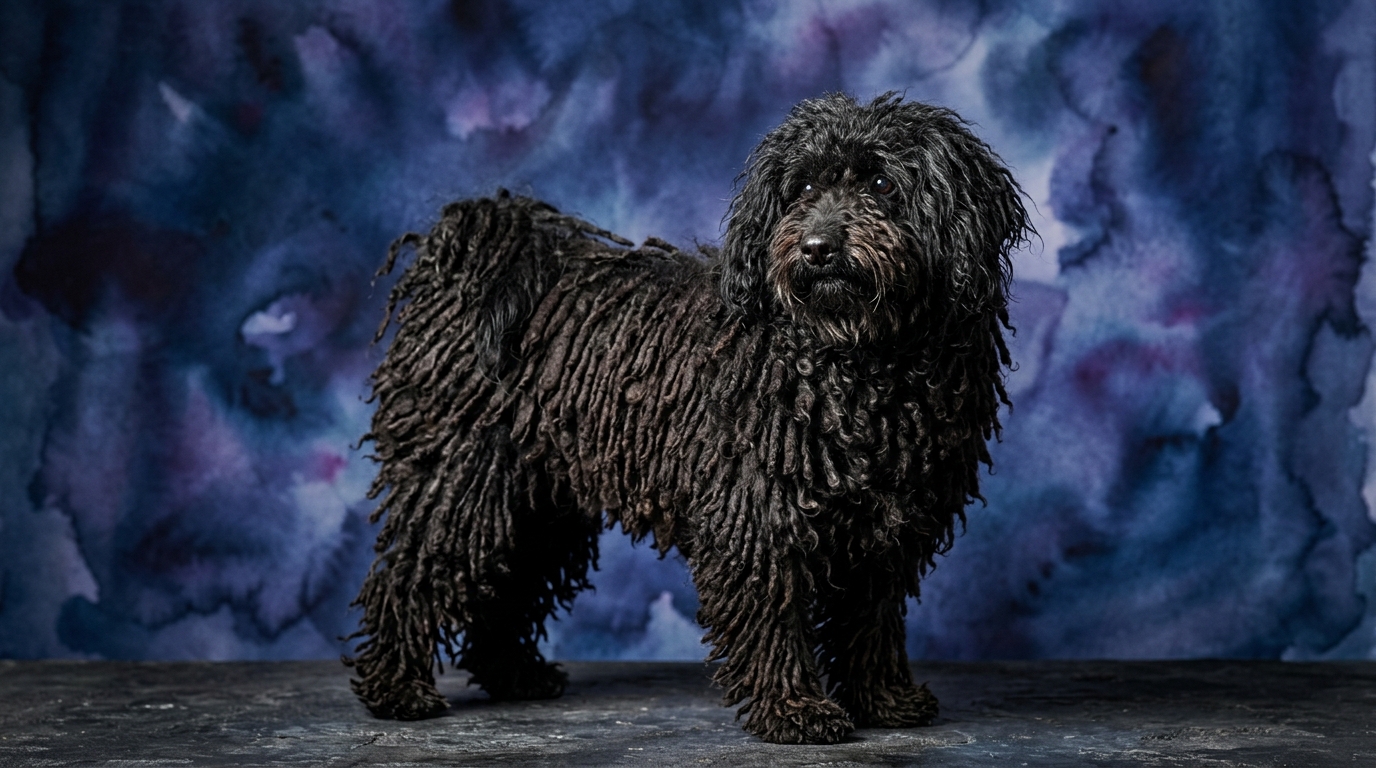
Puli at a glance
| IQ Rank / Score | #25 |
|---|---|
| Trainability | ★★★★☆ (4/5) |
| Social Intelligence | ★★★☆☆ (3/5) |
| Lifespan | 11-14 years |
| Shedding | Low to moderate |
| Exercise Needs | High (60+ min/day + training) |
| Origin | Hungary |
The Puli's Cognitive Keystone: The Independent Strategist
The Puli’s primary cognitive strength lies in its capacity for adaptive, independent strategic planning within dynamic environments. Unlike many herding breeds that work in close partnership with a human shepherd, Pulis were historically bred to operate with remarkable autonomy, often left alone to manage and protect their flocks on vast, open plains. This necessitated a profound ability to assess rapidly changing situations and devise effective solutions without constant human intervention.
This independent strategic planning involves a complex interplay of cognitive functions: the ability to observe a moving flock, anticipate its trajectory, identify potential threats, and then execute a coordinated response. Whether it was maneuvering a wayward sheep back into the fold or confronting a predator, the Puli was expected to make real-time, critical decisions. This intrinsic need for self-reliance shaped a dog that is not merely obedient but a genuine strategist in its own right.
For modern Puli owners, understanding this deep-seated cognitive trait is key. These dogs require mental stimulation that taps into their problem-solving prowess. Without engaging challenges that allow them to exercise their innate intelligence, a Puli may become bored, leading to behaviors often misinterpreted as stubbornness, but which are, in fact, expressions of an unfulfilled intellectual need.
Their cognitive independence is a testament to their ancestral role, making them exceptionally capable of self-directed learning and decision-making—a true hallmark of a high-functioning herding dog.
Beyond the Fluffy Facade: A Glimpse into Puli History & Cognition
A surprising historical fact about Puli cognition reveals their extraordinary self-reliance: they were often left entirely alone with their flocks for extended periods, functioning as autonomous shepherds and sentinels without direct human oversight. This level of independence was not merely tolerated but actively cultivated and prized, distinguishing them from many other herding breeds that typically rely on constant human direction.
This unique historical role cultivated profound cognitive skills in the Puli, far beyond simple obedience. It demanded advanced spatial reasoning to track scattered sheep over large territories, exceptional long-term memory for terrain and individual animals, and complex decision-making capabilities under immense pressure, such as confronting wolves or other predators. Their work wasn't just about moving sheep; it was about strategic intervention, foresight, and absolute protection, all executed with remarkable self-sufficiency.
The Puli's ability to process information, make independent judgments, and execute sophisticated plans with minimal human direction is a powerful testament to their innate intelligence. This deep-seated autonomy continues to define the breed's cognitive profile today, manifesting as a keen problem-solving ability and a strong-willed disposition that seeks purpose and mental engagement.
Deciphering Puli Intelligence: An Overview
The Puli, while instantly recognizable for its distinctive corded coat, possesses an intelligence that is equally, if not more, captivating. Ranking #25 out of 138 breeds in Stanley Coren's obedience and working intelligence, the Puli is firmly established as an above-average performer in terms of trainability and cognitive ability. This high ranking underscores their capacity for rapid learning and their eagerness to engage in mentally stimulating tasks.
Their intelligence is a finely balanced blend of powerful instinct, sophisticated problem-solving skills, and a remarkable aptitude for training. The Puli is not just a follower; they are thinkers who process information, understand commands, and often anticipate their owner's intentions. This makes them highly adaptable, capable of applying their inherent drives to a wide variety of tasks beyond traditional herding.
For those who understand and appreciate their intellectual depth, Pulis become exceptionally motivated and capable partners. They thrive when their minds are engaged in challenging activities, whether it's learning new tricks, participating in dog sports, or solving complex puzzles. Their intelligence is not merely about rote memorization but about a holistic understanding of their environment and their role within it, creating a truly dynamic and responsive companion.
Problem-Solving Prowess: Navigating Complex Challenges
Pulis exhibit significant problem-solving abilities, a direct inheritance from their demanding herding background. Rated a 4/5 in this category, they are adept at analyzing situations and devising inventive solutions. This translates into daily life, where they might figure out how to open a childproof gate, retrieve a toy from an inaccessible spot, or even 'herd' household objects into a desired location with impressive ingenuity.
Their herding heritage instilled in them a knack for assessing dynamic scenarios and formulating a plan of action. This means a Puli isn't easily stumped; they approach challenges with a determined and often strategic mindset, using trial-and-error combined with memory to find effective ways to achieve their goals. They are not content to wait for answers but actively seek them out.
For Puli owners, nurturing this problem-solving prowess is crucial. Providing engaging mental puzzles, interactive toys, and opportunities for 'brain games' prevents boredom and channels their cognitive energy constructively. A Puli who is challenged mentally is a happy Puli, eager to put their sharp intellect to good use and demonstrate their cleverness.
Swift Learners: The Puli's Trainability and Acumen
With a training speed rating of 4/5 and a #25 ranking by Stanley Coren, the Puli is an exceptionally fast learner. They grasp new commands and routines with remarkable ease, often requiring fewer repetitions than many other breeds. Their attentiveness and eagerness to understand what is being asked of them make the training process a rewarding experience for both dog and owner.
Pulis respond particularly well to positive reinforcement methods. They thrive on praise, high-value treats, and engaging play, quickly forging strong connections between their actions and desirable outcomes. Their cognitive flexibility allows them to generalize learned behaviors across different environments and situations, demonstrating a deep understanding beyond mere rote obedience.
Despite their independent streak, Pulis are highly trainable when approached with consistency, patience, and engaging, reward-based techniques. They are not simply dogs that follow commands; they are intelligent partners who genuinely enjoy the process of learning and mastering new skills, from basic obedience to complex tricks and various dog sports, showcasing their impressive acumen.
Social Savvy: Understanding the Puli's Pack Dynamics
The Puli's social intelligence, rated 3/5, is characterized by a deep devotion to their immediate family, whom they consider their 'flock.' They possess a keen observational ability to read human emotions, intentions, and social cues within this trusted group, often acting as intuitive and empathetic companions.
However, their protective and watchful nature, inherent from their guardian duties, often translates into a reserved or even wary demeanor around strangers. This is not a deficit in social intelligence but rather a manifestation of their deeply ingrained instinct to discern friend from potential foe and guard their loved ones. Early and extensive socialization is paramount to help a Puli develop appropriate social skills and confidence in varied environments.
Within their established social circle, Pulis are typically playful, affectionate, and highly attuned to their owners. They form profound bonds, often shadowing their favorite family members and engaging in interactive play. Their ability to understand and adapt their behavior to the nuances of their 'pack' makes them incredibly rewarding companions for those they trust completely.
Instinct Unleased: The Relentless Herding Drive
Rated a perfect 5/5 for instinctive drive, the Puli's core being is intrinsically tied to its herding heritage. This is not merely an urge but a profound, inherent motivation to gather, control, and protect. Their watchful eyes, quick movements, and natural inclination to oversee their environment are all manifestations of this powerful, deeply ingrained instinct.
In a domestic setting, this intense drive can translate into a variety of behaviors. Pulis may 'herd' children, other pets, or even inanimate objects, gently nudging or circling them. Their natural vigilance means they are often the first to alert their household to anything unusual, living up to their ancestral role as sentinels. This protective instinct extends fiercely to their human family and home.
Channeling this potent instinctive drive constructively is vital for a Puli's overall well-being. Activities such as herding trials, agility, rally obedience, or even advanced trick training provide essential outlets for their powerful cognitive and physical urges. Providing appropriate tasks allows them to express their natural behaviors in a positive way, preventing boredom and potential misdirected or destructive behaviors that can arise from an unfulfilled instinct.
Memory Mastery: Recalling Commands and Connections
Pulis possess excellent memory, earning a 4/5 rating, critical for their complex herding duties where remembering flock patterns, terrain boundaries, and learned commands was a matter of survival. They quickly commit new commands, routines, and environmental layouts to memory, retaining information over long periods.
Their strong recall ability significantly contributes to their trainability and adaptability. Once a Puli learns a command or a positive association, it tends to stick, making them highly reliable partners in training and daily life. This capacity for long-term retention means that once a skill is acquired, it often requires minimal refreshing.
This impressive memory, however, also means that consistency in training and household rules is paramount. A Puli will remember exceptions to rules or inconsistent training, potentially leveraging past experiences to test boundaries. Therefore, clear, consistent communication and repetition are key to effectively leveraging their exceptional cognitive strength for a harmonious relationship.
3 At-Home Tests to Measure Your Puli's IQ
These tests are adapted from peer-reviewed ethology research. No equipment is needed beyond items you have at home. Run each test 5–10 times for reliable results.
The Myth: "Pulis are stubborn and difficult to train due to their independent nature, often preferring to do their own thing."
✅ Pulis are highly intelligent and eager to please their loved ones, ranking #25 in obedience; their independence stems from a history of needing to make critical decisions autonomously, and they thrive on mental stimulation and respond exceptionally well to positive reinforcement and consistent, engaging training methods.
Puli vs. Similar Breeds
🧠 What's Your Dog's IQ Score?
Our full Pet IQ Lab assessment includes 12+ tests across 5 cognitive dimensions, calibrated for Pulis specifically.
Take the Full IQ Test →Frequently Asked Questions
How smart is a Puli?
Our Pet IQ Lab framework scores cognition across five dimensions (max 25). The Puli totals 20/25 — very high for a domestic dog. The full article breaks down each dimension with at-home tests.
Are Pulis easy to train?
Pulis are generally easy to train when you use consistent, reward-based sessions. They score 4/5 on Training Speed in our breed profile.
Are Pulis good with children and other pets?
Pulis can live well with families when socialized early. Their Social Intelligence scores 3/5, so supervise interactions with small children and introduce new pets gradually.
Do Pulis need a lot of mental stimulation?
Absolutely. With Problem Solving 4/5 and Instinctive Drive 5/5, Pulis need daily mental work — puzzle feeders, scent games, training sessions, or nose-work — to avoid boredom.
How much exercise does a Puli need?
Pulis need active engagement. Plan for 45-60 minutes of exercise and training per day, plus mental stimulation.
How good is a Puli's memory?
Pulis score 4/5 on memory. They remember routines, hiding spots, and learned cues for months, sometimes years.
What is the typical lifespan of a Puli?
Expect a lifespan of 11-14 years for a healthy Puli.
The Puli's intelligence is a magnificent tapestry woven from centuries of independent herding, sharp problem-solving, and unwavering loyalty. Understanding their unique cognitive profile allows us to appreciate them not just for their striking looks, but for the profound mental capabilities that make them truly exceptional companions.