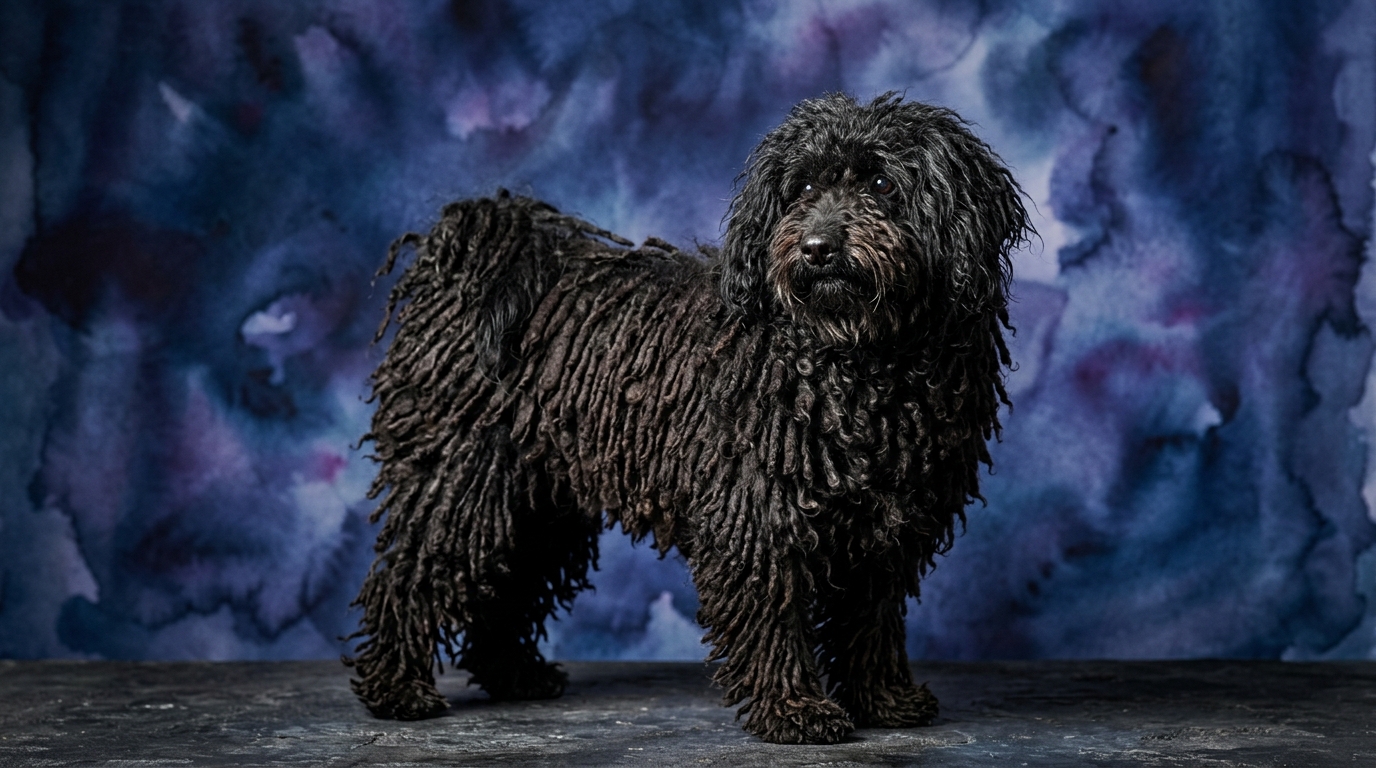

Side-by-Side IQ Profile: Puli vs. English Toy Spaniel
To understand the cognitive nuances of these breeds, The Cosmic Pet Pet IQ Lab employs a five-dimensional framework, allowing us to dissect their mental aptitudes:
**Puli (Herding, Coren rank #25)**
**Problem Solving (4/5)**: This score reflects the Puli's aptitude for independent thought and strategic thinking, vital for a herding dog managing livestock autonomously. They assess novel situations, devise solutions, and adapt approaches to changing circumstances.
**Training Speed (4/5)**: Their quick grasp of commands stems from a historical need to learn and execute complex instructions rapidly. They absorb new information efficiently and generalize learned behaviors to different contexts.
**Social Intelligence (3/5)**: Capable of strong bonds, their social intelligence focuses on understanding handler cues and maintaining group cohesion. They are observant of dynamics but less overtly people-pleasing than some breeds.
**Instinctive Drive (3/5)**: Primarily channeled into working tasks like herding, this isn't unfocused energy but a directed motivation to perform their ancestral role, requiring specific outlets.
**Memory (4/5)**: Excellent memory allows them to recall complex command sequences, familiar territories, and specific behaviors. This is vital for retaining intricate herding patterns and past solutions.
**English Toy Spaniel (Toy, Not Coren-ranked)**
**Problem Solving (3/5)**: Exhibits moderate capacity for problem-solving, navigating everyday challenges and learning cause-and-effect. Less inclined towards complex, multi-step solutions or independent strategizing.
**Training Speed (3/5)**: Learns at a steady pace, mastering basic obedience with consistent positive reinforcement. Their learning curve is predictable, though more repetition may be needed for intricate commands.
**Social Intelligence (3/5)**: Well-developed for a companion, allowing them to read human emotions, respond to subtle cues, and integrate smoothly into family life. They thrive on interaction.
**Instinctive Drive (3/5)**: Primarily centered on companionship and comfort. Their instincts are geared towards staying close to people, seeking affection, and maintaining a peaceful household.
**Memory (3/5)**: Possesses solid memory for routines, familiar faces, and positive experiences. They recall daily schedules and who provides treats, contributing to their adaptability as a pet.
Where the Puli Wins Cognitively
The Puli's cognitive profile distinctly outperforms the English Toy Spaniel in areas demanding independent action and complex learning. Their Problem Solving score of 4/5 means they are naturally adept at analyzing novel situations and formulating solutions without constant human intervention, a trait crucial for autonomous herding. For instance, a Puli might figure out how to open a child-proof gate or retrieve a toy from an inaccessible spot with remarkable ingenuity.
Furthermore, the Puli’s Training Speed of 4/5 signifies rapid acquisition of new commands and efficient generalization of learned behaviors. They are quick to connect actions with consequences and can absorb intricate sequences, making them highly receptive to advanced obedience or dog sports. Paired with their 4/5 Memory, the Puli retains these complex lessons over long periods, allowing for an extensive repertoire of skills. This advantage translates into a dog that not only learns quickly but also remembers what it has learned, making long-term training particularly rewarding. Their Herding background ingrained a need for precise recall and execution, fostering a mental framework for robust learning and retention.
Where the English Toy Spaniel Wins Cognitively
While the English Toy Spaniel may not boast higher numerical scores in individual cognitive dimensions compared to the Puli, its profile represents a distinct "win" in terms of balanced, companion-oriented intelligence. Its consistent 3/5 across all categories indicates a reliable and predictable mental landscape, advantageous for owners seeking moderate, steady cognitive demands. The English Toy Spaniel's intelligence is perfectly calibrated for its role as a devoted companion, excelling in the nuanced art of domestic life.
Specifically, its Social Intelligence (3/5) and Instinctive Drive (3/5), while numerically equal to the Puli's, manifest differently. For the English Toy Spaniel, this drive is almost entirely focused on forming deep attachments and maintaining harmonious human relationships. They are masters of reading subtle human cues and adapting their behavior to family rhythms, without the strong independent problem-solving or working drive that might lead to boredom-induced behaviors in a Puli. Their cognitive strengths lie in their capacity for quiet companionship and an innate ability to be a gentle, unobtrusive presence, making them incredibly intuitive and emotionally attuned pets. This makes them cognitively "winning" for those who prioritize a calm, consistently affectionate, and less mentally demanding presence.
Which is Easier to Train, and Why?
When considering ease of training, the Puli generally presents a more straightforward path for mastering complex tasks due to its superior cognitive attributes. Its Training Speed of 4/5 means it quickly grasps new commands and concepts, requiring fewer repetitions than the English Toy Spaniel. Coupled with a Problem Solving score of 4/5, a Puli is more likely to understand the *why* behind a command, enabling it to generalize behaviors and even troubleshoot. For instance, teaching a Puli a multi-step agility course would likely progress faster, as their memory (4/5) allows for excellent retention of complex sequences. Their ancestral role demanded rapid learning and precise execution, imbuing them with a natural inclination to engage with human instruction purposefully.
In contrast, the English Toy Spaniel, with a Training Speed of 3/5, will learn reliably but at a more moderate pace. While perfectly capable of mastering basic obedience, they may require more consistent repetition for advanced maneuvers. Their Problem Solving at 3/5 suggests they might follow learned patterns rather than independently devising solutions, meaning trainers need to be clearer and more consistent. However, their lower Instinctive Drive (3/5) compared to some working breeds can make them less prone to distractions during training, especially for basic companion manners. They are generally eager to please their beloved people, which, with positive reinforcement, makes them willing, if not always lightning-fast, students for foundational behaviors.
Suitability for Active vs. Relaxed Owners
The Puli is unequivocally better suited for active owners prepared to engage deeply with their dog's mental and physical needs. Their Herding background imbues them with substantial requirements for both physical exercise and, crucially, mental stimulation. An owner who enjoys dog sports like agility, herding trials, or advanced obedience will find the Puli a willing and enthusiastic partner. Their high Problem Solving and Training Speed mean they thrive on challenges and can become bored or destructive if their active minds are not adequately stimulated. An active owner understands that "active" extends beyond physical exertion to consistent cognitive engagement, providing outlets for the Puli's strong learning and working drives.
Conversely, the English Toy Spaniel is an ideal match for relaxed owners seeking a devoted, low-key companion. Their moderate scores across the board, particularly their more subdued Instinctive Drive (3/5), mean they are content with a less demanding routine. While they still enjoy short, regular walks and playtime, their primary joy comes from close companionship and being an integral part of family life. They do not possess the inherent working drive that necessitates constant complex tasks, making them suitable for individuals or families who prefer quiet evenings and gentle interactions over high-octane activities. A relaxed owner for an English Toy Spaniel prioritizes affection, a calm home, and a dog whose cognitive and physical needs align with a more leisurely pace of life.
The Verdict
Choose a Puli if you are an experienced, active owner seeking a highly trainable, problem-solving partner for dog sports, advanced training, or a working role.
Opt for an English Toy Spaniel if you desire a gentle, consistent, and devoted companion whose primary cognitive need is to be a loving presence in a relaxed home.
🧠 Find Your Pet's IQ Score
Our Pet IQ Lab assessment covers 25+ tests across 5 cognitive dimensions — personalized to your breed.
Take the Full IQ Test →Frequently Asked Questions
Do Pulis need a lot of mental stimulation?
Absolutely. With a Problem Solving and Memory score of 4/5, Pulis thrive on mental challenges, puzzles, and learning new commands. Without sufficient mental engagement, they can become bored and potentially develop undesirable behaviors.
Are English Toy Spaniels good for first-time dog owners?
Yes, their consistent and moderate cognitive profile, coupled with their strong desire for companionship, makes them an excellent choice. They are generally adaptable and less demanding in terms of training complexity or intense exercise needs.
Can an English Toy Spaniel learn tricks like a Puli?
While an English Toy Spaniel can certainly learn many tricks, their Training Speed (3/5) means they may take longer to master complex sequences than a Puli (4/5). Consistency and positive reinforcement are key to their learning success.