
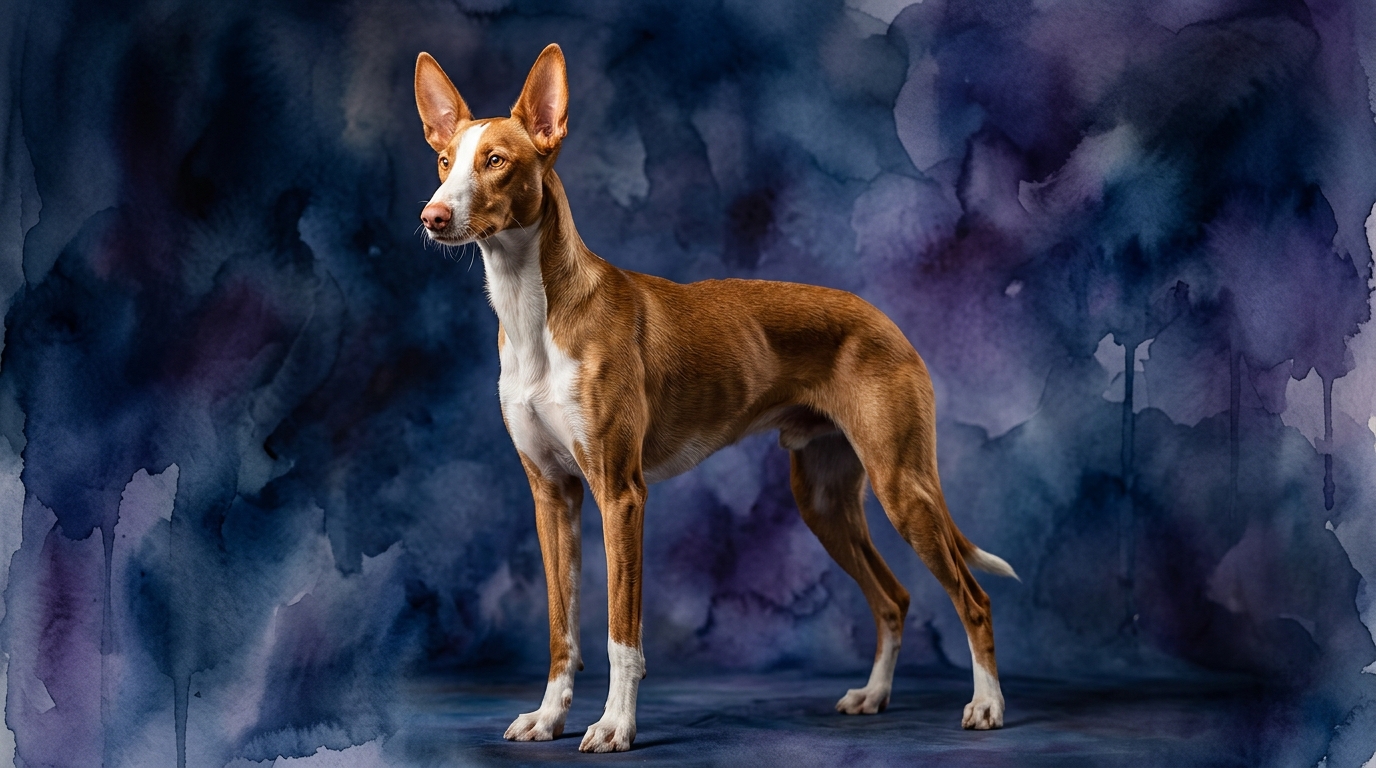
Side-by-Side Cognitive Profile: Rhodesian Ridgeback vs. Ibizan Hound
At The Cosmic Pet Pet IQ Lab, we evaluate canine intelligence across five key dimensions, each scored on a scale of 1 to 5. Interestingly, both the Rhodesian Ridgeback and the Ibizan Hound register a consistent 3/5 across all categories, suggesting a foundational level of cognitive ability that is competent yet not extraordinary in any single aspect. However, the *application* of these capacities varies significantly between the two breeds, reflecting their divergent evolutionary paths.
For Problem Solving (3/5): The Rhodesian Ridgeback approaches challenges with a methodical, often independent mindset. Their ancestral role in confronting dangerous game fostered a capacity for sustained focus and strategic thinking, enabling them to evaluate situations and devise solutions to physical obstacles or complex tracking tasks. This isn't about lightning-fast reactions, but rather a deliberate, persistent effort to achieve a goal. The Ibizan Hound, conversely, exhibits a reactive and agile problem-solving style, honed by generations of hunting swift, elusive prey. Their cognitive strength lies in rapidly assessing dynamic environments, instantly calculating trajectories, and making split-second decisions to intercept moving targets. Their solutions are often immediate and physically expressive, focused on efficiency in pursuit.
Regarding Training Speed (3/5): Rhodesian Ridgebacks are capable learners, quickly grasping new commands and routines when properly motivated. However, their independent nature means they can be selective about when and if they comply, often requiring a trainer who can inspire cooperation rather than simply demand obedience. Repetitive, uninspired drills may lead to disinterest or a desire to find their own 'better' way. Ibizan Hounds also possess a respectable training speed, understanding concepts readily. Their sensitivity, however, means they thrive on positive reinforcement and can become easily distracted or shut down by harsh methods. Their sighthound instincts often mean that while they learn a command, executing it flawlessly in the presence of tempting stimuli can be a significant challenge.
In Social Intelligence (3/5): The Rhodesian Ridgeback demonstrates a discerning understanding of their human family's emotions and social structures, forming deep, protective bonds. They are often reserved with strangers, indicating a careful assessment of new individuals rather than a lack of social acumen. This protective instinct is a manifestation of their ability to differentiate between welcomed family and potential outsiders. The Ibizan Hound, too, possesses a keen social awareness, being highly attuned to the moods and subtle cues of their human companions. They are affectionate and gentle within their trusted circle, expressing their social intelligence through close companionship and a desire for harmonious interaction. Their reserved demeanor with unfamiliar people is usually a trait of cautious observation, not aloofness.
Their Instinctive Drive (3/5) is a defining characteristic for both. The Rhodesian Ridgeback carries a strong prey drive and a profound territorial instinct, stemming from their heritage as guardians and hunters of formidable quarry. This translates into an inherent vigilance and a readiness to engage with perceived threats or challenges, requiring consistent management. The Ibizan Hound's instinctive drive is overwhelmingly dominated by its sighthound prey drive. The sight of anything moving quickly—be it a squirrel, a leaf, or a distant dog—can trigger an immediate, intense, and often unstoppable desire to chase. This deeply ingrained instinct is a primary consideration for their owners, necessitating secure environments and diligent leash work.
Finally, for Memory (3/5): Both breeds exhibit good retention. Rhodesian Ridgebacks possess a solid memory for past experiences, learned commands, and established routines, particularly if those memories are associated with strong emotional experiences or consistent reinforcement. They tend not to forget a person who has wronged them or a location where an exciting event occurred. Ibizan Hounds also demonstrate good memory, easily recalling training cues, the layout of familiar places, and the habits of their human family, especially when lessons are presented with engaging methods. They remember where the best sunbeams are and where the treat jar resides.
Where the Rhodesian Ridgeback's Cognition Shines
The Rhodesian Ridgeback's cognitive strengths particularly shine in scenarios demanding independent judgment and sustained focus under varied conditions. Their ancestral role in tracking and holding dangerous game required them to assess complex situations, make decisions without direct human command, and maintain a high level of vigilance. This translates into a capacity for thoughtful problem-solving in novel environments, where they might methodically investigate or strategize rather than react impulsively. Their social intelligence, while reserved, also equips them with a discerning ability to differentiate friend from foe, making them adept at understanding nuanced social cues within their family unit and acting as a protective presence.
Where the Ibizan Hound's Cognition Excels
The Ibizan Hound's cognitive prowess is most evident in tasks requiring lightning-fast reflexes and acute sensory processing. Bred to hunt swift, elusive prey, they excel at rapidly analyzing visual information and executing complex physical maneuvers based on real-time observations. This gives them an edge in activities that demand quick, reactive problem-solving, such as navigating agility courses or engaging in lure coursing where split-second decisions dictate success. Their keen observational skills also contribute to a nuanced understanding of their environment, allowing them to spot subtle changes or movements that others might miss, making them incredibly aware of their surroundings.
Training Dynamics: Which is 'Easier'?
While both breeds score 3/5 in training speed, their inherent behavioral traits dictate very different training experiences. The Rhodesian Ridgeback, with their independent streak and strong will, often requires a handler who can establish clear, consistent leadership and make training feel like a collaborative effort rather than a series of commands. They thrive on motivation and purpose, and can become stubborn if they perceive a task as pointless or if they feel their intelligence is being underestimated. This can make them challenging for those accustomed to more biddable breeds, but incredibly rewarding for an owner who appreciates a thinking partner.
The Ibizan Hound, conversely, is often described as sensitive and can be easily bored by repetition. Their powerful prey drive means that even a well-trained Ibizan might 'selectively hear' commands if a squirrel darts across their path. Training them requires patience, creativity, and a reliance on positive reinforcement to keep them engaged. Harsh corrections can cause them to shut down. Owners might find their training 'easier' in terms of their gentle nature and willingness to please, but 'harder' in terms of maintaining focus and managing their innate chase instinct in real-world scenarios. Ultimately, neither is universally 'easy'; success depends on the owner's understanding of the breed's unique motivations and sensitivities.
Matching Lifestyles: Active vs. Relaxed Owners
Both the Rhodesian Ridgeback and the Ibizan Hound are athletic breeds requiring significant physical outlets, making them best suited for active owners. However, the *type* of activity and their indoor demeanor present distinct matches. The Rhodesian Ridgeback thrives with an owner who provides vigorous daily exercise, such as long runs, hiking, or structured dog sports, coupled with mental challenges to satisfy their problem-solving mind. After sufficient activity, they transition into calm, relaxed house companions, often enjoying quiet time with their family. They are not suited for owners who cannot commit to substantial daily exercise and mental engagement.
The Ibizan Hound also requires significant physical outlet, particularly opportunities to sprint and stretch their agile bodies in a secure area. They are an excellent fit for owners who enjoy activities like lure coursing, trail running, or long walks in fenced areas where their prey drive can be safely indulged. Despite their athleticism, Ibizans are known for being quiet, clean, and elegant house dogs once their exercise needs are met, often enjoying lounging on soft surfaces. They are less suited for owners who expect a constant companion for intense, structured work, but perfect for those who appreciate bursts of speed followed by serene companionship.
The Verdict
Choose the Rhodesian Ridgeback if you seek a discerning, protective companion capable of independent thought, a dog that enjoys active outdoor adventures and then settles into a calm, watchful presence at home with consistent leadership.
Opt for the Ibizan Hound if you appreciate a graceful, sensitive partner with incredible speed and agility, thriving on positive interaction and needing safe spaces to unleash their powerful sighthound instincts before enjoying quiet companionship indoors.
🧠 Find Your Pet's IQ Score
Our Pet IQ Lab assessment covers 25+ tests across 5 cognitive dimensions — personalized to your breed.
Take the Full IQ Test →Frequently Asked Questions
Are Rhodesian Ridgebacks good with children?
With proper socialization from a young age, Rhodesian Ridgebacks can be loyal and protective family members. Their size and strength mean supervision is always wise with very young children, but they often form strong, gentle bonds.
Do Ibizan Hounds need a lot of grooming?
Ibizan Hounds are relatively low-maintenance when it comes to grooming. Their short, smooth coat requires minimal brushing, usually just once a week, and occasional bathing to keep them clean and healthy.
Which breed is more prone to separation anxiety?
Both breeds can develop separation anxiety if not properly conditioned or if left alone for excessive periods. Rhodesian Ridgebacks, due to their strong bonds, can become destructive. Ibizan Hounds, being sensitive and companionship-oriented, can also suffer, often expressing it through vocalizations or destructive chewing.