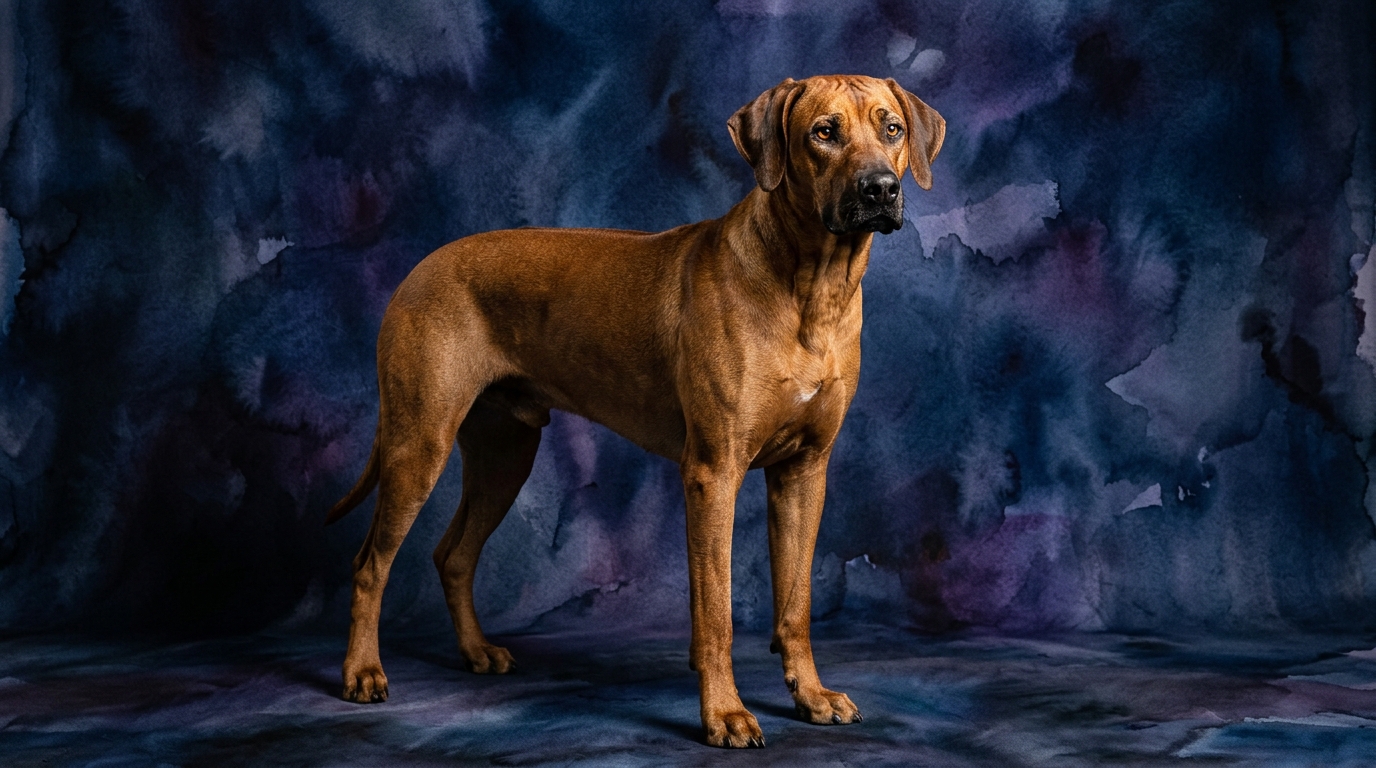

Side-by-Side Cognitive Profile: Ridgeback vs. IWS
The Rhodesian Ridgeback, ranking 52nd in Coren's intelligence scale, exhibits a balanced yet distinct cognitive makeup. Their Problem Solving is rated 3/5, indicating a moderate capacity for independent thought and figuring out novel situations, often relying on keen senses over intricate strategizing. Training Speed also stands at 3/5, meaning they learn new commands at a moderate pace, requiring consistent and patient repetition due to their independent streak. Social Intelligence is 3/5, showing a moderate understanding of human cues and forming strong family bonds, though they can be reserved with strangers. Their Instinctive Drive, also 3/5, manifests as a potent prey drive for tracking and pursuit, requiring appropriate outlets. Finally, Memory at 3/5 suggests moderate retention of learned commands and experiences, making consistent reinforcement key.
In contrast, the Irish Water Spaniel, positioned significantly higher at 24th on Coren's scale, presents a different cognitive landscape. Their Problem Solving capability is a robust 4/5, demonstrating a strong aptitude for analyzing and resolving new challenges, often with creative solutions. Training Speed is equally impressive at 4/5, allowing them to absorb new commands with swiftness, often after only a few repetitions, fueled by an eagerness to please. Social Intelligence is 3/5, similar to the Ridgeback, connecting well with family and displaying a playful demeanor, though their energetic nature sometimes requires guidance. Instinctive Drive is 3/5, but specifically geared towards retrieving and water work, characteristic of their sporting heritage. Memory is a strong 4/5, indicating robust retention of learned behaviors and experiences over time, making skills deeply ingrained.
Where the Rhodesian Ridgeback Shines Cognitively
While the Irish Water Spaniel generally scores higher in several cognitive dimensions, the Rhodesian Ridgeback's unique blend of traits confers distinct advantages, particularly in scenarios demanding independent vigilance. Their Problem Solving (3/5) and Instinctive Drive (3/5), combined with a more reserved Social Intelligence (3/5), make them exceptional at self-reliant, sentinel-like tasks. Unlike breeds that might constantly seek human direction, Ridgebacks can assess situations and act with a degree of self-sufficiency, a trait honed by their ancestral role in tracking dangerous game. This independence means they can excel in scenarios requiring sustained focus and decision-making without immediate handler input, such such as patrolling boundaries or tracking scents over long distances. Their moderate memory (3/5), while not top-tier, is sufficient for retaining critical safety protocols and territorial awareness, allowing them to remain vigilant and responsive to familiar threats or changes in their environment. Their cognitive 'win' lies in this balanced independence, making them less prone to over-reliance on human cues in critical, self-directed situations where immediate, nuanced action is paramount, offering a unique type of companionship that values observant loyalty.
Where the Irish Water Spaniel Excels Cognitively
The Irish Water Spaniel clearly distinguishes itself through its superior Problem Solving (4/5), Training Speed (4/5), and Memory (4/5). These combined attributes lead to a dog that not only grasps new concepts rapidly but also applies them creatively to novel situations and retains that knowledge long-term. This breed's quick cognitive processing allows them to learn complex sequences of commands with remarkable efficiency, making them adept at advanced obedience, agility, and intricate retrieving tasks. Their exceptional memory ensures that once a skill is acquired, it is deeply ingrained, requiring less frequent refreshers than many other breeds. Furthermore, their problem-solving acumen means they don't just follow instructions; they can understand the objective and often devise the most efficient way to achieve it, particularly evident in challenging retrieving scenarios where quick thinking and adaptability are crucial. This makes them highly adaptable and capable partners in varied working and sporting contexts, consistently demonstrating a capacity for sophisticated learning and application.
Ease of Training: A Comparative Look
Based on their respective cognitive profiles, the Irish Water Spaniel is demonstrably easier to train than the Rhodesian Ridgeback for most owners. The IWS boasts a Training Speed of 4/5 and Memory of 4/5, indicating a rapid acquisition of new commands and excellent long-term retention. Their strong Problem Solving (4/5) further enhances this, as they can understand the 'why' behind a command and apply it flexibly to various situations. This means fewer repetitions are needed for an IWS to master a new behavior, and they are less likely to 'forget' it over time. Their inherent eagerness to engage and playful nature often translate into a more enthusiastic and cooperative training partner, making the process smoother and more rewarding for both parties.
In contrast, the Rhodesian Ridgeback's Training Speed (3/5) and Memory (3/5) suggest a more moderate learning curve, requiring greater patience and consistency from the trainer. Their inherent independent nature, a hallmark of many hound breeds, means they might deliberate or prioritize their own instincts over immediate compliance, especially if not adequately motivated. Training a Ridgeback often involves more effort in building a strong working relationship and finding high-value rewards to maintain their focus. While capable learners, their journey to proficiency typically demands a more experienced handler or a first-time owner deeply committed to consistent, positive reinforcement and understanding breed-specific motivations.
Matching Breeds to Lifestyles: Active vs. Relaxed Owners
The cognitive and inherent drives of these breeds dictate different lifestyle fits. The Irish Water Spaniel, with its robust Problem Solving (4/5), Training Speed (4/5), and a moderate Instinctive Drive (3/5) geared towards retrieving and water work, thrives with active owners who can provide consistent mental and physical engagement. Their need for intellectual stimulation and a purpose makes them ideal for individuals or families interested in dog sports like agility, obedience, dock diving, or field trials. These activities not only burn off physical energy but also satisfy their keen minds. A relaxed owner might find the IWS's inherent energy and cognitive needs overwhelming, potentially leading to boredom-induced behaviors if not adequately stimulated.
Conversely, the Rhodesian Ridgeback, with its moderate Problem Solving (3/5), Training Speed (3/5), and a more generalized Instinctive Drive (3/5) focused on tracking and patrolling, suits owners who appreciate a dignified companion capable of sustained activity but also content with periods of calm. While they require regular exercise to maintain physical condition and mental well-being, their intelligence profile suggests they can be more selective in their engagement and do not necessarily demand constant, high-intensity mental tasks. They are well-suited for owners who enjoy long walks, hiking, or jogging, and who can provide clear boundaries and a consistent routine, rather than constant novel challenges. A relaxed owner who values a loyal, observant presence might find a good match, provided they commit to fundamental exercise and consistent behavioral guidance, understanding that while not constantly seeking engagement, they possess a strong, independent will.
The Verdict
Choose the Rhodesian Ridgeback if you seek a self-reliant, dignified companion capable of independent thought and sustained vigilance, valuing a strong, observant presence that thrives with consistent guidance and ample physical outlets but doesn't require constant, intricate mental tasks.
Opt for the Irish Water Spaniel if you desire an eager, highly trainable partner who excels at complex tasks, learns rapidly, and retains information effectively, ideal for active individuals keen on dog sports or engaging in consistent, stimulating activities.
🧠 Find Your Pet's IQ Score
Our Pet IQ Lab assessment covers 25+ tests across 5 cognitive dimensions — personalized to your breed.
Take the Full IQ Test →Frequently Asked Questions
Is a Rhodesian Ridgeback difficult to train for a first-time dog owner?
A Rhodesian Ridgeback presents a moderate challenge for a first-time owner due to their 3/5 Training Speed and independent nature. Success requires commitment to consistent, positive reinforcement training, clear communication, and understanding their need for strong leadership and socialization from an early age. Their problem-solving capacity means they will test boundaries, necessitating an owner who can remain patient and firm.
What specific activities best engage an Irish Water Spaniel's cognitive strengths?
An Irish Water Spaniel's 4/5 Problem Solving and 4/5 Memory make them excel in activities requiring quick thinking and retention. Dog sports like agility, competitive obedience, dock diving, and field retrieving trials are excellent choices. Puzzle toys, scent work, and learning complex trick sequences also provide stimulating outlets for their sharp minds and eagerness to engage.
How does the instinctive drive differ between these two breeds in practical terms?
Both breeds have a 3/5 instinctive drive, but its manifestation differs. The Rhodesian Ridgeback's drive is rooted in tracking and pursuit, leading to a strong inclination to follow scents and patrol, requiring secure containment and leash training. The Irish Water Spaniel's drive is centered on retrieving and water work, making them natural candidates for fetch games, swimming, and carrying objects, often with an inherent desire to work cooperatively with a handler in these tasks.