
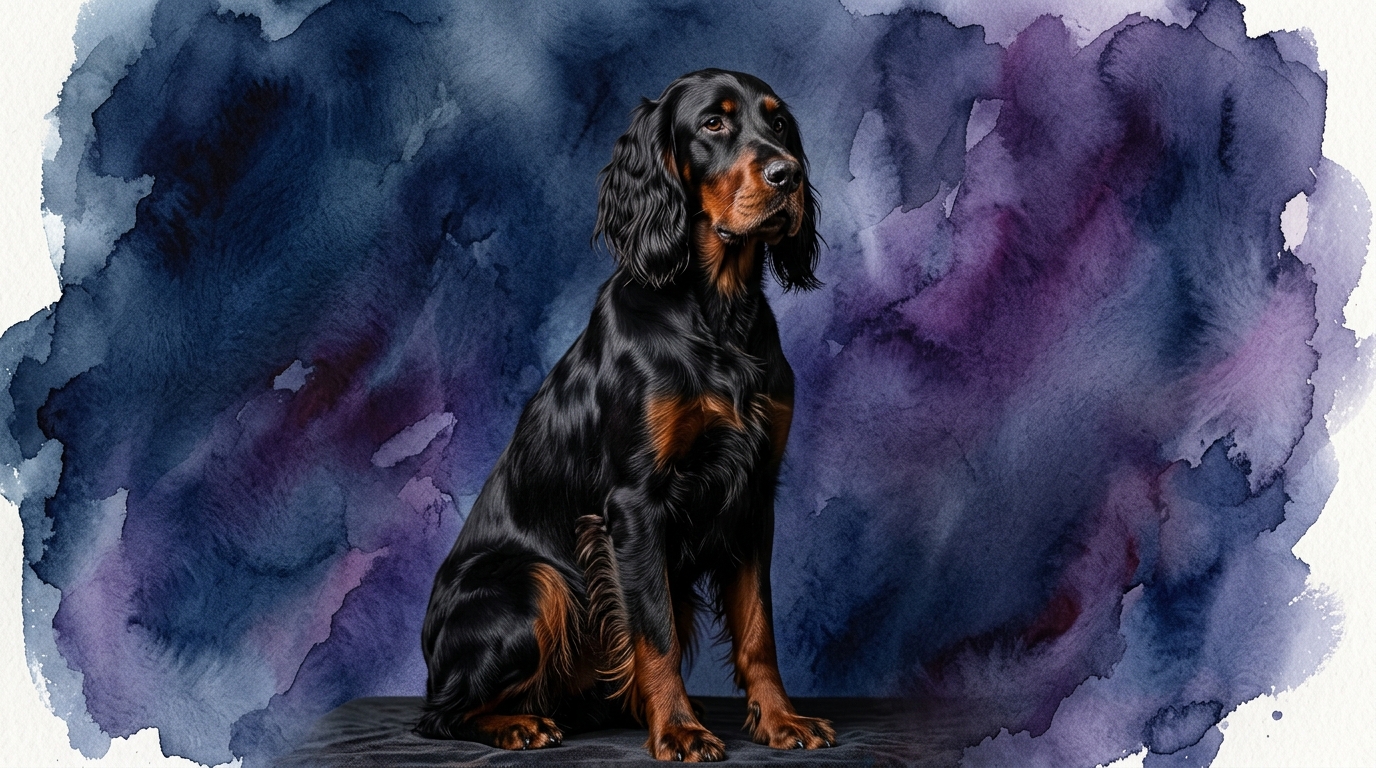
Side-by-Side IQ Profile: Rottweiler vs. Gordon Setter
At The Cosmic Pet Pet IQ Lab, we evaluate canine intelligence across five key dimensions. The Rottweiler, a Working group breed with a Coren ranking of #9, presents a strong cognitive profile, while the Gordon Setter, from the Sporting group and ranked #39 by Coren, demonstrates a distinct set of mental aptitudes.
For Problem Solving, the Rottweiler scores an exceptional 5/5, indicating a profound capacity to analyze and independently resolve complex situations, often demonstrating strategic thought. The Gordon Setter earns a commendable 4/5, showing strong abilities to navigate new puzzles and adapt to unfamiliar environments, though they might approach solutions with a slightly more exploratory style.
In Training Speed, both breeds achieve a solid 4/5. The Rottweiler’s focused nature and willingness to engage with tasks often result in quick acquisition of new commands. Similarly, the Gordon Setter’s eagerness to please and observational learning skills facilitate efficient uptake of new behaviors, particularly when aligned with their natural instincts.
Social Intelligence sees the Rottweiler at 4/5, reflecting their robust ability to interpret human cues, understand social hierarchies, and form deep, protective bonds. The Gordon Setter, with a 3/5 in social intelligence, forms affectionate connections within their family but may be slightly less attuned to subtle human emotional states or complex social dynamics compared to the Rottweiler.
Instinctive Drive is a standout for the Rottweiler at 5/5, showcasing a powerful, focused drive rooted in their heritage as guardians and drovers, manifesting as strong protective urges and a profound work ethic. The Gordon Setter’s instinctive drive is rated 3/5, primarily centered on their bird-hunting origins, displaying a keen desire for scenting, pointing, and retrieving, but generally with less intensity and broader application than the Rottweiler’s drives.
Finally, Memory is a Rottweiler strength at 5/5, indicating an exceptional ability to retain learned commands, routines, and experiences over extensive periods, contributing to their reliability. The Gordon Setter earns a 4/5, exhibiting good recall for commands and past events, though perhaps with a slightly shorter retention for less frequently reinforced information than the Rottweiler.
Where the Rottweiler Excels Cognitively
The Rottweiler’s cognitive advantages are particularly pronounced in their problem-solving prowess and memory, both rated 5/5. This breed can independently assess and devise solutions for intricate scenarios, such as figuring out how to bypass a complex barrier or navigating an unfamiliar route with minimal handler intervention, showcasing a remarkable capacity for strategic thinking. Their superior memory means that once a behavior is learned or a boundary is established, it is deeply ingrained, leading to consistently reliable and predictable conduct over extended periods. This makes them exceptionally effective in roles demanding consistent application of extensive learned skills, such as advanced obedience, protection work, or service dog tasks where retaining a vast repertoire of commands is crucial for safety and efficacy. Furthermore, their 5/5 instinctive drive, coupled with strong social intelligence, ensures their drive is not just powerful but also purposefully directed, aligning with their human companion's intentions. For example, a Rottweiler might not just follow a scent but actively strategize the most efficient path to its source, drawing upon past successful and unsuccessful attempts in similar contexts.
Where the Gordon Setter Demonstrates Unique Strengths
While the Rottweiler presents a formidable overall cognitive profile, the Gordon Setter possesses distinct strengths, particularly within the specialized nuances of their sporting heritage. Their 4/5 problem-solving ability, paired with a 4/5 training speed, means they are quick to grasp new concepts and adapt effectively to novel situations, whether it's a new agility course or a changing hunting environment. Unlike the Rottweiler's broad, protective drives, the Gordon Setter’s instinctive drive, while rated 3/5, is exquisitely tuned for specific tasks: scenting, pointing, and retrieving game. This specialized cognitive focus allows them to excel in activities that leverage these natural predispositions, demonstrating a precision and dedication in their field work that is unique. They may not exhibit the same generalized strategic problem-solving as a Rottweiler, but within their specific domain, they show remarkable ingenuity in tracking a challenging scent or flushing game from dense cover. Their solid 4/5 memory ensures they recall specific hunting grounds, familiar game trails, and successful retrieval strategies, making them highly effective companions for active outdoor pursuits where focused sensory work is paramount, rather than broad, abstract problem-solving.
Training Dynamics: Which Breed is More Amenable?
Both Rottweilers and Gordon Setters share a 4/5 training speed, indicating comparable rates of learning new commands. However, the perceived 'ease' of training can diverge based on their deeper cognitive profiles and primary motivators. The Rottweiler’s 5/5 instinctive drive and 4/5 social intelligence typically translate into a strong desire to engage with their handler and a clear understanding of their place within a family 'pack,' making them highly receptive to structured training. Their exceptional memory (5/5) means that once a lesson is effectively taught, it tends to persist, requiring less frequent reinforcement over time. Their robust problem-solving (5/5) also enables them to generalize learned behaviors across various new contexts more readily. In contrast, while the Gordon Setter also learns quickly, their slightly lower social intelligence (3/5) and instinctive drive (3/5) suggest their motivations might be more internally driven by scent or prey impulses rather than a constant desire for human affirmation or the understanding of complex social cues. This does not imply difficulty, but their focus can be more easily diverted by environmental stimuli, particularly compelling scents, necessitating trainers to be more engaging and consistent in redirecting their attention. For example, a Rottweiler is more likely to steadfastly ignore distractions to complete a task for their handler, whereas a Gordon Setter might be momentarily captivated by a passing bird scent, requiring more nuanced motivational techniques to maintain sustained focus. Consequently, while both learn rapidly, the Rottweiler often presents as more straightforward to train across a broader spectrum of situations due to their strong work ethic, memory retention, and directed focus on their human companion.
Matching Breeds to Lifestyles: Active vs. Relaxed Owners
The decision between these two breeds significantly hinges on an owner's lifestyle and commitment level. The Rottweiler, with its 5/5 instinctive drive, 5/5 problem-solving, and 5/5 memory, thrives with active, experienced, and engaged owners who can consistently provide substantial mental and physical challenges. They are not suited for relaxed, sedentary lifestyles, as their powerful drives and profound need for purpose can manifest as boredom and destructive behaviors if not adequately channeled into constructive outlets. They excel in activities like advanced obedience, protection sports, herding, or even search and rescue, demanding an owner willing to dedicate significant time and effort to consistent training and structured activity. Conversely, the Gordon Setter, with its 3/5 instinctive drive and 4/5 problem-solving, is an excellent match for active owners who enjoy outdoor pursuits but might not require the intense, highly structured 'work' that a Rottweiler demands. Their sporting background means they relish long walks, hikes, and especially activities involving scent work or retrieving. While they certainly require regular exercise to remain content and well-adjusted, their drives are generally less all-encompassing than the Rottweiler's, making them suitable for owners who appreciate an active companion but perhaps don't need a dog with a constant, demanding 'job.' A truly relaxed or sedentary owner, however, would likely struggle to meet the exercise and mental stimulation needs of either breed, but the Gordon Setter would be marginally more adaptable to a less rigorous, though still active, daily routine compared to the Rottweiler's profound need for purposeful engagement and consistent mental exertion.
The Verdict
Opt for a Rottweiler if you are an experienced, active owner seeking a highly trainable, focused companion for protection, advanced obedience, or a demanding working role, valuing their exceptional memory and problem-solving.
Select a Gordon Setter if you are an active individual or family who enjoys outdoor activities like hiking or field work, appreciating a keen, affectionate companion with a strong desire to please and a moderate, focused drive.
🧠 Find Your Pet's IQ Score
Our Pet IQ Lab assessment covers 25+ tests across 5 cognitive dimensions — personalized to your breed.
Take the Full IQ Test →Frequently Asked Questions
Do Rottweilers require more mental stimulation than Gordon Setters?
Yes, Rottweilers typically require more intensive and varied mental stimulation due to their 5/5 problem-solving and 5/5 instinctive drive. They thrive on complex tasks and consistent training to keep their minds engaged, whereas Gordon Setters, while still needing stimulation, often find fulfillment in activities aligned with their specific sporting instincts.
Which breed is better with children, considering their social intelligence?
The Rottweiler's 4/5 social intelligence, combined with their protective instincts, means they can be excellent family guardians when properly socialized and trained. The Gordon Setter's 3/5 social intelligence indicates they are affectionate with their family but may be less instinctively attuned to subtle child behaviors, requiring careful supervision and teaching children how to interact respectfully.
How do their different instinctive drives impact their suitability as family pets?
The Rottweiler's 5/5 instinctive drive translates to a strong need for purpose and clear leadership, making them devoted but demanding family members who thrive with structure. The Gordon Setter's 3/5 instinctive drive means they are generally more laid-back in a home environment once their exercise needs are met, less driven by a constant 'job,' and often more content with play and companionship.