
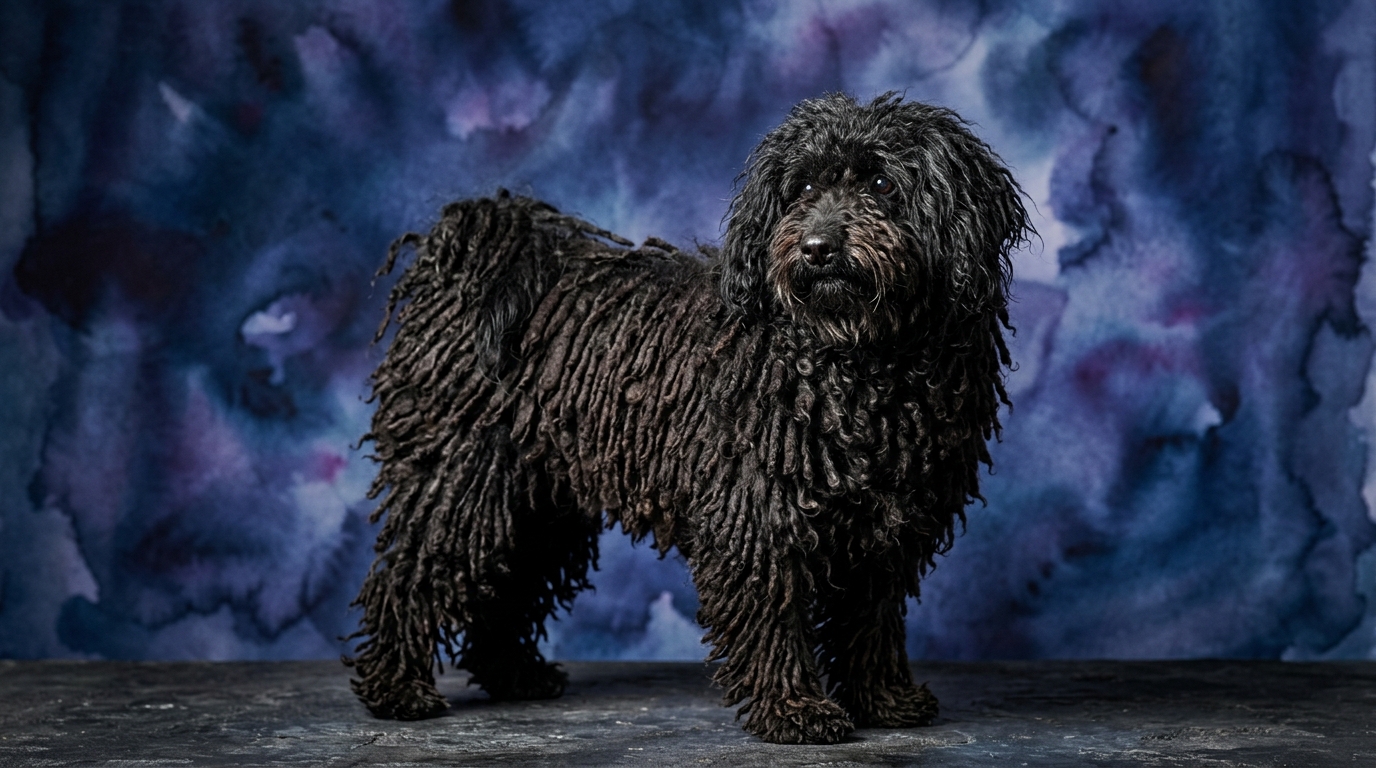
Side-by-Side IQ Profile: Rottweiler vs. Puli
The Cosmic Pet Pet IQ Lab employs a multi-faceted approach to evaluating canine intelligence, looking beyond mere obedience to encompass problem-solving, training speed, social intelligence, instinctive drive, and memory. For the Rottweiler, a Working breed, its Coren rank of #9 places it among the top echelons of canine cognition. Its profile shows exceptional problem-solving (5/5), strong training speed (4/5), robust social intelligence (4/5), a powerful instinctive drive (5/5), and an outstanding memory (5/5). This combination paints a picture of a dog that is not only capable of understanding complex commands but also highly motivated by purpose and deeply attuned to its environment and human companions.
In contrast, the Puli, a Herding breed, holds a respectable Coren rank of #25, reflecting a different, but equally functional, set of cognitive strengths. The Puli demonstrates strong problem-solving abilities (4/5), an equally impressive training speed (4/5), a solid social intelligence (3/5), a moderate instinctive drive (3/5), and a good memory (4/5). This profile suggests an agile, responsive thinker, adept at independent decision-making within dynamic situations, though perhaps with a more focused social scope and a less overwhelming drive compared to the Rottweiler.
Where the Rottweiler Wins Cognitively
The Rottweiler clearly distinguishes itself in two critical cognitive dimensions: problem-solving and memory, both rated at an exceptional 5/5. Their superior problem-solving acumen means they don't just follow instructions; they often analyze situations and strategize, particularly in scenarios demanding protection or complex task execution. This cognitive flexibility allows them to adapt rapidly to novel challenges, often finding efficient solutions where other breeds might falter. Furthermore, their perfect memory score indicates an extraordinary capacity to recall vast amounts of information, from intricate training sequences to specific environmental details and past experiences. This robust memory underpins their reliability and consistency, making them highly predictable once a behavior is established or a lesson learned. Their slightly higher social intelligence (4/5 vs. Puli's 3/5) also grants them a more nuanced understanding of human emotional states and social cues, fostering a deeper, more empathetic connection with their primary caregivers and a greater capacity to navigate complex social interactions.
Where the Puli Wins Cognitively
While the Puli's individual scores might not reach the Rottweiler's peaks, their cognitive profile is perfectly tailored for their historical role, showcasing a particular elegance in their problem-solving and training speed (both 4/5). Their problem-solving abilities are finely tuned for dynamic situations, such as maneuvering livestock, where quick, independent decisions are paramount for managing a shifting 'flock.' This doesn't necessarily mean devising complex strategies for abstract puzzles, but rather an agile, responsive intelligence in real-time scenarios. Their strong training speed, matching the Rottweiler's 4/5, demonstrates a keen readiness to learn and execute commands, particularly when those commands align with their natural drives. The Puli's cognitive strengths lie in their practical application of intelligence within a specific, fast-paced context, where their adaptability allows them to excel without needing the same depth of social nuance or intense drive as a guarding breed. Their memory, also a strong 4/5, ensures they retain the patterns and movements essential for effective herding over time, making them consistent in their learned tasks.
Ease of Training: Behavioral Differences
On paper, both the Rottweiler and the Puli share an impressive training speed of 4/5, suggesting a similar capacity to grasp new commands and concepts quickly. However, the *ease* of training can diverge significantly due to their distinct instinctive drives and social intelligence. The Rottweiler's powerful instinctive drive (5/5) means they are inherently motivated by purpose and work. When training taps into their natural desire to guard, protect, or perform tasks alongside their human, they become exceptionally focused and eager learners. Their higher social intelligence (4/5) also makes them highly attuned to their trainer's intentions and emotional state, often striving to please and forming a deep working partnership. Conversely, while the Puli also learns quickly, their training can be influenced by their independent herding temperament. Their instinctive drive (3/5) is geared towards managing and organizing, which can sometimes manifest as a 'my way' attitude if they perceive their own strategy as more efficient. This requires a trainer to be more creative, patient, and engaging, often needing to 'sell' the command as beneficial or interesting to the Puli's independent spirit, whereas a Rottweiler might be more intrinsically motivated by the bond and the task itself.
Matching Breeds to Lifestyles: Active vs. Relaxed Owners
The choice between a Rottweiler and a Puli for active versus relaxed owners hinges on their distinct cognitive needs and energy outputs. A Rottweiler, with its perfect 5/5 instinctive drive and problem-solving, thrives with active owners who can provide consistent mental and physical challenges. These dogs require structured work, advanced obedience, protection sports, or a 'job' that engages their formidable intellect and strong will. A relaxed owner who cannot fulfill this need for purpose and mental stimulation risks a bored Rottweiler, which can lead to destructive behaviors or an overzealous application of their guarding instincts in inappropriate situations. Their deep memory also means that early lessons, both good and bad, are profoundly ingrained. The Puli, while certainly an active breed with a 4/5 in problem-solving and training speed, suits owners who are active but perhaps seek a different type of engagement. Their herding drive (3/5) requires outlets like agility, herding trials, or long, interesting walks that allow them to 'manage' their environment. While they benefit from mental stimulation, their independent nature means they might be content with less intense, but still regular, activity compared to the Rottweiler's constant need for a 'mission.' A Puli might tolerate a more relaxed day if it's interspersed with interesting mental puzzles or opportunities to observe and 'organize,' whereas a Rottweiler truly needs to be actively engaged in a task or learning process to be content.
The Verdict
Choose a Rottweiler if you are an experienced, active owner ready to commit to consistent, purpose-driven training and provide ample mental and physical challenges for a deeply loyal and protective companion.
Opt for a Puli if you appreciate an independent, agile thinker who enjoys active engagement in activities like herding or agility, and you are prepared to engage their cleverness with patience and creativity.
🧠 Find Your Pet's IQ Score
Our Pet IQ Lab assessment covers 25+ tests across 5 cognitive dimensions — personalized to your breed.
Take the Full IQ Test →Frequently Asked Questions
How does a Rottweiler's superior memory influence its behavior and training?
A Rottweiler's 5/5 memory means they retain lessons, routines, and experiences for a lifetime, making early socialization and consistent training crucial. Both positive and negative associations become deeply ingrained, so positive reinforcement and clear boundaries are essential for shaping a well-adjusted temperament.
What kind of problem-solving tasks would a Puli excel at compared to a Rottweiler?
A Puli's 4/5 problem-solving shines in dynamic, real-time scenarios requiring quick judgment, like navigating an agility course or subtly redirecting livestock. While a Rottweiler might excel at complex obedience chains or strategic guarding, the Puli's strength lies in adaptable, on-the-fly decision-making in fluid environments.
Given their similar training speeds, what makes one breed potentially easier to train for a novice owner?
While both learn quickly, a Rottweiler's strong desire to please and higher social intelligence can make them more straightforward for a novice, provided the owner is consistent and firm. A Puli's independence and lower social intelligence might require a more creative, patient approach from a novice to maintain engagement and ensure compliance.