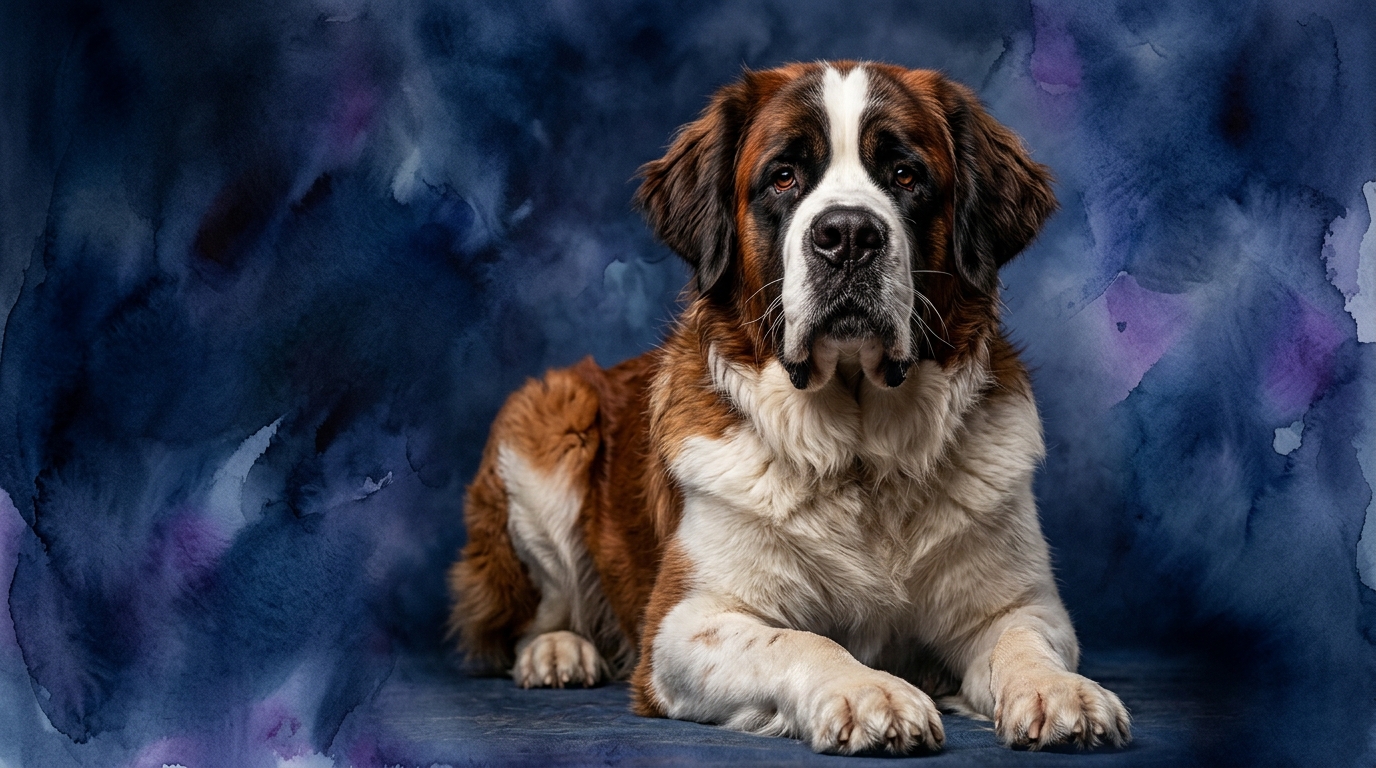
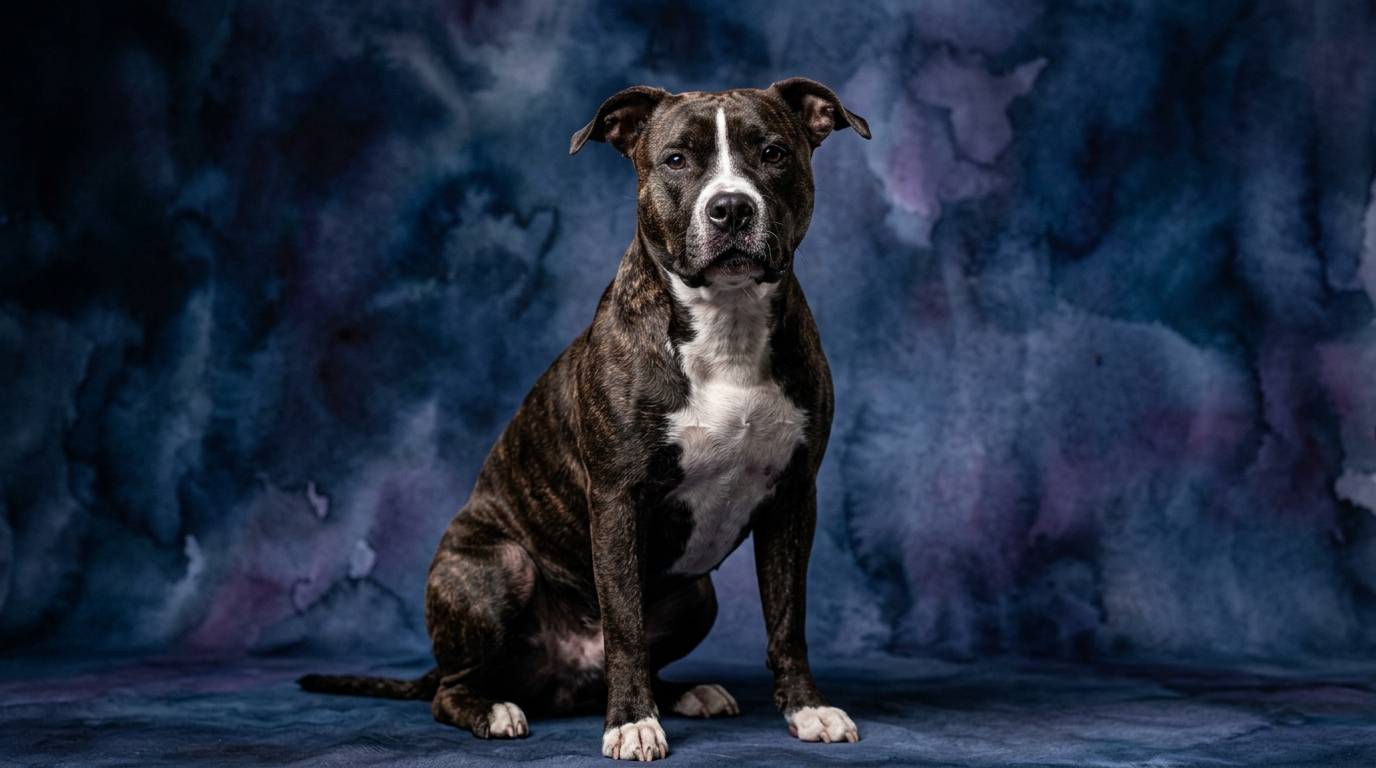
Side-by-Side IQ Profile: Saint Bernard vs. American Staffordshire Terrier
The Cosmic Pet Pet IQ Lab evaluates canine intelligence across five key dimensions, providing a nuanced understanding beyond simple obedience. Let's explore how the Saint Bernard, a Working group stalwart ranked #65 by Coren, and the American Staffordshire Terrier, a Terrier group dynamo ranked #48, compare.
For Problem Solving, both breeds score a 3 out of 5. The Saint Bernard's aptitude in this area often manifests in its historical role, navigating challenging terrains during rescue missions or finding its way home; it's a practical, situational resourcefulness. The American Staffordshire Terrier, conversely, applies its problem-solving skills to overcome physical barriers to reach a desired object or figure out novel ways to engage with its environment, often displaying a persistent, 'can-do' attitude when faced with a challenge.
Training Speed reveals a notable difference: the Saint Bernard scores 2 out of 5, while the American Staffordshire Terrier scores 3 out of 5. This indicates that while the AmStaff generally grasps new commands and concepts more quickly, the Saint Bernard requires more repetition and patience to solidify learning. The Saint Bernard's slower pace doesn't imply inability, but rather a more deliberate processing style, often requiring a clear purpose for each task. The AmStaff’s quicker uptake means it can progress through training levels at a faster clip, though motivation remains key.
Social Intelligence is a strong suit for the Saint Bernard, earning a 4 out of 5, compared to the American Staffordshire Terrier's 3 out of 5. The Saint Bernard possesses a profound capacity for empathy, often sensing human emotions and providing comfort without explicit cues. Their historical role as companions and rescuers has honed their ability to connect deeply and respond appropriately in various social contexts. The American Staffordshire Terrier, while devoted and loving to its family, tends to be more reserved with strangers and requires more deliberate socialization to interpret subtle social signals from unfamiliar humans or other animals. Their social intelligence is focused and loyal.
Instinctive Drive is exceptionally high in the Saint Bernard, rated at 5 out of 5, while the American Staffordshire Terrier scores 3 out of 5. The Saint Bernard’s powerful drive is rooted in its historical purpose: a deep-seated desire to guard, guide, and act as a devoted companion, often exhibiting a natural inclination for protective supervision and a profound sense of 'duty' within its family unit. The AmStaff's instinctive drive, while present, is more generalized; it manifests as a strong desire for engagement, play, and a tenacious pursuit of goals, often linked to its terrier heritage of spirited activity rather than a specific working role.
Finally, Memory shows the American Staffordshire Terrier with an edge at 4 out of 5, versus the Saint Bernard's 3 out of 5. The AmStaff demonstrates a robust capacity for recalling commands, routines, and past experiences, which aids in reinforcing training and understanding household expectations over time. The Saint Bernard remembers familiar faces, routines, and basic commands reliably, but may not retain complex sequences or intricate details of training with the same precision or longevity as the AmStaff, often relying more on consistent environmental cues.
Where the Saint Bernard Wins Cognitively
The Saint Bernard's profound strength lies in its Social Intelligence (4/5) and Instinctive Drive (5/5). Their ability to deeply connect with humans, sense distress, and provide unwavering comfort is unparalleled. This isn't just about being friendly; it's about an innate, empathetic understanding of social dynamics within a family unit. Their instinctive drive is a powerful engine for companionship and protection, manifesting as a gentle yet unwavering presence, always attuned to the well-being of their loved ones. This cognitive strength makes them exceptional therapy animals and deeply intuitive family members, often anticipating needs or offering solace without being prompted, a testament to their historical roles as compassionate guardians and rescuers in challenging environments.
Where the American Staffordshire Terrier Wins Cognitively
The American Staffordshire Terrier exhibits cognitive advantages in Training Speed (3/5) and Memory (4/5). Their quicker learning curve means they can master new commands and complex tasks with fewer repetitions, making them highly adaptable to various training disciplines, from obedience to agility. This speed, combined with their strong memory, allows them to retain a vast repertoire of skills and behavioral expectations over their lifetime, building on past lessons efficiently. While their Problem Solving (3/5) matches the Saint Bernard, their application often showcases a tenacious, persistent approach to challenges, reflecting their determined spirit. This combination makes them excellent candidates for owners who enjoy engaging in structured, progressive training and dog sports.
Which Is Easier to Train and Why?
Based on their cognitive profiles, the American Staffordshire Terrier is generally considered easier to train than the Saint Bernard. The AmStaff's higher Training Speed (3/5) means they typically pick up new commands more quickly, and their superior Memory (4/5) ensures better retention of those lessons. They often thrive on structured training, viewing it as an engaging activity, and respond well to positive reinforcement methods that challenge their intellect and channel their moderate instinctive drive. Their natural tenacity, while sometimes perceived as stubbornness, can be leveraged positively in training, as they are determined to complete tasks once they understand the reward.
The Saint Bernard, with a Training Speed of 2/5, requires significantly more patience and consistency. While they possess a strong desire to please due to their high Social Intelligence, their learning process is more deliberate. Repetitive drills might not hold their interest unless a clear, meaningful purpose is established. Effective training for a Saint Bernard relies heavily on positive reinforcement, short, engaging sessions, and understanding their independent streak. Their sheer size necessitates early and consistent training for manners and leash work, but owners must appreciate that progress will be slower and require a sustained, gentle approach rather than expecting rapid mastery.
Which Suits Active Owners vs. Relaxed Owners?
For active owners seeking a canine partner for sports, advanced obedience, or regular vigorous mental and physical challenges, the American Staffordshire Terrier is often the more suitable choice. Their quicker Training Speed, strong Memory, and moderate Instinctive Drive make them excel in activities like agility, rally obedience, and engaging puzzle work. They thrive on having a 'job' to do and appreciate consistent mental stimulation alongside physical exercise, making them ideal for owners who enjoy an interactive and structured routine.
Conversely, the Saint Bernard is better suited for more relaxed owners who appreciate a calm, deeply empathetic companion. While they require regular, moderate exercise to maintain their health, their cognitive profile—particularly their high Social Intelligence and profound Instinctive Drive for companionship—leans towards a less intense lifestyle. They are content with being a beloved family member, enjoying gentle walks, and providing comforting presence. Owners who value patience in training and a deep, intuitive bond over high-energy performance will find the Saint Bernard a profoundly rewarding companion.
The Verdict
Choose the Saint Bernard if you seek a deeply empathetic, instinctively protective, and gentle companion who thrives on social connection and has a more deliberate, patient learning style.
Choose the American Staffordshire Terrier if you enjoy structured training, dog sports, and appreciate a quick-witted, tenacious companion with a strong memory and moderate drive for engagement.
🧠 Find Your Pet's IQ Score
Our Pet IQ Lab assessment covers 25+ tests across 5 cognitive dimensions — personalized to your breed.
Take the Full IQ Test →Frequently Asked Questions
Are Saint Bernards difficult to train?
Saint Bernards are not inherently difficult, but their Training Speed of 2/5 means they learn at a slower, more deliberate pace than many other breeds. They require significant patience, consistency, and positive reinforcement, with training sessions needing to be engaging and purposeful to hold their interest.
Do American Staffordshire Terriers need a lot of mental stimulation?
Yes, American Staffordshire Terriers, with their 4/5 Memory and 3/5 Training Speed, thrive on mental stimulation. They are quick learners and possess a tenacious problem-solving approach, meaning they benefit greatly from consistent training, puzzle toys, and engaging activities to prevent boredom and channel their energy constructively.
Which breed is generally better with children?
The Saint Bernard's 4/5 Social Intelligence often makes them naturally gentle and patient with children, provided they are well-socialized and properly managed due to their size. American Staffordshire Terriers, with 3/5 Social Intelligence, can be wonderful family dogs, but their interactions with children should always be supervised, and early socialization is crucial to ensure they learn appropriate boundaries and cues.