
Side-by-Side IQ Profile
The Cosmic Pet Pet IQ Lab employs a comprehensive five-dimensional framework to assess canine intelligence, moving beyond simplistic notions to capture the nuanced mental capabilities of each breed. For the Saint Bernard, ranked #65 on the Coren scale, its profile reflects a powerful working background. Its Problem Solving score of 3/5 suggests a moderate capacity for independent thought in novel situations, capable of navigating complex tasks when motivated. Training Speed registers at 2/5, indicating that new commands and behaviors may require more repetition and patience to solidify. Where the Saint Bernard truly shines is in Social Intelligence, scoring 4/5; this reflects a strong aptitude for understanding human cues, forming deep bonds, and responding to social dynamics, a crucial trait for a historical companion and rescue dog. Its Instinctive Drive is exceptionally high at 5/5, pointing to a profound innate motivation to perform breed-specific tasks, whether it's guarding, rescuing, or companionship. Memory for this breed is moderate at 3/5, meaning they retain learned information adequately but may not recall every detail with lightning speed.
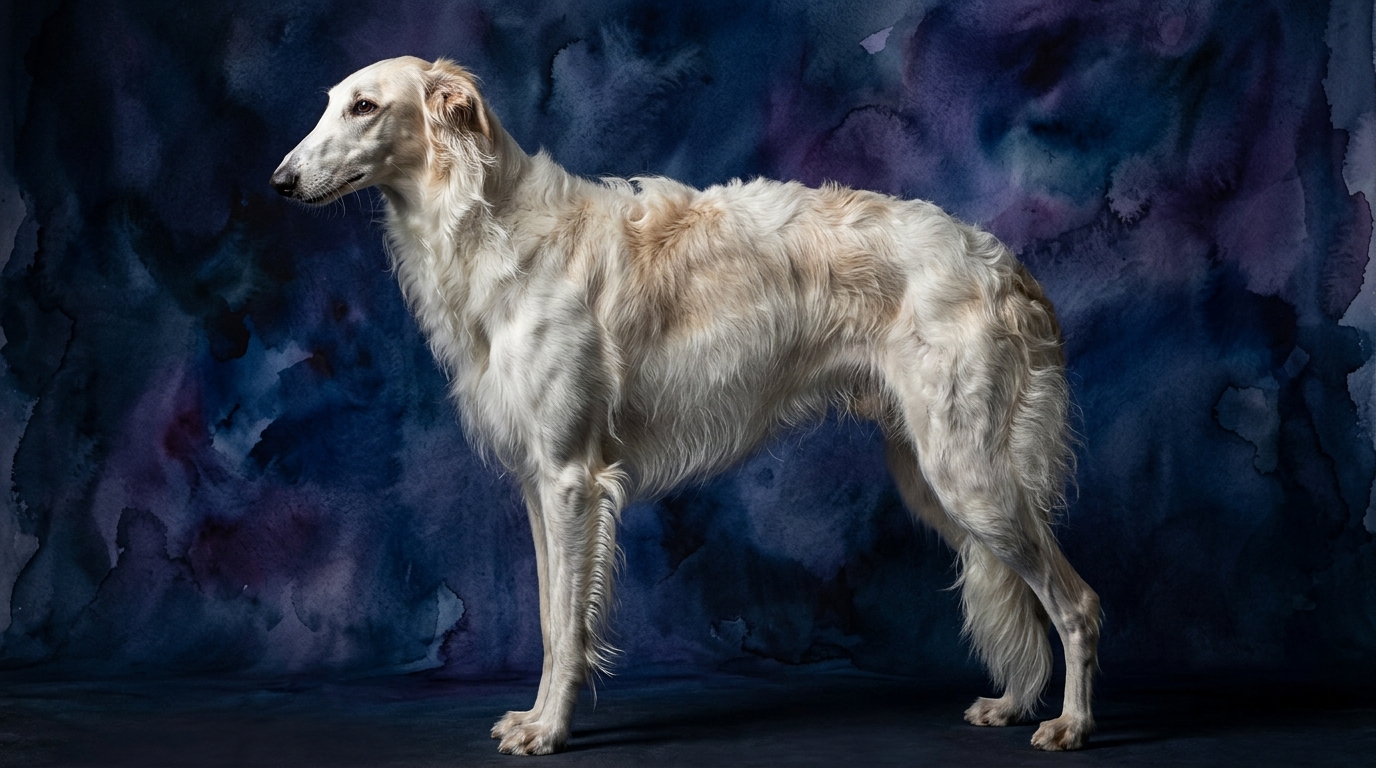
In contrast, the Borzoi, a sighthound ranked #75 on the Coren scale, presents a different cognitive blueprint, shaped by its history as a swift, independent hunter. Its Problem Solving score, like the Saint Bernard, stands at 3/5, suggesting a similar capacity for independent decision-making, particularly in pursuit scenarios where quick judgments are essential. The Borzoi's Training Speed is 3/5, indicating it can grasp new commands at a moderate pace, often quicker than the Saint Bernard, though its motivation to comply may differ. Social Intelligence for the Borzoi is 3/5, meaning it can form connections and interact appropriately, but may exhibit more independence and less overt eagerness to please compared to more people-centric breeds. Its Instinctive Drive is 3/5, primarily focused on its sighthound heritage of chase and pursuit, which can sometimes override other motivations. Memory for the Borzoi also scores 3/5, allowing it to remember learned behaviors and routines, but perhaps with a selective focus on what directly impacts its interests.
Where Saint Bernard Wins Cognitively
The Saint Bernard holds a distinct cognitive advantage in areas demanding deep human connection and inherent purpose. Its Social Intelligence, at 4/5 compared to the Borzoi's 3/5, means it possesses a superior capacity for reading and responding to human emotions and intentions. This manifests as a more profound desire for companionship and a greater sensitivity to its owner's moods, making it an exceptionally empathetic and intuitive family member. Furthermore, the Saint Bernard's Instinctive Drive, a perfect 5/5 versus the Borzoi's 3/5, signifies a powerful, intrinsic motivation to engage in activities that align with its historical role, whether it's 'watching over' its family or participating in structured tasks. This drive makes the Saint Bernard more inclined to seek a 'job' and derive satisfaction from working alongside humans, fostering a strong sense of belonging and contribution within its pack structure.
Where Borzoi Wins Cognitively
While the Borzoi's cognitive profile emphasizes independence, it distinctly outperforms the Saint Bernard in one key dimension: Training Speed. With a score of 3/5 compared to the Saint Bernard's 2/5, the Borzoi demonstrates a quicker ability to process and internalize new commands and behaviors. This means that, when properly motivated and engaged, a Borzoi can learn specific tasks or tricks in fewer repetitions. Its problem-solving capabilities, rated equally at 3/5, are often applied with a more self-directed approach, particularly in situations requiring quick, independent decisions, such as navigating complex terrain during a chase. This self-reliance, while sometimes perceived as aloofness, is a cognitive strength for tasks where immediate human direction isn't always present or necessary, allowing the Borzoi to act decisively based on its own perceptions and instincts.
Which is Easier to Train and Why
Determining which breed is 'easier' to train requires a nuanced understanding of their cognitive strengths and inherent motivations. The Saint Bernard, despite its lower Training Speed score of 2/5, benefits immensely from its high Social Intelligence (4/5) and exceptional Instinctive Drive (5/5). While it might take more repetitions for a Saint Bernard to grasp a new command, its profound desire to please its human companions and its innate drive to perform purposeful tasks provide strong motivational leverage. For example, a Saint Bernard is more likely to engage in obedience training because it inherently values the cooperative interaction and the positive reinforcement from its owner, often seeking to fulfill a perceived 'role' within the family unit. This means that while the initial learning phase might be slower, the long-term retention and willingness to comply, especially for tasks that involve companionship or 'helping,' are often very high.
Conversely, the Borzoi, with its higher Training Speed of 3/5, can technically learn commands more quickly. However, its lower Social Intelligence (3/5) and Instinctive Drive (3/5) mean that its motivation for compliance is often less about pleasing its owner and more about what's immediately rewarding or interesting to the dog itself. Borzoi are independent thinkers, and their sighthound heritage means they are often more attuned to visual stimuli and the thrill of the chase than to human directives. Training a Borzoi often requires more creativity, shorter sessions, and a deep understanding of its independent nature. They might learn a 'sit' command quickly, but consistently executing it when a squirrel darts by requires a higher level of engagement and a different training philosophy, often relying on high-value rewards and making training feel like a game rather than an obligation. Therefore, while a Borzoi might pick up a command faster, consistent, enthusiastic execution in varied environments might be more challenging due to their selective attention and self-directed nature.
Which Suits Active Owners vs Relaxed Owners
The Saint Bernard, despite its imposing size, is generally suited for owners who appreciate a more relaxed pace but are prepared for significant grooming and management of a large dog. Its high social intelligence means it thrives on companionship and family interaction, preferring to be an integral part of daily life rather than an independent outdoor dog. While it possesses a powerful instinctive drive, this often translates to a desire for purpose and moderate exercise, such as daily walks or gentle play, rather than intense, sustained activity. A relaxed owner who enjoys quiet evenings and gentle strolls, and who can provide consistent, loving attention, would find a Saint Bernard a fitting companion, understanding that its 'work' is often its presence and devotion.
The Borzoi, on the other hand, is better suited for owners who can accommodate its specific, albeit intermittent, need for intense physical activity. As a sighthound, it requires opportunities for full-speed running in a securely fenced area, typically in short, exhilarating bursts. While they are often calm and dignified indoors, their lower social intelligence and instinctive drive mean they are often content to lounge independently after their exercise needs are met, making them less demanding of constant human interaction than a Saint Bernard. An active owner who understands the sighthound's need for a good 'gallop' and respects its independent nature, providing ample secure space for running, would be a good match. They appreciate an owner who can meet their unique exercise requirements without necessarily demanding constant interactive play or training sessions.
The Verdict
Choose the Saint Bernard if you seek a deeply empathetic, family-oriented companion with a strong desire for connection, and you are prepared for a slower training pace but high long-term compliance.
Opt for the Borzoi if you appreciate an independent, elegant companion that learns commands quickly, and you can provide specific outlets for its sighthound instincts and burst of speed.
🧠 Find Your Pet's IQ Score
Our Pet IQ Lab assessment covers 25+ tests across 5 cognitive dimensions — personalized to your breed.
Take the Full IQ Test →Frequently Asked Questions
Do Saint Bernards like to play games?
Yes, Saint Bernards enjoy interactive play, especially games that involve their family. Their high social intelligence means they find joy in shared activities, though their play might be more gentle and less frenetic than some other breeds.
Are Borzoi good at agility sports?
While Borzoi possess incredible speed and agility for their size, their independent nature and moderate instinctive drive for human-directed tasks mean they may not be as consistently motivated for agility sports as some other breeds. Success often depends on the individual dog's personality and the trainer's approach.
Which breed is more prone to separation anxiety?
Given its higher social intelligence and strong desire for companionship, the Saint Bernard is generally more prone to displaying signs of distress or anxiety when left alone for extended periods. The more independent Borzoi tends to handle solitude with greater ease, provided its exercise needs are met.