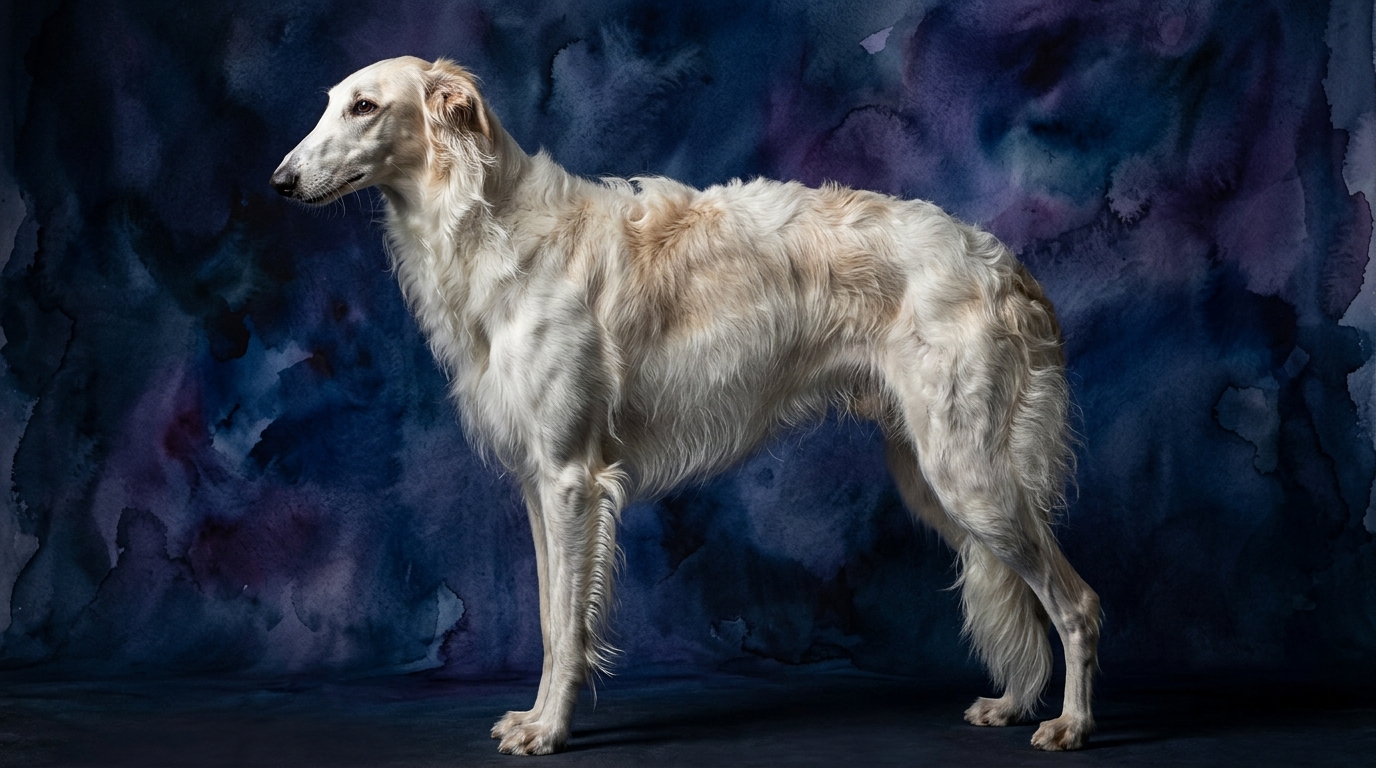
Borzoi at a glance
| IQ Rank / Score | #75 |
|---|---|
| Trainability | ★★☆☆☆ (2/5) |
| Social Intelligence | ★★★☆☆ (3/5) |
| Lifespan | 10-12 years |
| Shedding | Moderate to high |
| Exercise Needs | High (60+ min/day + training) |
| Origin | Russia |
The Independent Visual Pursuit Specialist: Borzoi's Primary Angle
The cornerstone of Borzoi intelligence lies in their unparalleled capacity for independent visual pursuit. Unlike many breeds whose cognitive strengths are geared towards direct collaboration with humans, the Borzoi's mind is a finely tuned instrument for spotting, assessing, and relentlessly pursuing prey across vast distances. This isn't merely instinct; it’s a complex, self-directed cognitive process involving rapid visual processing, strategic route planning, and autonomous decision-making in high-stakes, fast-paced environments. Their intelligence allows them to make split-second choices without human intervention, prioritizing efficiency and success in the chase, often across challenging terrain. This specialized intelligence defines their approach to learning and interaction, making them less 'eager to please' and more 'purposefully self-directed'.
Their brain is constantly analyzing the horizon, detecting the slightest movement, and calculating trajectory, speed, and optimal interception points. This highly specialized form of intelligence means they excel in situations where independent judgment and rapid execution are paramount. They do not rely on constant human direction during their primary 'work'; instead, they operate as intelligent, self-sufficient hunters, a trait that shapes every aspect of their cognitive profile. Understanding this primary angle is crucial to appreciating the Borzoi's unique intellectual landscape, which thrives on freedom of action and precise sensory input.
The Wolf Hunter's Wit: A Legacy of Autonomous Strategy
A surprising historical fact illuminating Borzoi cognition is their traditional role in hunting wolves in 17th-century Russia. This wasn't a solitary pursuit; Borzoi were typically worked in pairs or trios, often alongside horses and other hounds, but critically, they were expected to engage and subdue wolves without direct, real-time commands from their human handlers during the final stages of the chase. This required an extraordinary level of independent strategic thinking, cooperative intelligence among the dogs, and immense physical and mental fortitude. They had to assess the wolf's movements, anticipate escape routes, and execute a coordinated attack that minimized risk to themselves while maximizing effectiveness against dangerous prey. This historical context reveals a breed developed for complex, autonomous problem-solving and self-preservation in the face of genuine peril. It’s a testament to their deep-seated cognitive capabilities that extend far beyond simple obedience.
The very act of taking down a wolf demanded more than just speed and strength; it required a cognitive understanding of pack dynamics (both their own and the wolf's), an ability to predict behavior, and the mental resilience to engage in a struggle where failure meant severe injury or death. This heritage explains much about the modern Borzoi's independent streak, their discernment, and their often-reserved demeanor. They are thinkers and strategists, not merely followers, embodying a type of intelligence born from centuries of high-stakes, self-directed 'work'.
Understanding the Borzoi's Learning Style: Beyond Obedience
Stanley Coren's ranking of Borzoi at #75 out of 138 breeds for obedience is often misinterpreted as a lack of intelligence. However, this is far from the truth; it's a reflection of their distinct learning style and inherent independence. Borzoi are incredibly intelligent, but their intelligence is not primarily expressed through eager-to-please obedience or a strong desire for constant human direction. They learn very quickly what benefits them, what is consistent, and what is unfair. They will often choose to comply with a command if it makes sense to them, if the reward is appealing, or if it doesn't conflict with their own immediate interests, such as chasing a squirrel.
Their sensitivity means harsh training methods are counterproductive, leading to shut down or willful stubbornness. They respond best to positive reinforcement, consistency, and patient, respectful handling that appeals to their inherent intelligence and independent nature. Teaching a Borzoi a trick might take longer not because they don't understand, but because they often question the 'why' and decide if the effort is worthwhile. They possess excellent memory, especially for routines, places, and people, which aids in their learning within a structured, loving home environment, even if formal obedience isn't their forte.
Borzoi Cognitive Strengths: Vision, Memory, and Spatial Awareness
The Borzoi's cognitive profile is dominated by extraordinary visual acuity and spatial reasoning. Their long-distance vision, bred for spotting minute movements on the horizon, is paired with a brain that can instantly process this information to calculate speed, distance, and optimal pursuit paths. This makes them exceptional at tasks requiring visual discrimination and navigating complex environments efficiently. Furthermore, Borzoi exhibit excellent spatial memory, remembering routes, layouts, and the location of resources or dangers within their territory. This is a crucial adaptation for a breed that needs to cover large areas and recall terrain features during high-speed chases.
Beyond their hunting instincts, Borzoi also demonstrate a discerning social intelligence. While often reserved with strangers, they form deep, loyal bonds with their family, reading subtle cues and showing surprising empathy and sensitivity. They are not overtly demonstrative but are keenly aware of their human companions' moods and often adapt their behavior accordingly. This blend of specialized predatory intelligence, robust spatial memory, and nuanced social awareness paints a picture of a truly unique and sophisticated canine mind.
Living with a Borzoi: Harnessing Their Unique Mind
Integrating a Borzoi into a modern home means understanding and respecting their distinct cognitive makeup. Their independence, while a hallmark of their intelligence, requires a securely fenced yard to manage their strong prey drive, as their instinct to chase trumps obedience commands when a visual target presents itself. Mental stimulation for a Borzoi often involves activities that engage their senses, particularly their sight and their ability to navigate space. Lure coursing, for example, is a sport that perfectly taps into their instinctive drive and cognitive strengths, allowing them to engage in simulated pursuit in a safe, controlled environment.
Their reserved nature means they thrive in calm environments and benefit from consistent, gentle socialization rather than overwhelming exposure. Recognizing their intelligence isn't about training them to be 'obedient' in the traditional sense, but about appreciating their capacity for independent thought, problem-solving on their own terms, and the subtle ways they communicate and interact. A Borzoi's intelligence is best understood as a sophisticated blend of instinct, perception, and selective reasoning, making them endlessly fascinating companions for those who truly appreciate their unique mind.
3 At-Home Tests to Measure Your Borzoi's IQ
These tests are adapted from peer-reviewed ethology research. No equipment is needed beyond items you have at home. Run each test 5–10 times for reliable results.
The Myth: "Borzoi are unintelligent or difficult to train."
✅ Borzoi are highly intelligent, capable of complex thought and problem-solving, but their intelligence is self-directed. They learn quickly what is valuable to them and often require specific motivation or a logical reason to comply, making them discerning rather than 'difficult'.
Borzoi vs. Similar Breeds
🧠 What's Your Dog's IQ Score?
Our full Pet IQ Lab assessment includes 12+ tests across 5 cognitive dimensions, calibrated for Borzois specifically.
Take the Full IQ Test →Frequently Asked Questions
How smart is a Borzoi?
Our Pet IQ Lab framework scores cognition across five dimensions (max 25). The Borzoi totals 16/25 — high for a domestic dog. The full article breaks down each dimension with at-home tests.
Are Borzois easy to train?
Borzois are independent learners; short, highly-motivating sessions work best. They score 2/5 on Training Speed in our breed profile.
Are Borzois good with children and other pets?
Borzois can live well with families when socialized early. Their Social Intelligence scores 3/5, so supervise interactions with small children and introduce new pets gradually.
Do Borzois need a lot of mental stimulation?
Absolutely. With Problem Solving 3/5 and Instinctive Drive 5/5, Borzois need daily mental work — puzzle feeders, scent games, training sessions, or nose-work — to avoid boredom.
How much exercise does a Borzoi need?
Borzois need active engagement. Plan for 45-60 minutes of exercise and training per day, plus mental stimulation.
How good is a Borzoi's memory?
Borzois score 3/5 on memory. They remember high-value associations well; less-used cues fade without refresher sessions.
What is the typical lifespan of a Borzoi?
Typical lifespan is 10-12 years for a large dog like the Borzoi.
The Borzoi's intelligence is a majestic tapestry woven from centuries of independent strategic hunting, keen visual perception, and discerning social engagement. Appreciating their cognitive uniqueness means moving beyond conventional definitions of dog intelligence to embrace their profound self-reliance and grace of thought.