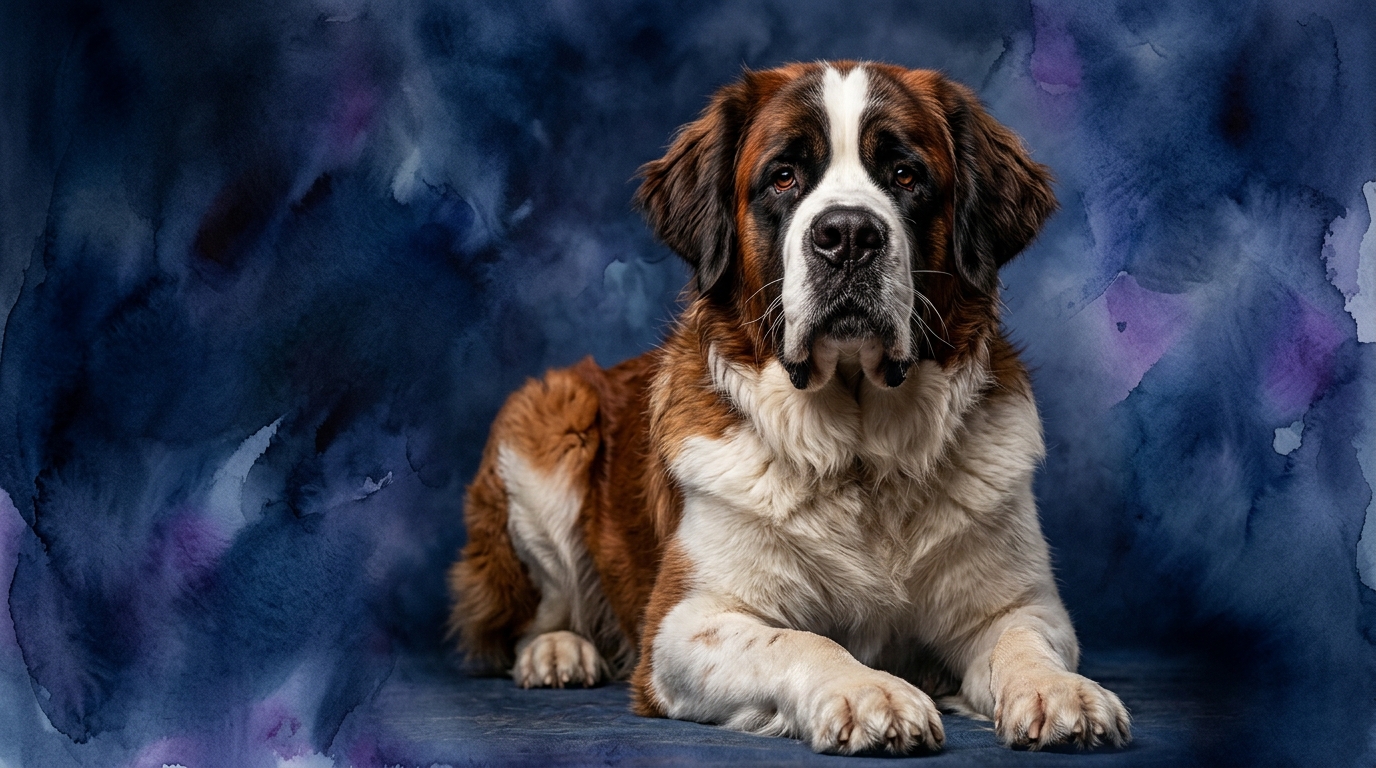

Side-by-Side IQ Profile: Saint Bernard vs. Mastiff
At The Cosmic Pet Pet IQ Lab, we dissect canine cognition into five core dimensions, providing a granular view of each breed's mental landscape. For the Saint Bernard, ranked #65 on the Coren scale, we observe a Problem Solving score of 3/5, indicating a solid capacity to navigate complex situations and find solutions, often leveraging their physical prowess. Their Training Speed registers at 2/5, suggesting that new commands and routines require consistent, patient repetition to solidify. Where they truly shine is Social Intelligence, scoring an impressive 4/5, reflecting a deep attunement to human emotions and social cues, fostering profound companionship. An exceptional Instinctive Drive of 5/5 underscores their historical roles in search and rescue, showcasing an innate, powerful motivation for purposeful tasks. Finally, their Memory stands at 3/5, indicating a moderate ability to retain learned behaviors and experiences over time.
The Mastiff, a stately working breed with a Coren ranking of #72, presents a slightly different cognitive tapestry. Their Problem Solving ability matches the Saint Bernard at 3/5, demonstrating a similar practical intelligence for assessing and overcoming environmental challenges, often with a focus on protection. In Training Speed, the Mastiff edges out their counterpart with a 3/5 score, suggesting a moderately quicker grasp of new commands, though still benefiting greatly from structured, positive reinforcement. Their Social Intelligence is rated 3/5; while deeply bonded to their immediate family, they tend to be more reserved and less overtly empathetic with strangers compared to the Saint Bernard. The Mastiff's Instinctive Drive is 3/5, reflecting a strong, focused protective instinct for their home and loved ones, rather than a broad, generalized working drive. Their Memory, like the Saint Bernard, is a respectable 3/5, allowing them to recall training and experiences effectively.
Where the Saint Bernard Excels Cognitively
The Saint Bernard's cognitive edge primarily manifests in two key areas: their superior Social Intelligence and their unparalleled Instinctive Drive. With a Social Intelligence score of 4/5 compared to the Mastiff's 3/5, Saint Bernards exhibit a profound capacity for empathy and emotional understanding. This isn't merely about being friendly; it means they are exceptionally attuned to the subtle shifts in human mood, tone, and body language. This makes them remarkably responsive companions, often appearing to anticipate their owner's needs or offer comfort during distress. Their ability to forge deep, almost intuitive connections is a hallmark of their social cognition, making them highly perceptive family members.
Furthermore, the Saint Bernard's Instinctive Drive, rated a perfect 5/5 against the Mastiff's 3/5, highlights an intrinsic motivation for purposeful activity that is truly exceptional. This isn't just a desire to 'do a job,' but a deep-seated impulse to engage with tasks that require endurance, dedication, and problem-solving in real-world scenarios, echoing their heritage as Alpine rescue dogs. While their Training Speed is lower, this immense drive means that when their instincts are properly channeled through consistent and engaging training, they can perform complex tasks with remarkable persistence. This drive provides a rich internal life and a clear sense of purpose that, when satisfied, contributes significantly to their overall well-being and engagement.
Where the Mastiff Shows Cognitive Advantages
The Mastiff's primary cognitive advantage, though subtle, lies in its Training Speed, scoring 3/5 compared to the Saint Bernard's 2/5. While neither breed is known for lightning-fast learning, the Mastiff's slightly quicker grasp of new commands can make initial obedience training a more straightforward process. This isn't to say they are effortless, but owners might find that a Mastiff requires marginally fewer repetitions to solidify a command, potentially leading to a more efficient progression through basic and intermediate training protocols. This quicker absorption of information can translate into a more predictable and consistent response to verbal cues and hand signals, building a strong foundation for a well-behaved companion.
While both breeds share a 3/5 score in Problem Solving and Memory, the Mastiff's focused Instinctive Drive of 3/5, primarily geared towards protection, can be seen as an advantage in certain domestic contexts. Unlike the Saint Bernard's broader, more generalized working drive, the Mastiff's protective instincts are typically more contained and directed towards guarding its immediate family and territory. This focused application of their intelligence means they are highly adept at assessing potential threats and acting as watchful guardians without necessarily seeking out more expansive 'work.' Their problem-solving skills are thus often applied to evaluating environmental safety and maintaining vigilance, providing a steadfast sense of security for their owners.
Training Dynamics: Which is Easier and Why?
When considering ease of training, the Mastiff generally presents a slightly less challenging path due to its higher Training Speed of 3/5 compared to the Saint Bernard's 2/5. This means a Mastiff might pick up basic obedience commands with a bit more efficiency, requiring fewer repetitions to ingrain a new behavior. Their problem-solving abilities are comparable, but the Mastiff's capacity to process and internalize new instructions marginally faster can make the initial stages of training feel more rewarding for the owner, fostering quicker progress in areas like leash manners, sit, stay, and recall.
The Saint Bernard, while possessing a higher social intelligence and an incredible instinctive drive, often requires more patience and creative motivation during training. Their strong instincts, while valuable for purposeful work, can sometimes lead to independent decision-making if not consistently guided, meaning an owner must be adept at channeling these drives rather than suppressing them. For the Saint Bernard, training success often hinges on making the learning process engaging and relevant to their innate desire for purpose, whereas the Mastiff's training benefits from clear, consistent, and confident leadership that establishes boundaries and routines effectively.
Matching Breeds to Lifestyles: Active vs. Relaxed Owners
For owners with an active lifestyle who are prepared to provide consistent mental and physical engagement, the Saint Bernard is an exceptional match. Despite their slower training speed, their robust Instinctive Drive (5/5) means they thrive when given a 'job' or a sense of purpose. This doesn't necessarily mean formal rescue work, but rather regular, varied activities that stimulate their problem-solving skills and allow them to utilize their natural persistence. Long, adventurous walks, scent work, or even participation in canine good citizen classes can satisfy their need for engagement. Their high Social Intelligence (4/5) also makes them wonderful partners for shared activities, as they are deeply connected to their owners and eager to participate in family life.
Conversely, for more relaxed owners who appreciate a steadfast, protective presence without the need for constant, demanding mental stimulation, the Mastiff may be a more suitable choice. Their moderate Instinctive Drive (3/5) and Social Intelligence (3/5) mean they are content with a consistent routine that includes daily walks and companionship, but they don't necessarily crave the intense purposeful work that a Saint Bernard might. Once their basic exercise and social needs are met, Mastiffs are often content to be calm, watchful guardians within the home. Their slightly quicker training speed also means that establishing basic obedience for a relaxed home environment can be achieved with a steady, consistent approach, without requiring the same level of creative engagement needed for a Saint Bernard's deeper drives.
The Verdict: When to Choose Each Gentle Giant
The Verdict
Choose the Saint Bernard if you seek a deeply empathetic, purpose-driven companion and are willing to invest significant, consistent effort into channeling their robust natural instincts and fostering their profound social connections through engaging activities.
Opt for the Mastiff if you desire a steadfast, protective presence with a slightly quicker grasp of obedience commands, and you value a companion whose drives are more focused on home and family security rather than broad, demanding working tasks.
🧠 Find Your Pet's IQ Score
Our Pet IQ Lab assessment covers 25+ tests across 5 cognitive dimensions — personalized to your breed.
Take the Full IQ Test →Frequently Asked Questions
Do Saint Bernards make good family pets?
Yes, Saint Bernards are generally excellent family pets, particularly due to their high social intelligence and empathetic nature. They form deep bonds with family members and are often patient and gentle with children, making them loving companions.
Are Mastiffs difficult to train for basic obedience?
Mastiffs are not inherently difficult to train for basic obedience; in fact, their training speed is slightly better than a Saint Bernard's. They respond well to consistent, positive reinforcement methods and clear communication, though their independent streak means patience is still key.
Which breed is more protective of its family?
Both breeds possess protective instincts, but they manifest differently. The Mastiff's instinctive drive is more overtly focused on guarding its family and territory, while the Saint Bernard's broader instinctive drive, rooted in rescue, translates to a general watchfulness coupled with a profound empathy for its loved ones' well-being.