
Side-by-Side Cognitive Profile: SWD vs. IWS
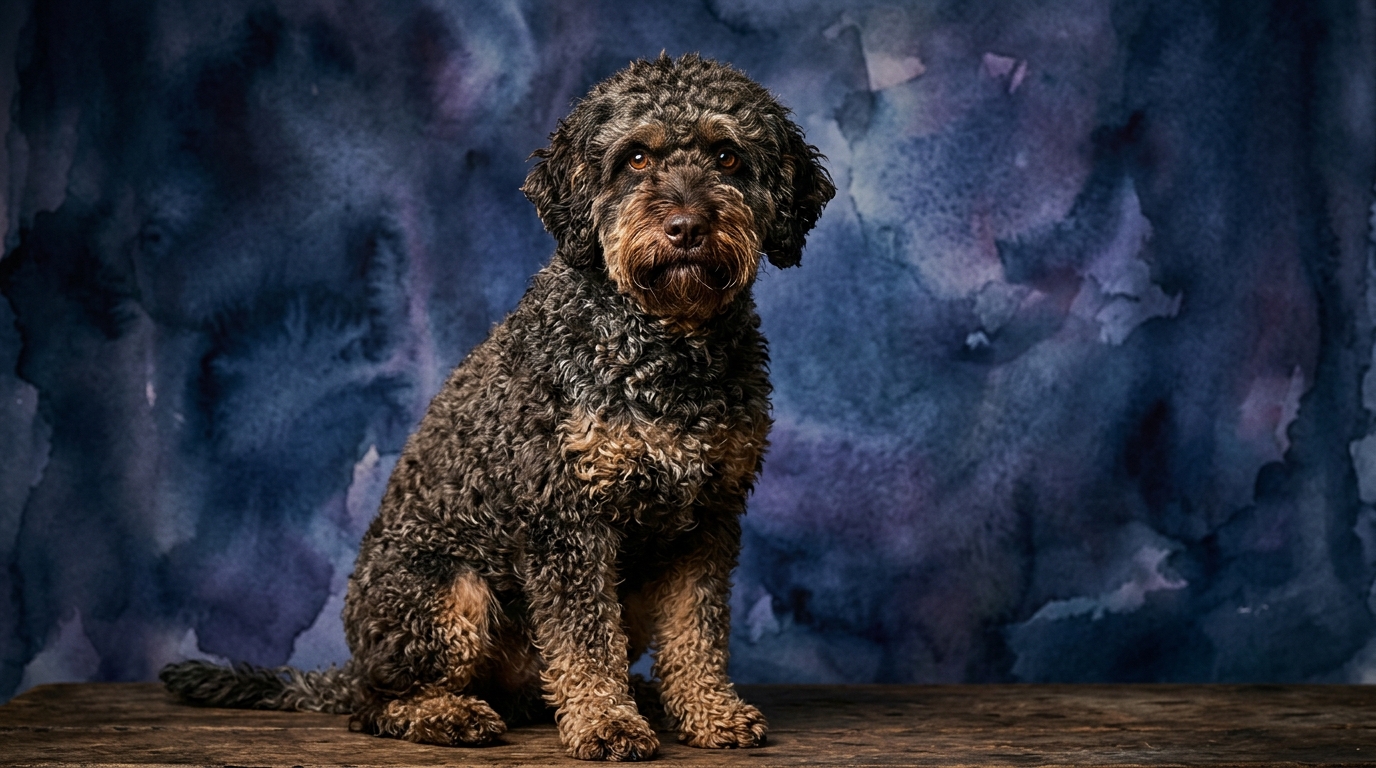
The Spanish Water Dog, a member of the Herding group, exhibits a remarkably consistent cognitive profile, scoring 3 out of 5 across all five dimensions: Problem Solving, Training Speed, Social Intelligence, Instinctive Drive, and Memory. This balanced aptitude suggests a dog that is capable and adaptable across a range of mental tasks, without extreme highs or lows in any particular area. Its problem-solving capacity at 3/5 indicates an ability to navigate moderately complex situations and learn new tasks with consistent guidance, while its 3/5 training speed suggests a steady, rather than rapid, learning curve. Social intelligence at 3/5 points to a good understanding of human cues and interactions, and a 3/5 instinctive drive highlights a moderate inherent motivation for work. Its memory, also at 3/5, implies a solid retention of learned commands and experiences over time.
In contrast, the Irish Water Spaniel, a Sporting group dog with a notable Coren rank of #24, presents a profile with distinct peaks. It scores 4 out of 5 in Problem Solving, Training Speed, and Memory, while matching the Spanish Water Dog with 3 out of 5 in Social Intelligence and Instinctive Drive. The higher scores in problem-solving, training speed, and memory denote a dog with a pronounced capacity for independent thought, rapid acquisition of new skills, and superior retention of information. A 4/5 in problem-solving suggests an ability to figure out novel situations and puzzles with less human intervention, and a 4/5 training speed means it will typically pick up commands and routines more quickly than its Spanish counterpart. Its 4/5 memory ensures that these lessons are not easily forgotten, making advanced training more efficient. Both breeds share a 3/5 in social intelligence, indicating a similar level of responsiveness to human social cues, and a 3/5 instinctive drive, suggesting a moderate but present internal motivation for activity and work.
Where the Spanish Water Dog Wins Cognitively
While the Irish Water Spaniel boasts higher scores in several cognitive dimensions, the Spanish Water Dog's uniform 3/5 profile across all metrics presents a unique advantage for specific owner expectations. This consistent, balanced cognitive makeup means the SWD is less likely to exhibit extreme tendencies in any single area, offering a predictable and adaptable companion. For instance, its 3/5 problem-solving ability, while not as high as the IWS, means it is capable of learning complex tasks without necessarily possessing the intense, independent drive that might lead a higher-scoring dog to find its own, potentially mischievous, solutions to boredom. This can translate to a dog that is easier to manage in everyday scenarios where an owner might prefer a steady, cooperative partner over one constantly seeking advanced mental challenges.
The SWD's balanced instinctive drive at 3/5, coupled with its herding background, means its work ethic is often channeled towards cooperative tasks like managing livestock or participating in agility, where consistency and responsiveness are key. Owners who appreciate a dog that is consistently capable across a spectrum of activities—from learning new tricks to navigating new environments—without the demanding intellectual intensity of a dog scoring 4/5 in multiple areas, will find the Spanish Water Dog's cognitive balance a distinct win. It provides a solid foundation for a versatile working or family companion, offering reliability and a manageable level of mental engagement without requiring constant, high-level intellectual stimulation to prevent boredom.
Where the Irish Water Spaniel Wins Cognitively
The Irish Water Spaniel truly shines in its elevated capacities for Problem Solving, Training Speed, and Memory, each scoring a robust 4 out of 5. These higher metrics signify a dog that is inherently quicker to grasp new concepts, more adept at figuring out novel situations, and better at retaining complex information over the long term. For owners who enjoy engaging in advanced training, competitive dog sports like obedience or agility, or even specialized working roles, the IWS's superior cognitive efficiency is a clear advantage. Its faster training speed means fewer repetitions are needed for skill acquisition, allowing for a broader and deeper training curriculum.
Furthermore, the IWS's enhanced problem-solving skills mean it is often capable of independent thought and adapting to changing circumstances with greater fluidity. This can be particularly beneficial in dynamic environments such as field trials, where quick, intelligent decisions are paramount. The combination of a keen memory and strong problem-solving ability allows the Irish Water Spaniel to not only learn intricate sequences but also to apply that knowledge creatively to new challenges. Its #24 Coren rank further underscores its established reputation for working and obedience intelligence, making it an excellent choice for owners seeking a canine partner with exceptional learning potential and mental acuity.
Ease of Training: Behavioral Differences
When considering ease of training, the Irish Water Spaniel holds a distinct edge due to its higher scores in Training Speed (4/5) and Memory (4/5). These attributes translate directly into behavioral differences: an IWS typically learns new commands and routines with fewer repetitions and retains them for longer periods. This means training sessions can progress more rapidly, covering more ground in less time, and the dog is likely to generalize learned behaviors to new situations more effectively. Owners of an IWS often find that once a command is taught, it is deeply ingrained, requiring less frequent reinforcement to maintain proficiency. This faster assimilation and superior retention make the IWS particularly rewarding for those who enjoy pushing the boundaries of canine learning and participating in advanced dog sports or complex tasks.
The Spanish Water Dog, with its 3/5 scores in both Training Speed and Memory, is certainly trainable, but it will generally require more patience and consistency from its handler. While capable of learning a wide array of commands, an SWD might need more repetitions to fully grasp a concept and may require more regular reinforcement to keep those commands sharp. This doesn't mean the SWD is difficult to train, but rather that its learning pace is more moderate. Both breeds share a 3/5 in Instinctive Drive, indicating a similar level of inherent motivation for work, which can be harnessed effectively in training. However, the IWS's quicker cognitive processing and better memory inherently make the training journey feel 'easier' and more efficient for the dedicated owner seeking rapid progress and high-level skill acquisition.
Matching Breeds to Owner Lifestyles
Both the Spanish Water Dog and the Irish Water Spaniel are active breeds that thrive with engagement, but their specific cognitive profiles suggest different nuances for owner lifestyles. The Irish Water Spaniel, with its 4/5 problem-solving, training speed, and memory, is an ideal match for highly active owners who are not only physically robust but also intellectually ambitious in their dog ownership. This breed flourishes with owners dedicated to advanced training, competitive dog sports like agility, obedience, dock diving, or field work, and those who enjoy teaching complex sequences and engaging in mentally stimulating activities daily. An IWS needs its mind challenged as much as its body, making it perfect for owners who view dog training as an ongoing, evolving partnership and who can provide consistent, high-level cognitive enrichment.
The Spanish Water Dog, with its balanced 3/5 across all cognitive dimensions, is also suited for active owners, but perhaps those seeking a versatile companion without the intense cognitive demands of an IWS. An SWD thrives in a home where it receives consistent, engaging physical activity such as hiking, swimming, or herding-based games, along with regular training sessions that reinforce its moderate learning curve. Owners who appreciate a steady, adaptable dog for various outdoor adventures and structured work, and who are content with a capable, cooperative partner rather than one constantly pushing for elite intellectual challenges, will find the SWD a rewarding fit. For owners who might be described as 'relaxed' in terms of not pursuing competitive dog sports or advanced specialized training, but still committed to daily activity and consistent basic to intermediate training, the SWD's balanced profile might be marginally more forgiving than the IWS, which could become bored or destructive without sufficient high-level mental stimulation.
The Verdict
Choose the Spanish Water Dog if you seek a versatile, balanced, and adaptable canine companion capable of consistent performance across varied activities, and you appreciate a steady cognitive partner without extreme intellectual demands.
Opt for the Irish Water Spaniel if you are an owner dedicated to advanced training, competitive dog sports, or complex working roles, valuing a dog with a demonstrated capacity for rapid learning, superior problem-solving, and excellent memory.
🧠 Find Your Pet's IQ Score
Our Pet IQ Lab assessment covers 25+ tests across 5 cognitive dimensions — personalized to your breed.
Take the Full IQ Test →Frequently Asked Questions
Are Spanish Water Dogs difficult to train?
No, Spanish Water Dogs are not difficult to train, but their 3/5 training speed and memory mean they require more consistency and repetition than some breeds. They are capable of learning complex commands but benefit from patient, engaging methods to ensure retention and proficiency.
Do Irish Water Spaniels need a lot of mental stimulation?
Yes, Irish Water Spaniels, with their 4/5 problem-solving and memory, thrive on significant mental stimulation. They need regular challenges like advanced obedience, puzzle toys, and dog sports to prevent boredom and channel their considerable cognitive energies constructively.
How do their social intelligence scores impact their family life?
Both breeds share a 3/5 social intelligence score, indicating they possess a good capacity to understand human social cues and integrate well into a family environment. This means both breeds are generally responsive to their owners' moods and intentions, making them affectionate and attentive companions, though individual personalities can vary.