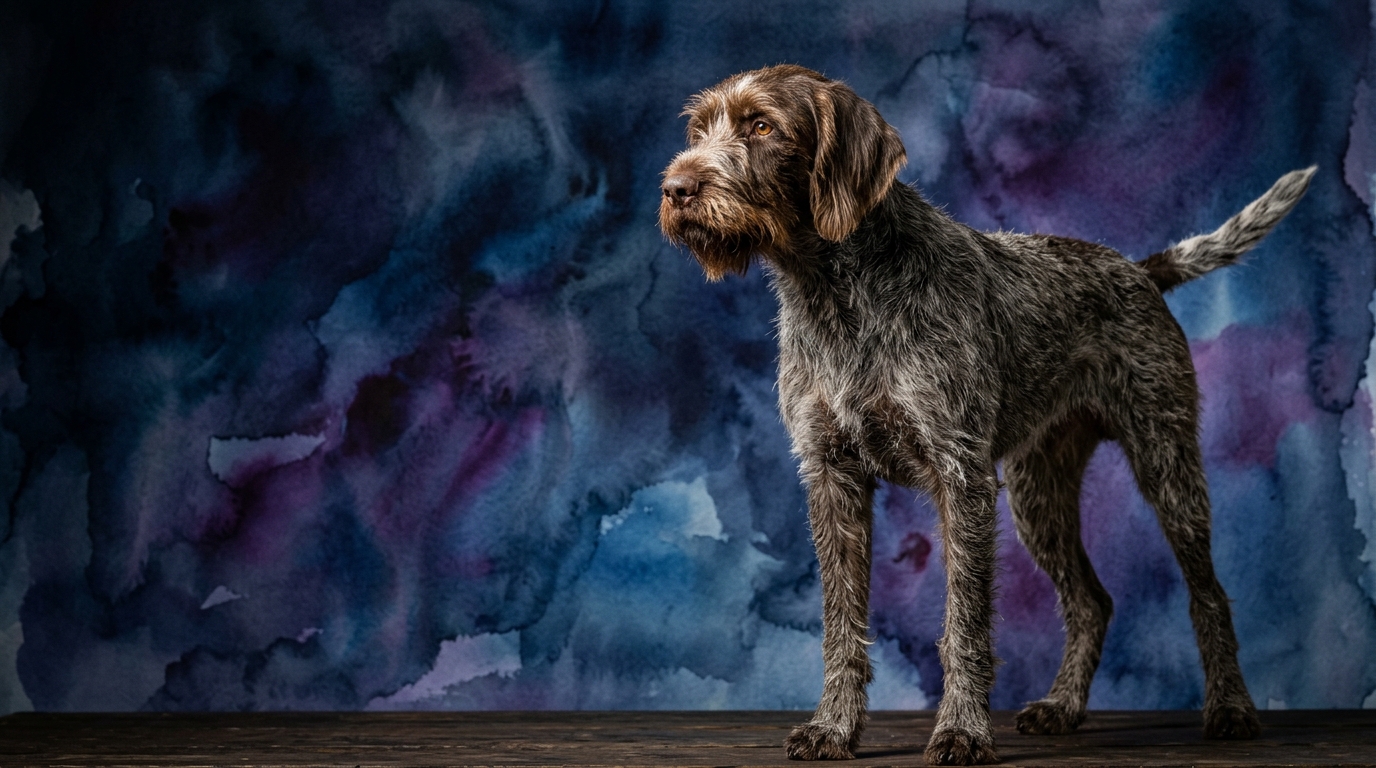
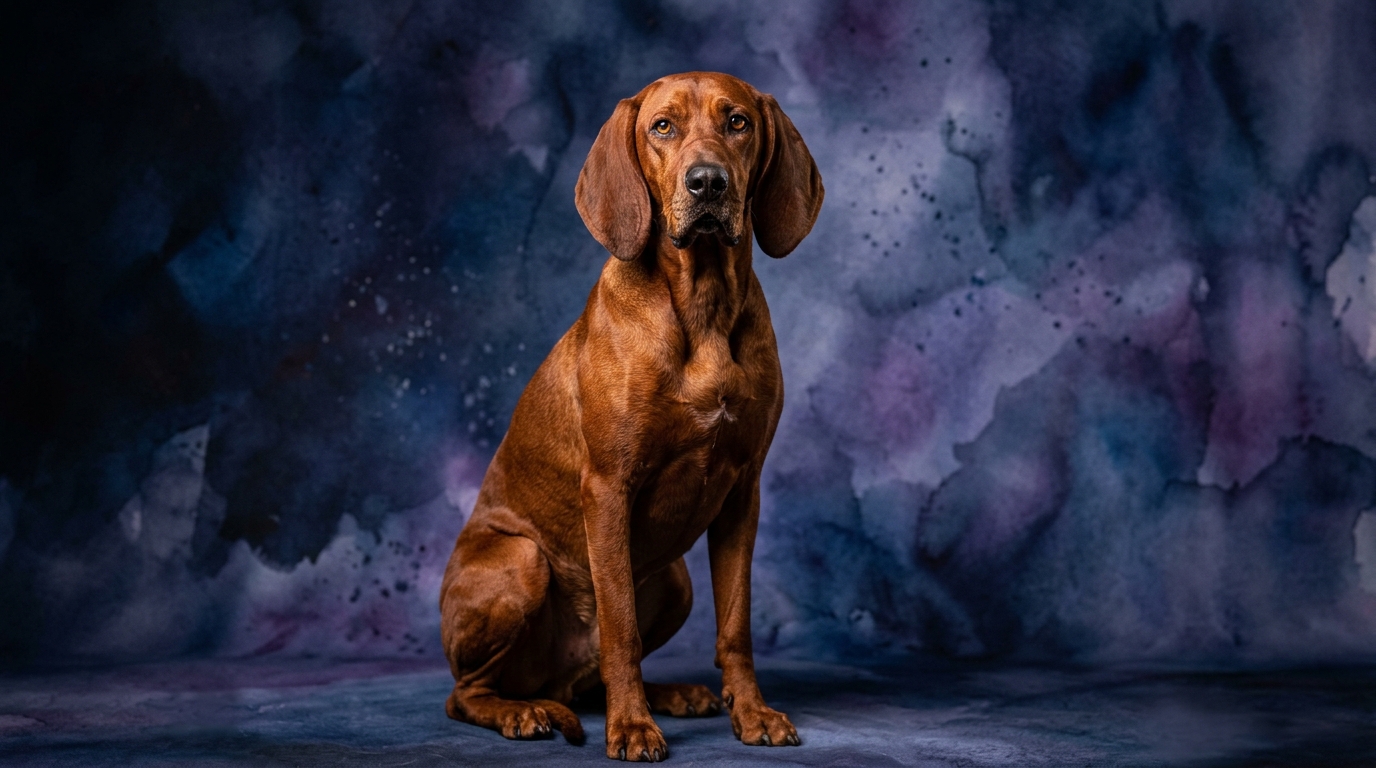
Side-by-Side Cognitive Profiles
While both the Wirehaired Pointing Griffon and the Redbone Coonhound register a consistent 3/5 across all five cognitive dimensions in The Cosmic Pet Pet IQ Lab, the *expression* of these scores differs significantly due to their distinct working heritage. It's not just about the score, but how that cognitive capacity is channeled and applied in their world.
The Wirehaired Pointing Griffon, a dog from the Sporting group, displays its 3/5 in these areas:
Problem Solving (3/5): Their problem-solving centers on practical tasks in the field, like navigating dense cover to flush game or figuring out the best path for a retrieve across varied terrain. They excel at applying learned behaviors to new environmental challenges, often making quick decisions to achieve a goal in collaboration with their handler.
Training Speed (3/5): Griffons generally pick up new commands with moderate speed, driven by an eagerness to collaborate with their handler. While not instant learners, their focus on partnership means they are receptive to consistent positive reinforcement and clear guidance, making progress steady and rewarding for both dog and owner.
Social Intelligence (3/5): These dogs form strong, discerning bonds with their human family, reading cues for direction and approval during work. Their social awareness helps them integrate into family life, though they can be reserved with unfamiliar individuals, preferring to observe before engaging.
Instinctive Drive (3/5): A robust pointing and retrieving drive defines the Griffon. They possess a persistent instinct to locate birds, hold a steady point, and retrieve shot game, demonstrating a controlled and purposeful approach to their natural predispositions that aligns with human direction.
Memory (3/5): Griffons exhibit a solid memory for established routines, learned commands, and the layout of hunting grounds. They can recall complex sequences of actions and retain information about specific locations, which is vital for effective field work and consistent performance.
The Redbone Coonhound, a member of the Hound group, interprets its 3/5 scores as follows:
Problem Solving (3/5): Redbone Coonhounds' problem-solving is deeply rooted in their scenting work, involving complex navigation and persistence to follow a trail. They excel at figuring out how to overcome obstacles – like fences or water – to stay on a scent, demonstrating an independent resourcefulness driven primarily by their nose.
Training Speed (3/5): Due to their independent and scent-driven nature, Redbones learn at a moderate pace, but often require more repetition and motivation to comply when their nose is engaged. Their focus can be singular, meaning training success hinges on understanding their inherent drives and making commands highly rewarding to compete with environmental distractions.
Social Intelligence (3/5): Redbones are typically amiable and devoted to their human "pack," displaying a relaxed social demeanor once comfortable. While they enjoy companionship, their social intelligence leans more towards group harmony and less towards intricate human-dog working partnerships compared to a pointing dog; they appreciate their family but often work independently.
Instinctive Drive (3/5): Their instinctive drive is overwhelmingly focused on scent. Redbones possess an intense, unwavering drive to track and tree game, vocalizing their progress with a characteristic bay. This drive is powerful and often takes precedence over other stimuli, making them singularly focused on their olfactory mission.
Memory (3/5): These hounds possess an exceptional long-term memory for scent trails, familiar territories, and the specific "tells" of their quarry. While they remember commands, their most impressive memory function is tied directly to their olfactory capabilities and the intricacies of a hunt, allowing them to recall specific scent profiles over long periods.
Where the Wirehaired Pointing Griffon Excels Cognitively
The Wirehaired Pointing Griffon's cognitive strengths shine in scenarios requiring close partnership and versatile adaptation. Their social intelligence, though rated 3/5, manifests as a strong desire to collaborate, making them exceptionally attuned to human cues. This allows them to quickly adjust their hunting strategy based on a handler's whistle or hand signal, a nuanced cognitive skill crucial for coordinated field work. Furthermore, their problem-solving ability is more geared towards varied tasks beyond just scent, such as complex retrieves over water or through varied cover, requiring them to process multiple environmental factors and human directives simultaneously. They demonstrate a cognitive flexibility to switch between pointing, flushing, and retrieving with precision, making them highly adaptable working companions.
Where the Redbone Coonhound Excels Cognitively
The Redbone Coonhound's cognitive prowess is unparalleled in the realm of independent scent work and relentless pursuit. Their problem-solving, also a 3/5, is singularly focused on navigating intricate environments to follow a scent trail, demonstrating remarkable endurance and determination. They can independently interpret complex scent patterns, differentiate between old and fresh trails, and make autonomous decisions to overcome natural obstacles, relying solely on their incredible olfactory memory. This deep memory for specific scents and terrain, combined with their potent instinctive drive, allows them to maintain focus on a quarry for hours, showcasing a specialized cognitive tenacity that few breeds can match. Their intelligence is a testament to their ability to execute a singular, demanding task with unwavering dedication.
Training: Griffon's Partnership vs. Coonhound's Independence
When it comes to training, the Wirehaired Pointing Griffon generally presents a more straightforward experience for most owners. Their strong desire for partnership and their attentive nature means they are often more eager to please and responsive to command-based training. While their training speed is 3/5, their social intelligence, which emphasizes working *with* a human, translates into a higher likelihood of compliance and quicker understanding of what's expected. They thrive on collaborative tasks and positive reinforcement, making them receptive to learning a wide array of commands and tricks.
The Redbone Coonhound, conversely, can be more challenging to train, primarily due to their profound independent streak and powerful scent drive. Their 3/5 training speed is often impacted by their tendency to follow their nose, which can override human commands, especially in stimulating environments. While they are capable of learning, their problem-solving and instinctive drives are so heavily geared towards tracking that they require immense patience, consistency, and high-value rewards to maintain focus on the handler. Off-leash recall, in particular, demands dedicated and persistent training, as their desire to pursue a scent can easily trump any command, making them less inherently biddable than a Griffon.
Active vs. Relaxed Owners: A Mismatch for the Sedentary
Neither the Wirehaired Pointing Griffon nor the Redbone Coonhound is suited for a truly relaxed or sedentary owner; both are working breeds with substantial physical and mental stimulation needs. However, the *type* of activity they thrive on differs.
The Wirehaired Pointing Griffon is an ideal match for active owners who enjoy engaging their dog in collaborative outdoor pursuits. They thrive on varied activities like hiking, retrieving games, agility, and particularly field work that allows them to use their pointing and retrieving instincts alongside their human partner. Their need for mental engagement is often met through structured training and interactive play, making them a superb companion for owners seeking a dog to share adventures with.
The Redbone Coonhound, while also requiring an active owner, needs a different kind of engagement. Their stamina and deep-seated scent drive necessitate extensive exercise, often involving long walks or runs where they can explore scents, ideally in a secure, fenced area. They are less about structured, collaborative "work" and more about independent exploration and following their nose. Owners who appreciate a dog with immense endurance and a singular focus on scent, and who can provide ample opportunities for this pursuit, will find a compatible companion. They are not dogs content with short strolls around the block; they need to *move* and *think* with their noses.
The Verdict
Choose the Wirehaired Pointing Griffon if you seek a versatile, engaged canine partner eager for collaborative outdoor activities and dog sports, thriving on working closely with you.
Opt for the Redbone Coonhound if you admire an independent, tenacious scent hound, are prepared for extensive exercise requirements, and appreciate a dog that excels in following its nose with unwavering determination.
🧠 Find Your Pet's IQ Score
Our Pet IQ Lab assessment covers 25+ tests across 5 cognitive dimensions — personalized to your breed.
Take the Full IQ Test →Frequently Asked Questions
Are Wirehaired Pointing Griffons good for first-time owners?
Griffons can be suitable for first-time owners who are committed to consistent training, early socialization, and providing ample physical and mental exercise. Their desire to please makes them responsive, but their energy and intelligence require dedicated engagement to prevent boredom.
How much exercise does a Redbone Coonhound need daily?
Redbone Coonhounds require substantial daily exercise, typically an hour or more of vigorous activity, often involving opportunities to run and explore scents in a secure area. Their stamina is considerable, and they benefit from activities that engage their powerful olfactory instincts.
Do Redbone Coonhounds bark a lot?
Redbone Coonhounds are known for their distinctive baying, which they primarily use to alert their owners during tracking or when excited. While not constant barkers in a nuisance way, they will vocalize, especially when on a scent trail or when feeling playful, so owners should be prepared for their unique sound.