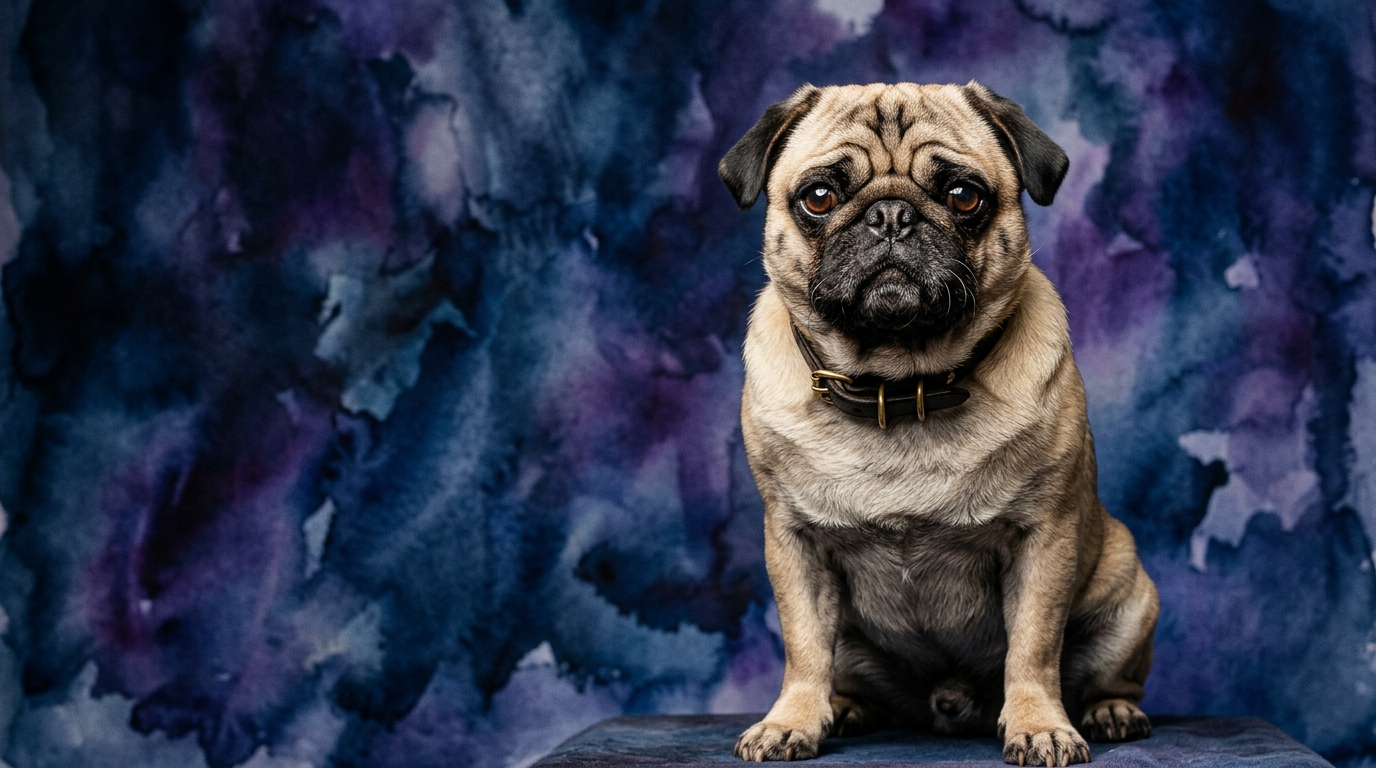
Pug at a glance
| IQ Rank / Score | #57 |
|---|---|
| Trainability | ★★☆☆☆ (2/5) |
| Social Intelligence | ★★★★★ (5/5) |
| Lifespan | 12-16 years |
| Shedding | Low to moderate |
| Exercise Needs | Moderate (30-45 min/day) |
| Origin | China |
The Pug's Unique Brain: A Social Chameleon
Originating from ancient China, where they were cherished companions of emperors, Pugs have a rich history intertwined with human society. In fact, a group of Pugs is collectively known as a 'grumble' – a fitting term for these famously expressive dogs. Their legacy extends to European royalty, with stories like William II of Orange's Pug reportedly saved his life by alerting him to Spanish attackers, cementing their role as loyal and observant companions.
This deep historical bond highlights a key aspect of Pug cognition: their exceptional social intelligence. Unlike breeds bred for hunting or herding, the Pug's evolution has prioritized the ability to understand and integrate seamlessly into human social structures. They are perceptive observers, adept at reading emotional cues and adapting their behavior to fit the mood of a room, often with a humorous twist.
While a Pug's problem-solving skills might rate a 2 out of 5 and their training speed a 2 out of 5 on some scales, their social intelligence shines at a remarkable 5 out of 5. This means they are less about complex logic puzzles and more about understanding you. They excel at emotional mirroring and using physical comedy, whether it's a dramatic sigh or a head tilt, to manage social dynamics and ensure they're always at the center of attention and affection.
Decoding Pug Cognition: More Than Just a Pretty Face
To truly appreciate a Pug's mind, we must look beyond conventional metrics of working dog intelligence and focus on their unique strengths. Their high social intelligence isn't just about being friendly; it's a sophisticated ability to form strong, empathic bonds, making them highly attuned to their human companions' feelings. They are masters of non-verbal communication, often 'telling' you what they need or how they feel through their extensive repertoire of facial expressions and body language, which their wrinkly faces amplify.
Their memory, rated at 3 out of 5, is particularly strong when it comes to routines, people, and positive associations. They quickly learn who provides the best belly rubs or the most delicious treats, and they rarely forget a friendly face. This memory, combined with their social drive, makes them surprisingly consistent in familiar environments, even if complex abstract tasks aren't their forte.
Instinctive drive, at 2 out of 5, indicates that Pugs aren't driven by innate urges to chase, retrieve, or guard in the way many other breeds are. Their primary motivation is connection and comfort. This allows their training to focus heavily on positive reinforcement and reward-based methods, leveraging their desire to please and engage with their favorite people rather than relying on an instinct to perform a specific job. Their relatively low problem-solving score also means they often prefer to charm their way to a solution rather than figure out a complex mechanism, a strategy that often works given their undeniable cuteness.
Training the Grumble: Leveraging Social Savvy
Training a Pug is a testament to the power of social motivation. While they may not be the fastest to pick up a new command, their eagerness to interact and earn praise means they can learn a wide array of behaviors with patience and consistency. Short, fun training sessions, abundant positive reinforcement, and clear, concise commands work best. Think of it as a collaborative game rather than strict instruction, and you'll find your Pug a willing participant, especially if treats and cuddles are involved.
Their social intelligence makes them excellent candidates for therapy work or as comforting companions. They naturally gravitate towards people in need of a gentle presence, intuitively offering comfort without needing extensive training for such roles. This innate ability to connect on an emotional level is a cornerstone of their intelligence profile and a joy for any owner to witness.
Providing mental stimulation for a Pug isn't about advanced agility courses, but about engaging their social and communicative skills. Interactive toys that don't require high physical exertion, gentle scent games, and opportunities for social interaction – both with humans and well-socialized dogs – are ideal. Simple tasks like 'find the treat' games where you hide a treat under a cup (once they learn the pointing test!) can be highly engaging, reinforcing their human-centric problem-solving.
3 At-Home Tests to Measure Your Pug's IQ
These tests are adapted from peer-reviewed ethology research. No equipment is needed beyond items you have at home. Run each test 5–10 times for reliable results.
The Myth: "Pugs are too physically limited and dumb to learn complex behaviors."
✅ Pugs are entirely capable of learning complex behaviors, provided the training methods are adapted to their physical attributes and strong social motivation. While they might not be built for high-impact agility, they can master intricate trick sequences, learn complex scent work, or perform specific tasks that leverage their keen social understanding and desire to please their humans. Their intelligence simply expresses itself differently.
Pug vs. Similar Breeds
🧠 What's Your Dog's IQ Score?
Our full Pet IQ Lab assessment includes 12+ tests across 5 cognitive dimensions, calibrated for Pugs specifically.
Take the Full IQ Test →Frequently Asked Questions
How smart is a Pug?
Our Pet IQ Lab framework scores cognition across five dimensions (max 25). The Pug totals 14/25 — above-average for a domestic dog. The full article breaks down each dimension with at-home tests.
Are Pugs easy to train?
Pugs are independent learners; short, highly-motivating sessions work best. They score 2/5 on Training Speed in our breed profile.
Are Pugs good with children and other pets?
Yes — their Social Intelligence rates 5/5 in our Pet IQ Lab framework. With early socialization and supervised play, most Pugs integrate well into families with respectful children and other pets.
Do Pugs need a lot of mental stimulation?
Pugs benefit from 10-15 minutes of focused enrichment a day: food puzzles, short training drills, or novel toys rotated weekly.
How much exercise does a Pug need?
Pugs do well with 20-40 minutes of daily walks and play plus a few short training moments.
How good is a Pug's memory?
Pugs score 3/5 on memory. They remember high-value associations well; less-used cues fade without refresher sessions.
What is the typical lifespan of a Pug?
Pugs commonly live 12-16 years when kept at a healthy weight.
Pugs prove that intelligence comes in many delightful forms, often masked by their endearing, snorting charm. Their social acumen and ability to deeply connect make them far more than just pretty faces; they're astute companions who truly understand the heart of a home.