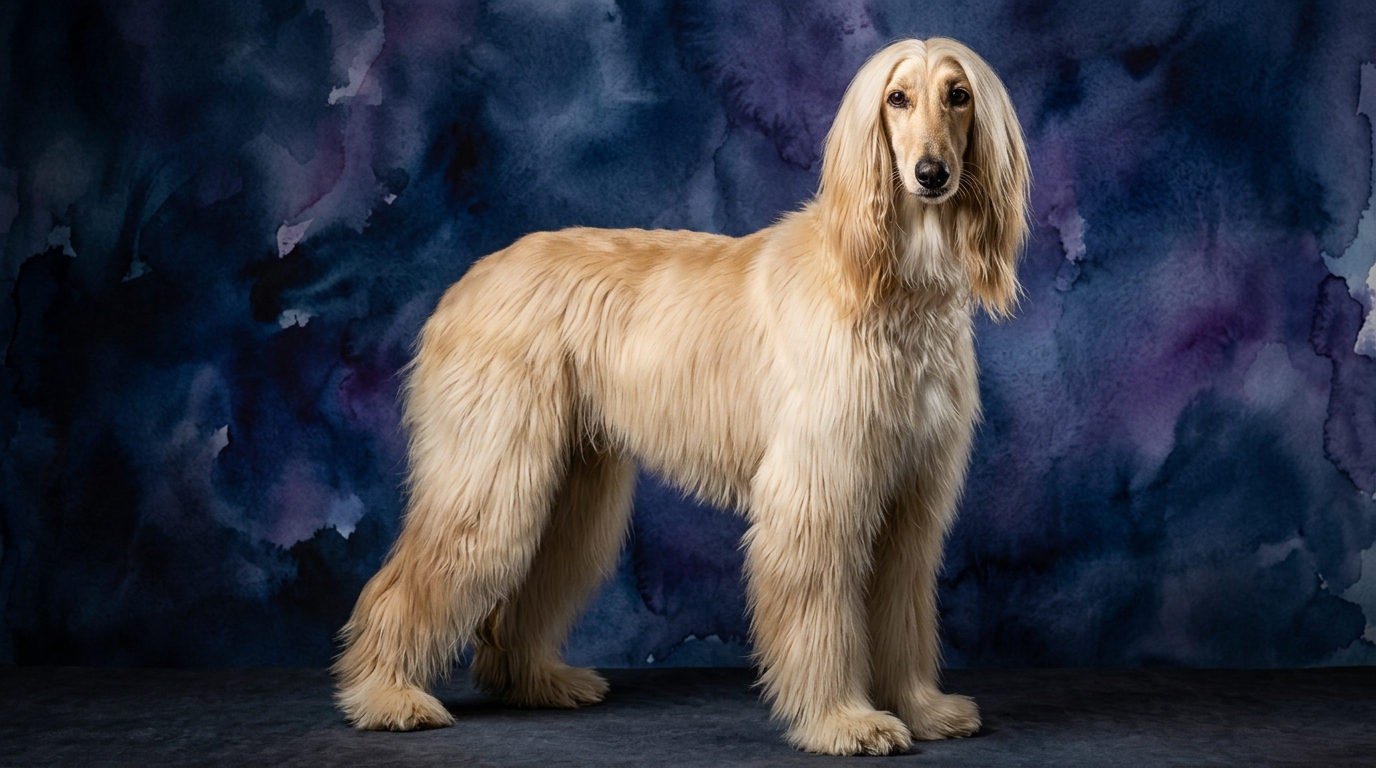
Afghan Hound at a glance
| IQ Rank / Score | #79 |
|---|---|
| Trainability | ★☆☆☆☆ (1/5) |
| Social Intelligence | ★★☆☆☆ (2/5) |
| Lifespan | 10-12 years |
| Shedding | Moderate to high |
| Exercise Needs | High (60+ min/day + training) |
| Origin | Afghanistan |
The Myth of the 'Dumb' Hound: Rethinking Intelligence Scores
For years, popular rankings have placed the Afghan Hound low on the obedience intelligence scale, sometimes leading to the unfair assumption that they lack mental capacity. Stanley Coren's often-cited work, for example, positions them at #79 out of 138 breeds for 'working and obedience intelligence.' However, this specific metric primarily measures a dog's willingness and speed to comply with human commands, not their overall problem-solving ability or adaptive thinking. It's crucial to understand that a dog who doesn't readily follow instructions isn't necessarily a dog who can't think; often, they're simply thinking independently.
The traditional concept of 'dog intelligence' frequently overemphasizes a breed's eagerness to please and quick response to training cues. For the Afghan Hound, whose ancestral role demanded self-reliance and autonomous decision-making in vast, unforgiving terrains, such obedience was not only unnecessary but potentially detrimental. Their survival depended on an entirely different set of mental tools, favoring independent action over waiting for human direction. This historical context provides a critical lens through which to view their unique cognitive architecture, moving beyond a narrow definition of canine smarts.
A Hunter's Mind: Instinct, Problem-Solving, and Perception
To truly appreciate the Afghan Hound's intelligence, one must look at their core strengths, particularly their profound instinctive drive and exceptional problem-solving capabilities. These sighthounds were bred for coursing game across the rugged mountains and deserts of Afghanistan, a task that required swift, independent judgments and incredible physical agility. This ancient purpose shaped a mind that prioritizes immediate, effective action over waiting for a human signal.
Their intelligence profile reveals a significant 'Instinctive Drive' at 5/5, indicating an almost unparalleled natural inclination to hunt, chase, and pursue. Coupled with a 'Problem Solving' score of 4/5, it becomes clear that these dogs possess a formidable capacity to analyze and navigate complex environments on their own terms. Imagine a dog needing to track fast-moving prey over varied terrain, making split-second decisions about the best path and timing without a human voice guiding them. Their very survival hinged on superior autonomous cognitive function.
This unique blend of perception and agility is astonishing. Afghan Hounds can see objects up to a mile away, allowing them to spot quarry from incredible distances. Furthermore, their physical design complements their mental acuity; they can turn their hip joints with cat-like flexibility, allowing them to pivot sharply while coursing at full speed. This combination of far-reaching vision, acute problem-solving, and unparalleled physical dexterity illustrates a specific, highly adapted form of intelligence far removed from rote obedience. Their success in such demanding conditions speaks volumes about their inherent cognitive strengths.
The Independent Thinker: Training Speed and Social Dynamics
Where Afghan Hounds often surprise owners is in their 'Training Speed,' ranked at 1/5. This isn't an indicator of an inability to learn, but rather a reflection of their deep-seated independence. An Afghan Hound learns quickly what *they* want to learn, and often decides if a human command aligns with their own agenda. Their history as solitary hunters meant they rarely relied on close human partnership in the field, fostering a self-sufficient mindset that translates into a different approach to training.
Their 'Social Intelligence' also sits at 2/5, suggesting they are not always seeking to please or deeply entwined with human emotional states in the same way some other breeds might be. This aloofness is a hallmark of their breed and often interpreted incorrectly as disinterest or lack of affection. Instead, it reflects a dog who is secure in their own judgment and less inclined to defer to external authority. Training an Afghan Hound, therefore, requires patience, creativity, and a deep understanding of their motivations. It's less about commanding and more about convincing and making the desired action appealing to their independent nature. Positive reinforcement, especially when linked to their inherent drives, is key to unlocking their cooperation.
Memory and Learning: Retention on Their Own Terms
With a 'Memory' score of 3/5, Afghan Hounds demonstrate a moderate but effective capacity for retaining information. This memory serves them well in navigating familiar territories, recalling scents, and remembering advantageous hunting paths. While they might not remember every command immediately after being taught, they certainly remember experiences, routines, and places with impressive clarity. Their learning is often experiential and context-dependent; they learn best through repetition in situations that make sense to them, rather beautiful through abstract command drills. Understanding this helps owners tailor training methods that respect their cognitive style, leading to more successful and less frustrating interactions. They are observant and capable of learning complex sequences, but their application of that learning is often self-directed.
Unlocking Their Potential: Enrichment for the Afghan Hound Mind
Engaging an Afghan Hound's intelligence means catering to their unique profile. Activities that tap into their 'Instinctive Drive' and 'Problem Solving' skills are highly beneficial. Lure coursing, where they can chase an artificial 'prey' in a safe environment, provides an unparalleled outlet for their natural instincts and sharpens their incredible speed and agility. Puzzle toys that require them to figure out how to get a treat, or scent games that leverage their moderate memory and keen senses, can provide valuable mental stimulation.
Instead of focusing solely on traditional obedience drills, consider integrating training into more engaging, 'real-world' scenarios. Long, varied walks where they can explore new scents and sights, securely fenced areas for free running, and opportunities for independent exploration (always safely managed) will help keep their minds active and satisfied. Building a trusting relationship, where you respect their independent decision-making while still providing gentle guidance, is the most effective way to foster cooperation and deepen your bond with this magnificent, thinking breed.
3 At-Home Tests to Measure Your Afghan Hound's IQ
These tests are adapted from peer-reviewed ethology research. No equipment is needed beyond items you have at home. Run each test 5–10 times for reliable results.
The Myth: "The Afghan Hound is the dumbest purebred dog, incapable of learning."
✅ Afghan Hounds possess a sophisticated, independent intelligence geared towards autonomous problem-solving and instinctive action, rather than obedience. They are highly capable of learning, but often choose to apply their intellect in ways that suit their own agenda, reflecting their historical role as self-reliant hunters.
Afghan Hound vs. Similar Breeds
🧠 What's Your Dog's IQ Score?
Our full Pet IQ Lab assessment includes 12+ tests across 5 cognitive dimensions, calibrated for Afghan Hounds specifically.
Take the Full IQ Test →Frequently Asked Questions
How smart is a Afghan Hound?
Our Pet IQ Lab framework scores cognition across five dimensions (max 25). The Afghan Hound totals 15/25 — above-average for a domestic dog. The full article breaks down each dimension with at-home tests.
Are Afghan Hounds easy to train?
Afghan Hounds are independent learners; short, highly-motivating sessions work best. They score 1/5 on Training Speed in our breed profile.
Are Afghan Hounds good with children and other pets?
Afghan Hounds can live well with families when socialized early. Their Social Intelligence scores 2/5, so supervise interactions with small children and introduce new pets gradually.
Do Afghan Hounds need a lot of mental stimulation?
Absolutely. With Problem Solving 4/5 and Instinctive Drive 5/5, Afghan Hounds need daily mental work — puzzle feeders, scent games, training sessions, or nose-work — to avoid boredom.
How much exercise does a Afghan Hound need?
Afghan Hounds need active engagement. Plan for 45-60 minutes of exercise and training per day, plus mental stimulation.
How good is a Afghan Hound's memory?
Afghan Hounds score 3/5 on memory. They remember high-value associations well; less-used cues fade without refresher sessions.
What is the typical lifespan of a Afghan Hound?
Typical lifespan is 10-12 years for a large dog like the Afghan Hound.
The Afghan Hound's intelligence is a testament to adaptive evolution, perfectly suited for the challenging landscapes of their origin. Beyond the veneer of perceived stubbornness lies a profoundly capable, independent mind waiting to be understood and celebrated for its unique brilliance.