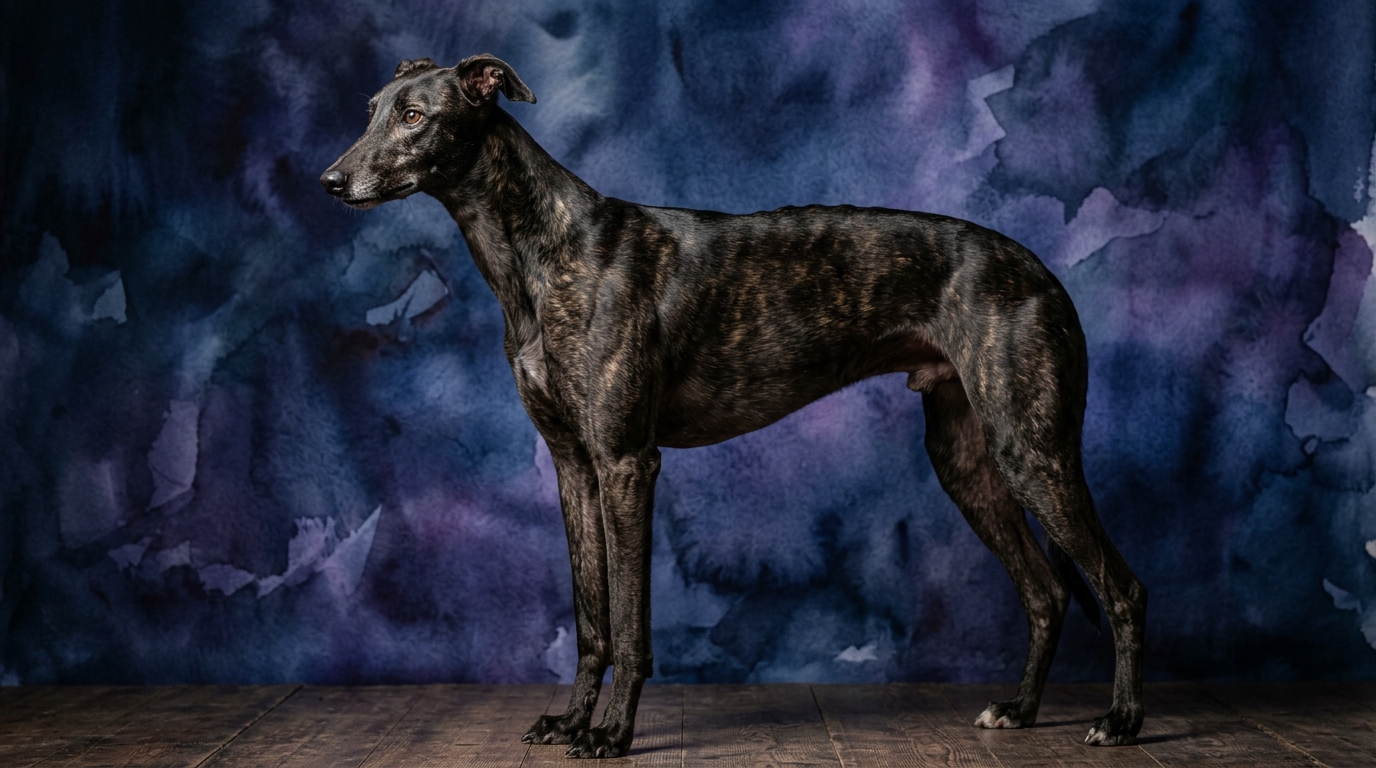
Greyhound at a glance
| IQ Rank / Score | #46 |
|---|---|
| Trainability | ★★☆☆☆ (2/5) |
| Social Intelligence | ★★★☆☆ (3/5) |
| Lifespan | 10-12 years |
| Shedding | Moderate to high |
| Exercise Needs | High (60+ min/day + training) |
| Origin | Egypt/Middle East |
The Greyhound's Ancient Mindset
Far beyond the racetrack, the Greyhound stands as a testament to specialized evolution and keen intellect. These elegant canines are often perceived solely through the lens of their blistering speed, yet beneath their sleek physique lies a mind finely tuned to observation, strategy, and environmental awareness. To truly appreciate a Greyhound's unique intelligence, we must look beyond conventional metrics and understand the profound history that shaped their cognitive strengths.
Indeed, the Greyhound’s lineage is as long and distinguished as any breed. They are the only dog breed mentioned by name in the Bible and were depicted in Egyptian tomb paintings dating to 4000 BCE — solidifying their status as the oldest purebred dog in history. This incredible heritage speaks volumes about their enduring purpose and the specific traits that humans have valued in them for millennia. Their presence alongside pharaohs and in ancient scriptures underscores a deeply ingrained working partnership.
This ancient partnership was not just about companionship; it was about performance. Their ability to hunt by sight, tracking fast-moving prey across open plains, demanded exceptional cognitive processing. This specialized role forged a breed whose brain is inherently optimized for rapid visual information analysis, trajectory calculation, and instantaneous decision-making – faculties that are often overlooked in standard intelligence assessments but are crucial to their very essence.
Decoding Greyhound Cognition: A Sighthound's Perspective
When we look at standardized intelligence rankings, Greyhounds sit at number 46 out of 138 breeds according to Stanley Coren's obedience framework. This ranking, while a useful benchmark for task-based obedience, doesn't fully capture the breadth of their cognitive capabilities. It simply indicates that their intelligence manifests differently than, say, a Border Collie, prioritizing instinct and independent thought over eagerness to follow complex human commands. Their intelligence isn't less, it's just *different* and adapted to a distinct evolutionary purpose.
The cornerstone of Greyhound cognition is their astonishing sight-based processing. With a visual field spanning an incredible 270 degrees, these dogs perceive the world with an expansive perspective unknown to many other breeds. Their brains are finely tuned, not just to see, but to *analyze* motion-detection and calculate trajectories with precision, even at speeds up to 70 km/h. This isn't just about fast reflexes; it's a sophisticated form of spatial intelligence, allowing them to predict and react to movement in their environment with unparalleled accuracy.
This superior visual acuity and processing power translates into highly developed instinctive drives. They are masters of the chase, able to assess distance, speed, and evasive maneuvers of prey targets in an instant. This rapid, instinctual problem-solving in a dynamic, high-stakes environment is a testament to their specialized intelligence. Their memory (3/5) also plays a role here, helping them recall successful hunting strategies or safe routes within their familiar territory, contributing to their efficiency and survival skills.
What Makes a Greyhound's Brain Tick?
Diving into specific cognitive dimensions, Greyhounds demonstrate a Problem Solving score of 3/5. This isn't about solving puzzle toys in a living room, but about intricate, real-world solutions during a pursuit. A Greyhound might calculate the optimal path to intercept a moving object, navigate complex terrain at speed, or quickly assess which direction a perceived "prey" animal is likely to bolt. Their problem-solving is quick, decisive, and often tied directly to their visual perception and prey drive.
Their Training Speed, rated at 2/5, can sometimes be misinterpreted as a lack of smarts. In reality, it often reflects their independent nature and a strong focus on what *they* find intrinsically rewarding, rather than simply pleasing a human. Greyhounds learn quickly when the task aligns with their instincts or offers clear, positive reinforcement. They thrive with patient, reward-based methods that acknowledge their sensitive temperament and independent spirit, rather than repetitive, rote drills.
Social Intelligence, at 3/5, highlights their nuanced understanding of emotional cues. Greyhounds are often surprisingly sensitive dogs, capable of reading human body language and tone with accuracy. They tend to form deep bonds with their chosen people, often showing a reserved affection that blossoms into quiet devotion. While not always overtly demonstrative, their subtle responses demonstrate a clear understanding of social dynamics within their family unit, making them intuitive companions.
The Instinctive Drive of a Greyhound is a resounding 5/5, which is the very core of their cognitive design. This isn't just a brute urge; it's a highly sophisticated, ingrained set of behaviors and decision-making processes optimized for hunting by sight. This drive fuels their bursts of speed, their focus on moving objects, and their innate understanding of pursuit dynamics. It's a primal intelligence, honed over millennia, that dictates much of their interaction with the world and makes them uniquely who they are.
Finally, their Memory, scoring 3/5, supports their ability to navigate familiar environments and learn routines. While perhaps not retaining every single command with perfect recall, they remember places, people, and experiences that are significant to them. This allows them to quickly adapt to new homes, learn the layout of a park, and recognize their family members even after a period of absence, demonstrating a practical and robust memory for what matters in their daily lives.
3 At-Home Tests to Measure Your Greyhound's IQ
These tests are adapted from peer-reviewed ethology research. No equipment is needed beyond items you have at home. Run each test 5–10 times for reliable results.
The Myth: "Greyhounds need massive amounts of exercise — they're unsuitable for apartment living"
✅ While Greyhounds are built for bursts of speed, they are surprisingly calm and enjoy lounging, often earning them the nickname '45 mph couch potatoes.' A few brisk walks or short sprints in a secure area daily are usually sufficient, and their docile indoor nature makes them perfectly suited for apartment living, provided they have a soft spot to nap.
Greyhound vs. Similar Breeds
🧠 What's Your Dog's IQ Score?
Our full Pet IQ Lab assessment includes 12+ tests across 5 cognitive dimensions, calibrated for Greyhounds specifically.
Take the Full IQ Test →Frequently Asked Questions
How smart is a Greyhound?
Our Pet IQ Lab framework scores cognition across five dimensions (max 25). The Greyhound totals 16/25 — high for a domestic dog. The full article breaks down each dimension with at-home tests.
Are Greyhounds easy to train?
Greyhounds are independent learners; short, highly-motivating sessions work best. They score 2/5 on Training Speed in our breed profile.
Are Greyhounds good with children and other pets?
Greyhounds can live well with families when socialized early. Their Social Intelligence scores 3/5, so supervise interactions with small children and introduce new pets gradually.
Do Greyhounds need a lot of mental stimulation?
Absolutely. With Problem Solving 3/5 and Instinctive Drive 5/5, Greyhounds need daily mental work — puzzle feeders, scent games, training sessions, or nose-work — to avoid boredom.
How much exercise does a Greyhound need?
Greyhounds need active engagement. Plan for 45-60 minutes of exercise and training per day, plus mental stimulation.
How good is a Greyhound's memory?
Greyhounds score 3/5 on memory. They remember high-value associations well; less-used cues fade without refresher sessions.
What is the typical lifespan of a Greyhound?
Typical lifespan is 10-12 years for a large dog like the Greyhound.
From ancient Egyptian murals to modern homes, the Greyhound's intelligence, rooted in sight and instinct, continues to captivate. Embrace their unique cognitive profile, and you'll discover a loyal, surprising, and truly special companion.