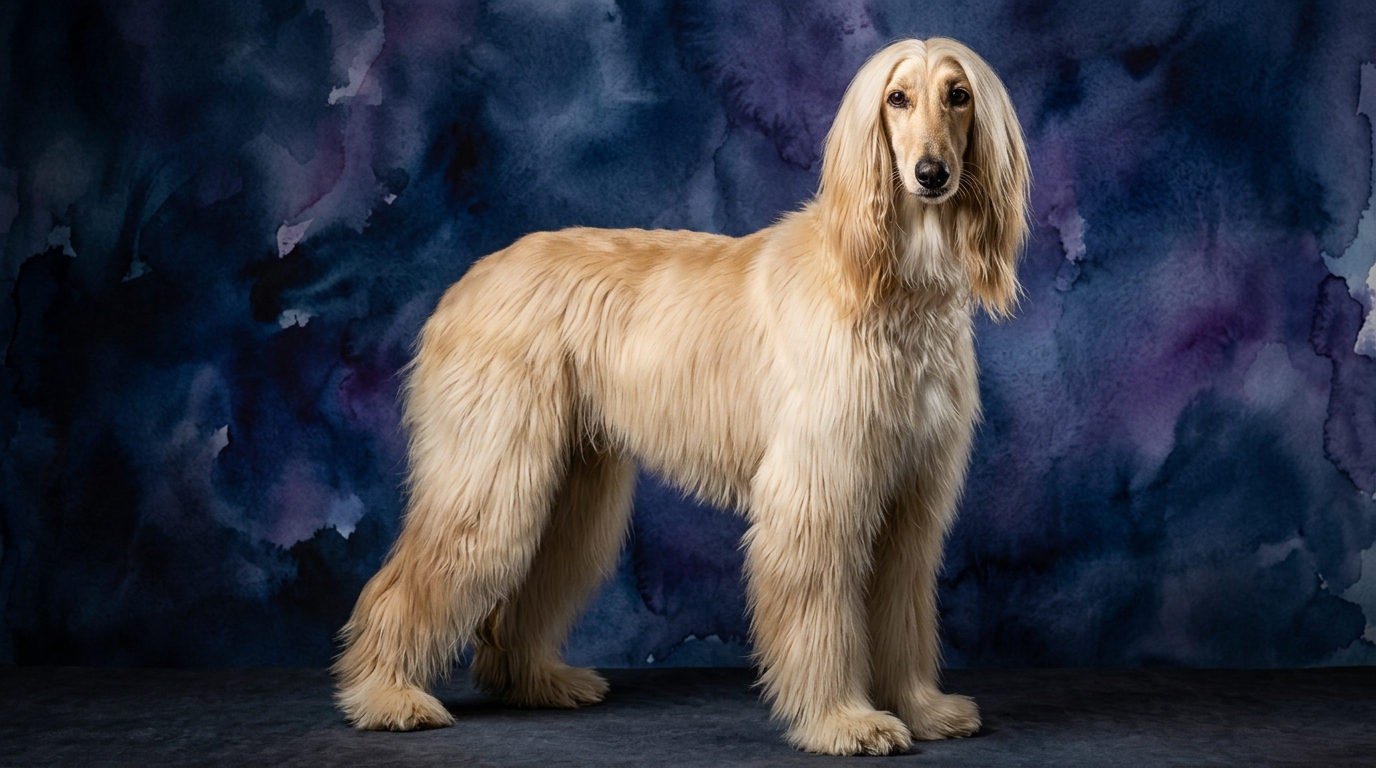

Side-by-Side Cognitive Profile
The Cosmic Pet Pet IQ Lab employs five key dimensions to evaluate canine intelligence, offering a nuanced understanding beyond simple obedience. Let's examine how the Afghan Hound and English Cocker Spaniel stack up against each other.
The Afghan Hound, with a Coren ranking of #79, is often perceived as aloof, but their cognitive profile reveals a distinct form of intelligence. Their Problem Solving is rated 4/5, indicating a strong capacity for complex thought, frequently applied to navigating their environment independently or devising strategies during a chase. Training Speed, however, is 1/5, reflecting their profound independence and minimal desire to perform repetitive tasks for human approval, making them slow to grasp new commands. Social Intelligence stands at 2/5; while they can interpret human cues, they often choose to act on their own terms rather than seeking constant interaction or affirmation. Their Instinctive Drive is a powerful 5/5, fueled by an intense prey drive and an inherent need for running and hunting, a direct legacy of their sighthound heritage. Memory is assessed at 3/5, meaning they retain routines and significant experiences adequately, but recall of specific commands can be inconsistent without high motivation.
In stark contrast, the English Cocker Spaniel, ranked #18 by Coren, presents a profile geared towards cooperative endeavors. Their Problem Solving is also 4/5, demonstrating excellent cognitive flexibility and an aptitude for figuring out puzzles or practical tasks, especially when a reward or a shared goal is involved. Training Speed is a high 4/5; they typically learn new commands and concepts quickly, displaying enthusiasm and a strong desire to work alongside their human companions. Social Intelligence is 3/5, as they are generally adept at reading human emotions and intentions, often seeking interaction and eager to please, though they can be sensitive to perceived harshness. Their Instinctive Drive is a moderate 3/5, a remnant of their flushing and retrieving origins, which is typically manageable and readily channeled into interactive play or scent work. Memory is an impressive 5/5, allowing them to recall commands, names, and established routines with remarkable consistency, establishing them as highly reliable learners.
Where the Afghan Hound Excels Cognitively
The Afghan Hound's cognitive strengths lie in their self-directed problem-solving and unparalleled instinctive drive. While their 4/5 problem-solving score matches the Cocker's, the application differs significantly. Afghan Hounds often employ their cognitive abilities in autonomous ways, such as finding the most efficient path during a free run or independently assessing a situation rather than waiting for human instruction. This makes them remarkably adept at tasks requiring independent thought and less reliant on constant human guidance. Their 5/5 Instinctive Drive is a clear cognitive win for specific purposes, such as lure coursing, where their natural drive to chase and their inherent agility and speed are unmatched by most breeds. In these contexts, their deep-seated instincts become a powerful cognitive tool, allowing them to perform with an intensity and focus that is difficult to replicate through training alone. They possess a primal intelligence perfectly tuned for their original purpose, showcasing a profound understanding of their own body mechanics and environmental dynamics during pursuit.
Where the English Cocker Spaniel Shines Cognitively
The English Cocker Spaniel's cognitive advantages are rooted in their cooperative intelligence and remarkable capacity for learning and retention. Their 4/5 Training Speed and perfect 5/5 Memory score make them exceptionally receptive to instruction and highly reliable in performing learned behaviors over time. This combination allows them to rapidly acquire a vast repertoire of commands and tricks, making them versatile companions for various activities, from obedience and agility to therapy work. Their problem-solving capabilities (4/5), when combined with their eagerness to please and strong memory, translate into a dog that can not only figure things out but also remembers how to apply those solutions consistently within a human-structured environment. Furthermore, their 3/5 Social Intelligence gives them an edge in understanding and responding appropriately to human social cues, fostering a strong, communicative bond that is crucial for successful partnership and complex task execution. They thrive on collaborative learning, making them highly adaptable to new challenges presented by their owners.
Training: Ease and Behavioral Differences
When it comes to ease of training, the English Cocker Spaniel holds a distinct advantage due to fundamental differences in motivation and learning styles. Their 4/5 Training Speed and 5/5 Memory mean they pick up commands quickly and retain them reliably. English Cockers possess a strong intrinsic desire to please their owners and thrive on positive reinforcement and interactive learning sessions, making them highly responsive pupils. They enjoy the process of learning and working alongside their humans, viewing training as a collaborative game. This eagerness translates into a dog that is generally forgiving of handler errors and consistently motivated to perform.
The Afghan Hound, conversely, presents a more significant training challenge, reflected in their 1/5 Training Speed. Their independent nature means they are not inherently driven by a desire to please and often find repetitive drills tedious. While capable of learning, their motivation must be exceptionally high, and training methods must be highly engaging and varied to hold their interest. They are more likely to respond to a command if they perceive a direct benefit to themselves or if the task aligns with their natural instincts, rather than simply for human approval. This behavioral difference means that while an Afghan Hound can be trained, it requires immense patience, consistency, and a deep understanding of their unique, self-reliant temperament.
Suitability for Active vs. Relaxed Owners
The distinction between an active and a relaxed owner is crucial when considering these two breeds. The Afghan Hound, with its 5/5 Instinctive Drive, requires a highly active owner who can provide ample opportunities for free running in a secure, fenced area. Their exercise needs go beyond leashed walks; they need to gallop and stretch their powerful sighthound bodies to be content. Owners for an Afghan Hound should also be 'relaxed' in the sense that they appreciate and respect the breed's independent nature, not expecting constant interaction or unwavering obedience. They suit owners who understand that companionship can exist without constant supervision or a dog that lives to please every command.
The English Cocker Spaniel, while also an active breed, suits an owner whose activity is more interactive and structured. Their moderate 3/5 Instinctive Drive means they enjoy walks, hikes, and engaging play sessions that involve their human. They thrive on mental stimulation and companionship, making them ideal for owners who enjoy consistent training, games, and shared activities. They are less suited for owners who prefer a truly 'relaxed' approach to dog ownership, as their need for engagement and mental stimulation means they require regular attention and interaction to prevent boredom and potential behavioral issues. An English Cocker Spaniel thrives with an owner who wants an active participant in their daily life, rather than a self-sufficient observer.
The Verdict
Choose an Afghan Hound if you are an experienced owner who appreciates a majestic, independent companion, capable of self-directed thought, and can provide extensive secure space for their powerful running instincts.
Opt for an English Cocker Spaniel if you seek an eager-to-please, highly trainable, and interactive companion who thrives on shared activities, consistent engagement, and a strong partnership.
🧠 Find Your Pet's IQ Score
Our Pet IQ Lab assessment covers 25+ tests across 5 cognitive dimensions — personalized to your breed.
Take the Full IQ Test →Frequently Asked Questions
Are Afghan Hounds truly difficult to train?
Afghan Hounds are not 'difficult' in the sense of lacking capacity, but rather 'challenging' due to their strong independent spirit and low desire to please. Training requires immense patience, positive reinforcement, and understanding their unique motivations, often involving making tasks rewarding for them directly.
Which breed is better for a family with children?
The English Cocker Spaniel generally adapts better to family life with children due to their higher social intelligence and eagerness to please, often enjoying interactive play. Afghan Hounds can be good with respectful children, but their independent nature means they may tolerate rather than actively seek out interaction, and their sheer size requires careful supervision.
Do English Cocker Spaniels require a lot of exercise?
English Cocker Spaniels do require a good amount of exercise, but it is typically more about interactive engagement than sheer mileage. Daily walks, play sessions, and mental stimulation through training or puzzle toys are essential to keep them happy and prevent boredom, channeling their moderate instinctive drive constructively.