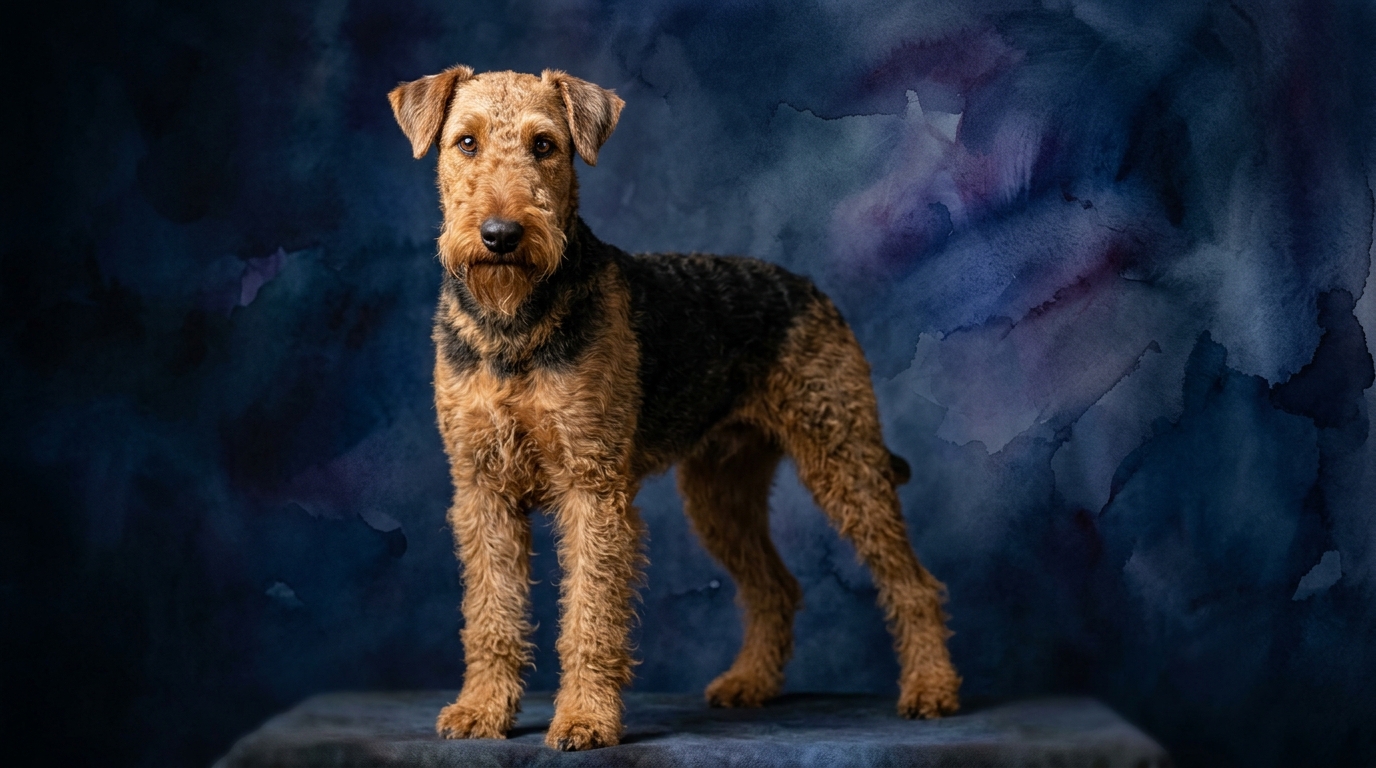

Side-by-Side Cognitive Profiles: Airedale Terrier vs. Rhodesian Ridgeback
Understanding the specific dimensions of intelligence, as outlined by The Cosmic Pet Pet IQ Lab, helps us dissect the unique mental aptitudes of these breeds.
The Airedale Terrier, ranked #29 by Coren, presents a profile marked by agility and retention. Their Problem Solving is rated at 4/5, indicating a robust capacity for independent thought and quickly devising effective solutions in novel situations. Training Speed also stands at 4/5, meaning they typically grasp new commands and routines with impressive alacrity, often requiring fewer repetitions to solidify learning. Social Intelligence is 3/5, showing a moderate understanding of human social cues and group dynamics, capable of forming strong bonds and responding to emotional states. Their Instinctive Drive is 3/5, manifesting as a present, yet manageable, drive for chasing, digging, and investigating, reflecting their historical role in vermin control. Finally, Memory is 4/5, signifying a strong recall for learned behaviors, locations, and experiences over extended periods.
The Rhodesian Ridgeback, with a Coren rank of #52, exhibits a more balanced and steady cognitive array. Their Problem Solving is 3/5, indicating a competent ability to navigate challenges, often employing a thoughtful, methodical approach rather than impulsive action. Training Speed is 3/5, meaning this breed learns at a steady pace, requiring consistent, positive reinforcement to absorb new commands effectively. Social Intelligence is 3/5, displaying a similar moderate level of social attunement, connecting deeply with their families and understanding social structures within the home, though often discerning with strangers. Their Instinctive Drive is 3/5, reflecting a hunting background that imbues them with a moderate prey drive and an instinct for guarding, translating into vigilance and a desire to patrol their territory. Memory is 3/5, demonstrating a reliable recall for training and experiences, building upon their knowledge base steadily.
Where the Airedale Terrier Wins Cognitively
The Airedale Terrier's cognitive advantages are most pronounced in areas demanding quick uptake and inventive solutions. Their superior Problem Solving score of 4/5 indicates a more agile mind when confronted with novel challenges, allowing them to independently assess and act. This might manifest in quickly figuring out how to open a child-proof gate or retrieving a dropped toy from an awkward spot without direct instruction, showcasing their capacity for independent thought and creative solutions.
Coupled with a Training Speed of 4/5, Airedales generally process and internalize new commands and complex sequences of actions with greater efficiency. They often require fewer repetitions to achieve proficiency in obedience, agility, or other learned tasks, making the initial stages of training particularly rewarding for their human companions. This responsiveness to instruction allows for faster progression through training levels.
Furthermore, their Memory score of 4/5 means that once a lesson is learned or an experience is cataloged, it tends to stick, contributing to a consistently responsive and reliable companion over time. This robust memory also aids in their ability to recall complex routes or sequences, making them adept at navigation or multi-step tasks, and ensures that training investments yield lasting results.
Where the Rhodesian Ridgeback Wins Cognitively
While the Rhodesian Ridgeback's individual cognitive scores are generally a point lower than the Airedale's, their particular blend of attributes forms a distinct cognitive profile that excels in different contexts. A Ridgeback's Problem Solving at 3/5, while not as rapid as an Airedale's, often comes with a more deliberate and thoughtful approach. They may take longer to arrive at a solution, but once they do, it's often a well-considered one, less prone to the impulsive trial-and-error sometimes seen in quicker problem-solvers.
Their consistent 3/5 across Training Speed, Social Intelligence, Instinctive Drive, and Memory suggests a balanced and steady cognitive makeup. This balance translates into a composed and less reactive disposition, where learning is steady and retention is reliable, promoting a sense of calm and predictability. The Ridgeback's social intelligence, while rated similarly, often presents as a deep, quiet understanding of their family, coupled with a discerning watchfulness towards strangers, reflecting their guardian instincts rather than an overt eagerness to please.
Their instinctive drive, also 3/5, is often channeled into a protective vigilance rather than the more boisterous exploratory drive of a terrier, making them particularly astute at sensing and reacting to environmental changes related to security. This translates into a loyal and observant companion who often operates with a clear sense of purpose within their environment.
Which is Easier to Train and Why?
Comparing the ease of training between these two breeds highlights their inherent differences. The Airedale Terrier, with its 4/5 Training Speed, generally proves easier to train in terms of initial command acquisition. Their quicker grasp of concepts means they often pick up new tricks or obedience cues with fewer repetitions, making the early stages of training feel more rewarding and progressive. This efficiency is further bolstered by their strong 4/5 Memory, ensuring that learned behaviors are retained effectively and consistently.
Airedales often thrive on varied training sessions that challenge their agile minds, making them excellent candidates for advanced obedience, agility, or even trick training where novelty is key. However, their 3/5 Instinctive Drive, rooted in their terrier nature, means they can sometimes be independently minded or prone to following their nose, requiring consistent motivation and engagement to maintain focus and prevent distractions.
The Rhodesian Ridgeback, with a 3/5 Training Speed and 3/5 Memory, requires a more patient and consistent approach. They absorb information steadily, not rapidly, meaning training sessions need to be clear, positive, and regular to build a strong foundation, often taking more repetitions to solidify a command. Their 3/5 Instinctive Drive often manifests as a strong will and a discerning nature, meaning they need to understand the 'why' behind a command or feel a strong bond with their trainer to truly commit, rather than simply complying out of eagerness.
While they may not learn as quickly as an Airedale, once a Ridgeback understands and accepts a command, their performance is typically reliable and steadfast. Their training is less about speed and more about building trust and mutual respect, which, once established, forms a remarkably dependable partnership.
Active Owners vs. Relaxed Owners: Finding the Right Fit
For owners leading an active lifestyle who enjoy engaging in various dog sports or outdoor adventures, the Airedale Terrier often makes an excellent companion. Their combination of a 4/5 Problem Solving ability and a moderate 3/5 Instinctive Drive means they thrive on activities that provide mental stimulation and physical exertion, such as complex scent work, agility courses, or long hikes where they can explore with purpose. They enjoy having a 'job' and are often eager participants in family activities, adapting readily to new challenges and learning new skills.
Their robust memory and quick training speed mean they can learn complex routines for sports or perform reliably in diverse environments, making them suitable for competitive and adventurous owners. Airedales require consistent engagement to prevent boredom, which can lead to inventive, sometimes mischievous, independent activities.
Conversely, while Rhodesian Ridgebacks are certainly active dogs requiring regular exercise, their cognitive profile aligns well with owners who appreciate a more composed and deliberate companion, even if active. Their steady 3/5 scores across most dimensions suggest a dog that is less prone to impulsive decision-making and more inclined towards routines and predictable environments. While they need vigorous exercise, such as long runs or brisk walks, they are often content to then settle down and be a calm, watchful presence indoors.
Their discerning social intelligence means they form deep bonds and appreciate quiet companionship, making them suitable for owners who value a loyal, watchful presence but might not seek the constant mental gymnastics an Airedale often craves from its activities. They are excellent companions for long, steady outdoor adventures rather than quick, agile bursts of activity.
The Verdict
Opt for an Airedale Terrier if you seek a quick-witted, agile learner eager for diverse mental challenges and engaging training, and you are prepared to manage their independent terrier spirit.
Choose a Rhodesian Ridgeback if you value a composed, loyal companion with a steady learning pace and a discerning nature, and you are committed to patient, consistent training that builds a strong, respectful bond.
🧠 Find Your Pet's IQ Score
Our Pet IQ Lab assessment covers 25+ tests across 5 cognitive dimensions — personalized to your breed.
Take the Full IQ Test →Frequently Asked Questions
Are Airedale Terriers good for first-time dog owners?
Airedale Terriers can be a good fit for first-time owners who are committed to consistent training and mental stimulation. Their quick learning and strong memory are assets, but their independent terrier nature requires dedication to guidance and managing their active minds.
Do Rhodesian Ridgebacks require a lot of exercise?
Yes, Rhodesian Ridgebacks are athletic dogs that require regular, vigorous exercise to maintain their physical and mental well-being. Daily long walks, runs, or secure off-leash play are essential for this breed, typically for at least 60-90 minutes.
Which breed is more protective of its family?
While both breeds can be protective, the Rhodesian Ridgeback's historical role and discernible social intelligence often manifest in a more pronounced, watchful, and protective instinct towards their family and home. Airedales are alert but may be more focused on their own investigations or playful interactions.