Side-by-Side Cognitive Profiles
The Cosmic Pet Pet IQ Lab employs a five-dimensional framework to assess canine cognition, offering a granular view of each breed's intellectual blueprint. Understanding these specific scores helps illuminate not just what a dog can do, but how they approach the world mentally.
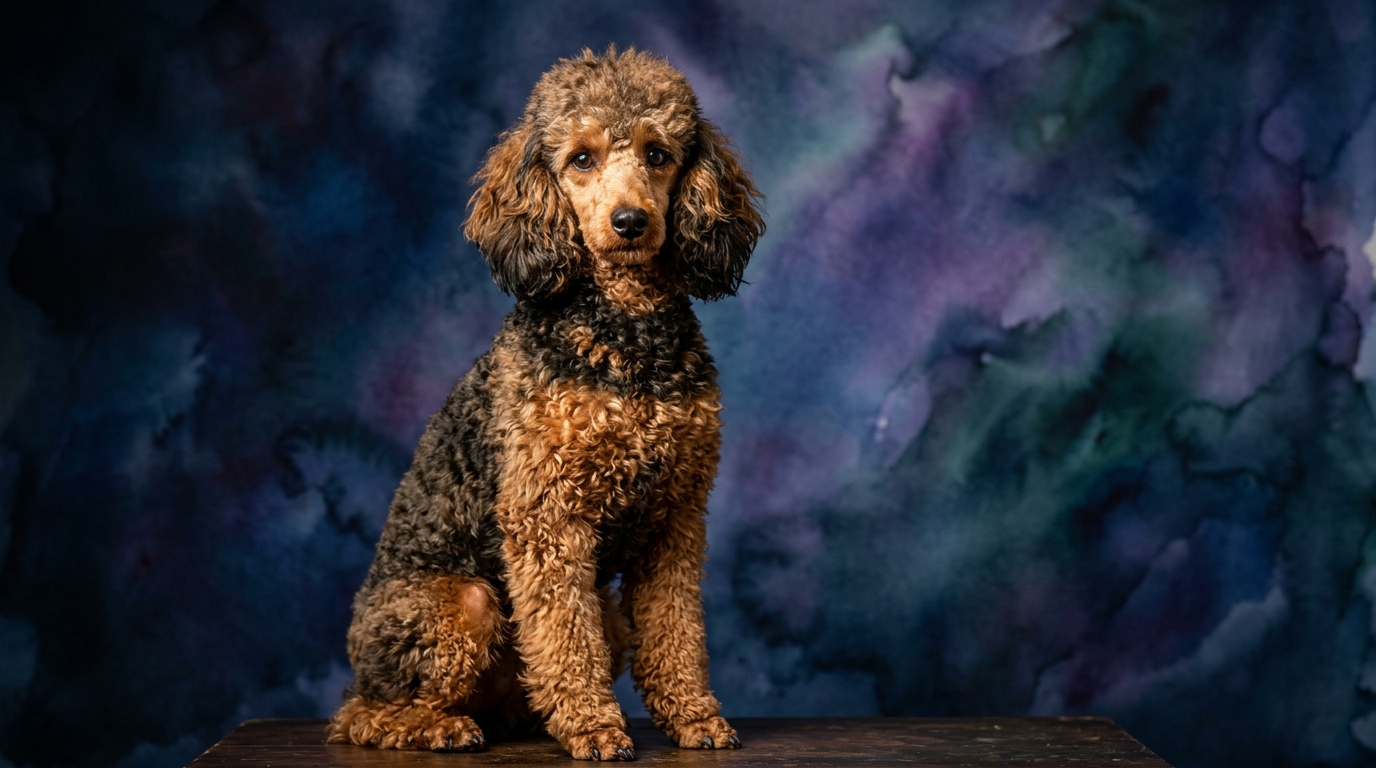
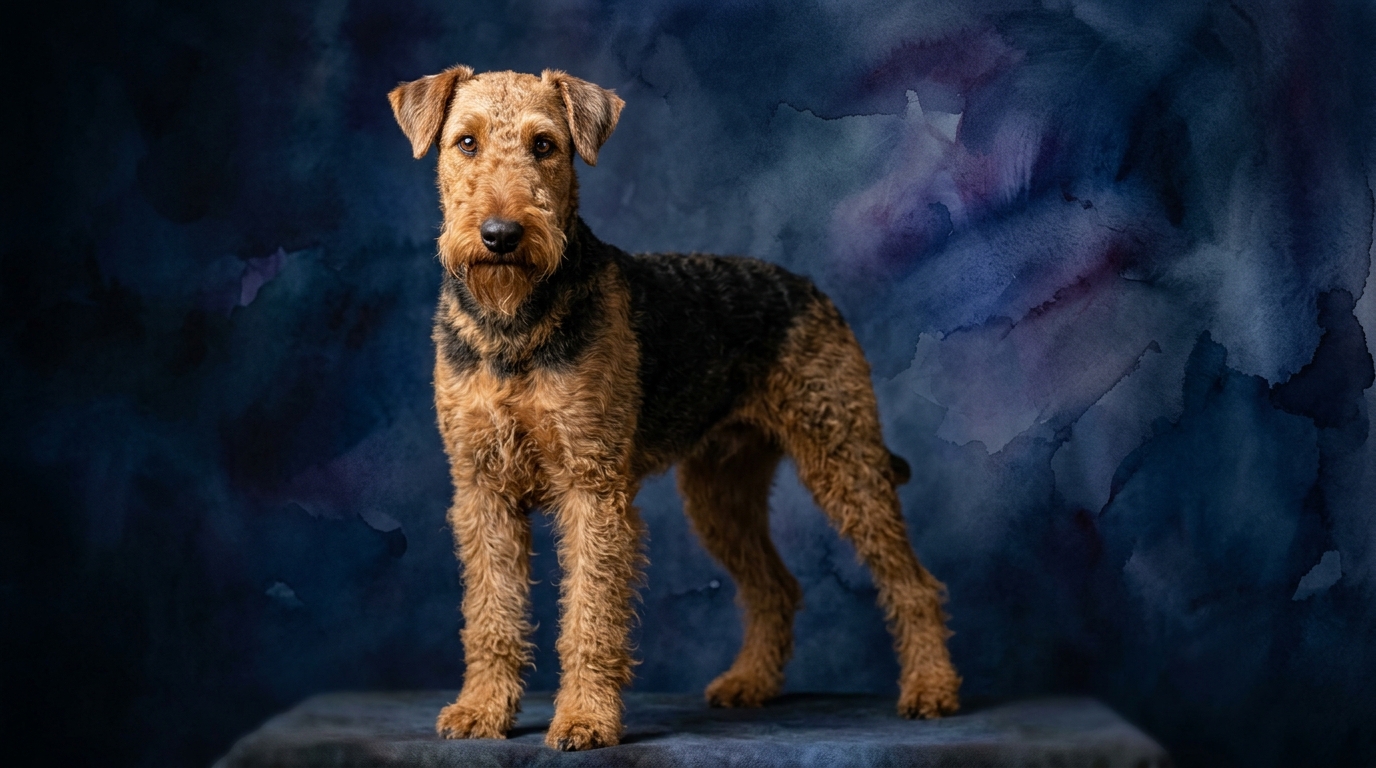
The Standard Poodle, a breed long associated with diverse roles from waterfowl retrieving to circus performance, exhibits a profound cognitive architecture. Its Problem Solving score of 5/5 indicates an exceptional capacity to analyze novel situations and devise effective strategies, often demonstrating foresight and planning. Training Speed, also at 5/5, reflects their rapid acquisition of new commands and complex sequences, requiring minimal repetition. Social Intelligence, another 5/5, highlights their acute understanding of human emotions, intentions, and social cues, fostering deep communicative bonds. An Instinctive Drive of 4/5 suggests a well-directed, purposeful motivation, particularly for tasks involving retrieval or structured activity. Finally, their Memory, rated 5/5, ensures enduring recall of learned behaviors, associations, and environmental details, contributing to their consistent performance. The Airedale Terrier, historically a formidable working dog, possesses a robust and independent cognitive profile. Their Problem Solving at 4/5 signifies a strong ability to tackle challenges and navigate obstacles, often employing practical, trial-and-error methods to reach a solution. A Training Speed of 4/5 indicates they learn efficiently, grasping new concepts with focused instruction, though perhaps not with the instantaneous uptake of a Poodle. Social Intelligence, at 3/5, suggests they understand basic human communication but may interpret social cues with a greater degree of independence, prioritizing task over explicit social appeasement. Their Instinctive Drive, rated 3/5, points to a moderate but persistent drive, often channeled into investigative tasks, scent work, or guarding behaviors. A Memory score of 4/5 ensures they retain important information and learned skills reliably, particularly those relevant to their working heritage.
Where the Standard Poodle Excels Cognitively
The Standard Poodle's cognitive superiority is most evident in its unparalleled capacity for abstract reasoning and rapid, nuanced communication. Their 5/5 Problem Solving allows them to quickly generalize learned concepts to new scenarios, solving multi-step puzzles or navigating complex agility courses with minimal prior exposure. This isn't just about repetition; it's about applying underlying principles. Coupled with their 5/5 Social Intelligence, they excel at interpreting subtle human body language and vocal intonations, allowing for sophisticated non-verbal communication and an almost anticipatory understanding of their owner's next move. This makes them exceptional candidates for service work where understanding subtle human needs is paramount. Furthermore, their 5/5 Training Speed and Memory mean they can master an expansive repertoire of commands and perform intricate routines with precision and recall, even after long breaks. They can be taught to differentiate between many objects by name or perform complex sequential tasks, demonstrating a profound depth of cognitive processing and adaptability across diverse learning environments.
Where the Airedale Terrier Excels Cognitively
The Airedale Terrier's cognitive strengths shine in areas demanding independent thought, tenacity, and practical application of learned skills. While their Problem Solving is rated 4/5, it's characterized by a determined, focused approach to overcoming physical or environmental challenges. They might not devise the most elegant solution, but they will persist until a functional one is found, often relying on their physical prowess and keen senses. Their 3/5 Instinctive Drive, though lower than the Poodle's, is often directed towards specific, task-oriented goals, such as tracking a scent or patrolling a boundary, where their independent nature can be an asset. This drive supports their ability to work autonomously without constant human direction. Their 4/5 Memory is particularly robust for practical sequences and spatial awareness relevant to their environment or a specific task, enabling them to navigate complex terrains or remember the location of hidden objects with accuracy. They excel in scenarios where a degree of self-reliance and a resolute pursuit of a goal are more valuable than immediate human compliance, such as certain detection or search-and-rescue tasks, showcasing their robust and resilient cognitive make-up.
Training Dynamics: Poodle vs. Airedale
Evaluating ease of training requires considering both the dog's inherent cognitive wiring and behavioral predispositions. The Standard Poodle, with its 5/5 Training Speed and 5/5 Social Intelligence, is generally perceived as significantly easier to train. Their eagerness to engage with human instruction, coupled with their rapid comprehension and robust memory, means they absorb new commands quickly and retain them effectively. They are highly attuned to their handler's feedback, both positive and corrective, and are motivated by a strong desire to collaborate. This translates to fewer repetitions needed for mastery and a greater willingness to perform complex, multi-step behaviors in diverse environments. Their high social intelligence means they often seek to understand and comply with human expectations, making the training process a cooperative endeavor. In contrast, the Airedale Terrier, while possessing a respectable 4/5 Training Speed, often requires a different training approach. Their 3/5 Social Intelligence and inherent terrier independence mean they might question commands or choose to pursue their own interests if not adequately motivated. Training an Airedale often involves more consistent, firm, and engaging sessions to overcome their independent streak, rather than relying solely on their desire to please. They learn well but might need a stronger 'why' – perhaps a higher value reward or a more compelling reason to comply – and owners must be prepared for a dog that sometimes prefers to think for itself rather than merely obey. Their natural drive to explore and investigate can also serve as a distraction during training if not properly channeled, demanding more creative and patient methods from their handler.
Matching Breeds to Lifestyles
The optimal owner match for these breeds largely depends on the owner's lifestyle and their willingness to engage with their dog's specific cognitive and physical needs. The Standard Poodle, with its profound cognitive capacity and 4/5 Instinctive Drive, thrives with active owners who enjoy engaging in complex training, canine sports like agility or obedience, or even service work. Their need for mental stimulation is considerable; a relaxed owner who provides insufficient intellectual challenge might find their Poodle resorting to self-directed problem-solving, which could manifest as undesirable behaviors. They flourish when given a job, even if that job is learning new tricks or participating in advanced classes, benefiting from an owner who can consistently provide intellectual outlets. For the Airedale Terrier, their 3/5 Instinctive Drive and independent spirit also lean towards active owners, but with a different emphasis. They require owners who appreciate a dog with a strong will and who can provide consistent, structured activities that tap into their working heritage, such as long hikes, scent work, or earthdog trials. A relaxed owner might find an Airedale to be too independent or prone to boredom without sufficient physical and mental outlets, potentially leading to destructive behaviors or excessive barking. Neither breed is truly suited for a 'relaxed' owner in the sense of minimal engagement; both require significant interaction, though the *nature* of that interaction differs, reflecting their distinct cognitive strengths and motivational drivers.
The Verdict
If an owner seeks a highly collaborative, adaptable companion capable of mastering intricate commands and excelling in diverse, nuanced roles requiring deep social understanding, the Standard Poodle stands out.
Conversely, for an owner who appreciates an independent, tenacious problem-solver with a robust working ethic and a strong will, capable of autonomous action in practical tasks, the Airedale Terrier offers a rewarding, though perhaps more challenging, partnership.
🧠 Find Your Pet's IQ Score
Our Pet IQ Lab assessment covers 25+ tests across 5 cognitive dimensions — personalized to your breed.
Take the Full IQ Test →Frequently Asked Questions
Is a Standard Poodle better for first-time dog owners?
A Standard Poodle's exceptional training speed and high social intelligence generally make them a more forgiving choice for first-time owners who are committed to consistent positive reinforcement training. Their eagerness to please and rapid comprehension simplify the learning process for both dog and human.
Which breed excels more in competitive canine sports like agility?
While both breeds can participate, the Standard Poodle's superior problem-solving, training speed, and ability to generalize learned concepts across varied obstacles give them an edge in high-level competitive agility. Their natural athleticism combined with mental agility makes them formidable competitors.
How does an Airedale's 'instinctive drive' manifest in daily life?
An Airedale's 3/5 instinctive drive often manifests as a strong desire to investigate, chase, or dig, stemming from their terrier heritage of hunting vermin. This can lead to a keen interest in scents, a tendency to patrol the yard, or a resolute pursuit of small critters, requiring consistent management and appropriate outlets.