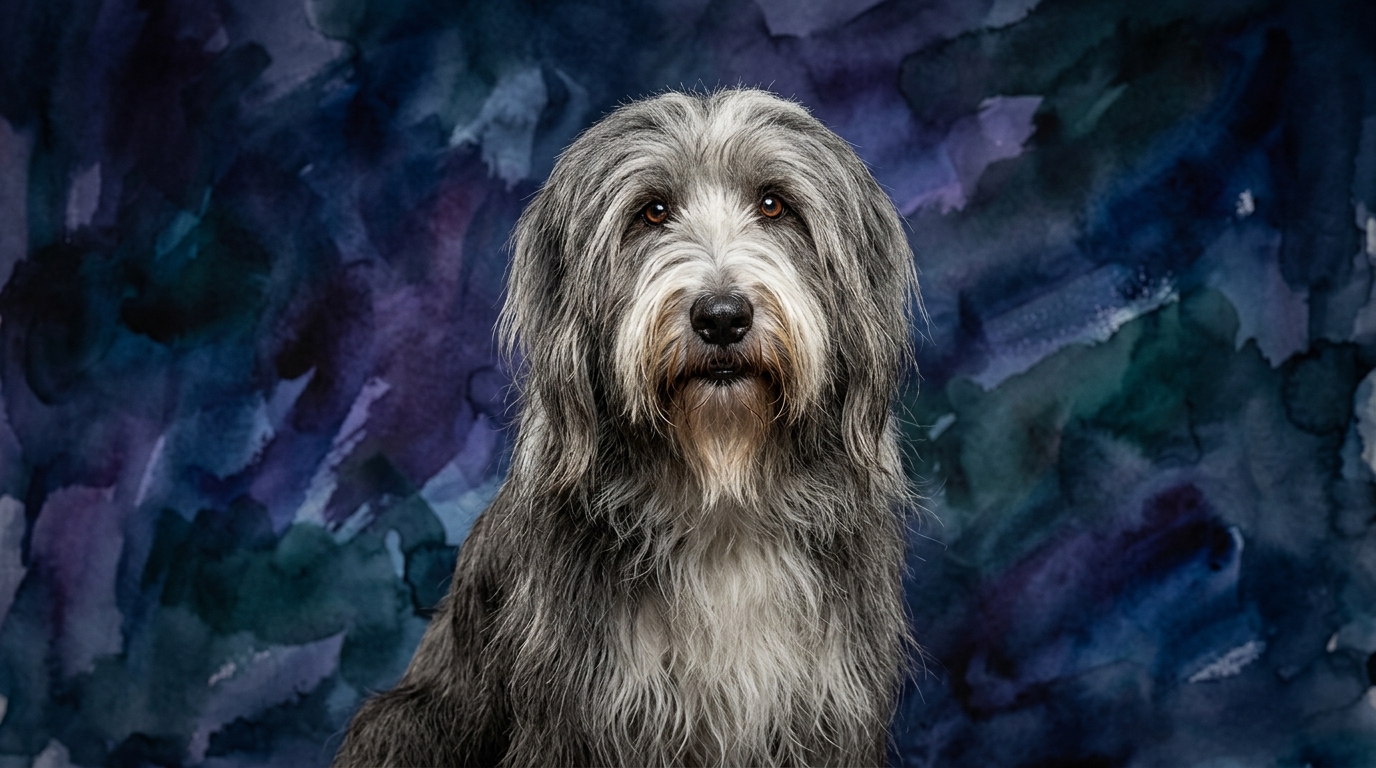

Side-by-Side IQ Profile: Bearded Collie vs. Rat Terrier
The Cosmic Pet Pet IQ Lab employs a five-dimensional framework to assess canine intelligence, moving beyond simple obedience to encompass a broader spectrum of cognitive abilities. Here's how the Bearded Collie and Rat Terrier measure up:
**Bearded Collie (Herding, Coren rank #34)**
**Problem Solving (4/5):** The Bearded Collie approaches novel challenges with a thoughtful, often strategic mind. Their herding lineage demanded a sophisticated understanding of cause and effect, requiring them to anticipate flock movements and adapt tactics on the fly. This translates to a dog that can methodically work through puzzle toys, figure out how to open latches, or devise clever ways to retrieve a desired object. They tend to observe, process, and then act, often showing a capacity for sequential thinking.
**Training Speed (4/5):** These dogs display a notable aptitude for quickly grasping new commands and complex routines. Their strong desire to cooperate with their human partners, combined with an alert and attentive nature, means they often pick up new behaviors after only a few repetitions. They thrive on structured learning and excel in activities that require a rapid response to cues, making them highly receptive students in obedience or dog sports.
**Social Intelligence (3/5):** Bearded Collies generally possess a respectable understanding of human emotional states and social cues within their immediate family. They are often sensitive to their owner's moods, offering comfort or adjusting their behavior accordingly. While they form deep bonds and enjoy cooperative interaction, their social acumen is primarily focused on their inner circle, rather than a broad, nuanced reading of unfamiliar people or complex group dynamics.
**Instinctive Drive (3/5):** Their core instinctive drive is deeply rooted in their herding heritage. This manifests not as an aggressive prey chase, but as an innate desire to gather, control, and 'manage' their environment, often extending to family members or other pets. They find satisfaction in having a purpose or a 'job' that allows them to channel this organizational impulse, whether it's collecting toys or guiding children gently.
**Memory (4/5):** Bearded Collies exhibit excellent long-term retention of learned information, routines, and experiences. Once a command is mastered or a sequence of actions understood, it tends to be firmly embedded. This strong memory contributes to their consistent performance in training and their ability to recall complex patterns, making them reliable partners over time.
**Rat Terrier (Terrier, Not Coren-ranked)**
**Problem Solving (3/5):** The Rat Terrier's problem-solving approach is characterized by quick, decisive action and an acute focus on practical outcomes. Their intelligence is geared towards efficiently overcoming physical obstacles or locating hidden targets, reflecting their historical role in vermin control. They are adept at finding shortcuts, squeezing into tight spaces, or persistently digging to achieve a goal. Their solutions are often direct and physical, rather than strategic or observational.
**Training Speed (3/5):** Rat Terriers are capable of learning new commands and behaviors, but their progress can be influenced by their strong independent streak and a tendency to prioritize their own interests. They learn at a steady pace, often requiring consistent, positive reinforcement and a clear understanding of how the task benefits them. While intelligent, their focus may waver if the training isn't engaging or if a more stimulating distraction arises.
**Social Intelligence (3/5):** Rat Terriers display a moderate level of social intelligence, forming intense bonds with their chosen human companions and often demonstrating an awareness of their family's moods. They can be expressive in their affections and communication with those they trust. However, their social interactions, particularly with unfamiliar individuals or animals, are often approached with a cautious, self-assured terrier attitude, prioritizing their own space and comfort.
**Instinctive Drive (3/5):** The Rat Terrier's defining instinctive drive is profoundly shaped by their original purpose: hunting and dispatching small prey. This manifests as a keen sense of smell, sharp eyesight for movement, and an intense focus on anything that resembles a quarry. This drive fuels their curiosity, provides a powerful intrinsic motivator for exploration, and makes them exceptionally alert to their surroundings.
**Memory (3/5):** Rat Terriers possess a solid memory for information critical to their daily lives, such as food locations, established routines, and the identities of their family members. While they retain training commands, particularly those frequently used, less common cues might require occasional refreshers. Their memory serves their practical, task-oriented nature effectively.
Where the Bearded Collie Wins Cognitively
The Bearded Collie's cognitive strengths truly shine in areas demanding sustained mental engagement and cooperative problem-solving. Their 4/5 rating in problem-solving means they are more inclined to analyze complex situations, such as navigating a multi-step obedience course or figuring out novel ways to manipulate puzzle feeders, often demonstrating foresight in their actions. This contrasts with a more impulsive approach. Their 4/5 training speed is a direct result of their eagerness to partner with humans and their superb memory, allowing them to absorb and retain intricate sequences of commands with fewer repetitions. This makes them exceptional candidates for advanced dog sports like agility or competitive obedience, where understanding complex patterns and executing them flawlessly is paramount. They excel at tasks requiring abstract thinking and the ability to generalize learned behaviors to new situations.
Where the Rat Terrier's Cognitive Profile Shines
While not scoring higher in raw metrics, the Rat Terrier's cognitive profile is exceptionally optimized for its specific purpose, demonstrating unique strengths. Their 3/5 in instinctive drive, though numerically equal, represents an intense, focused tenacity geared towards detection and pursuit—a distinct form of intelligence. They excel at quickly assessing a scent trail or the rustle of a small animal, demonstrating a rapid, decisive problem-solving ability (3/5) tailored to immediate, physical challenges. This isn't about broad strategic planning, but about swift, effective action in their chosen domain. Their cognitive 'win' lies in their extraordinary focus and determination when engaged in tasks that tap into their prey drive, showcasing a specialized, highly efficient intelligence for specific, practical challenges. They are masters of their immediate physical environment, quickly learning the quickest routes or best hiding spots.
Which is Easier to Train and Why?
Based on their cognitive profiles, the Bearded Collie is generally easier to train for a wide array of tasks, especially those requiring complex sequences or abstract understanding. Their 4/5 training speed and 4/5 problem-solving indicate a dog that not only learns quickly but also enjoys the mental engagement of training. They are eager to please and possess a strong memory, allowing them to generalize commands and retain lessons over time. In contrast, the Rat Terrier's 3/5 in both training speed and problem-solving, coupled with their independent terrier spirit, means training requires more patience and creativity. While capable, a Rat Terrier might prioritize an interesting scent over a 'sit' command, making consistency and high-value rewards crucial. Their training success often hinges on making the task immediately rewarding and engaging their focused prey drive constructively.
Suitability for Active vs. Relaxed Owners
The Bearded Collie, with its herding background and strong cognitive drive for engagement, generally suits active owners who can provide consistent mental and physical stimulation. Their need for problem-solving and a 'job' means they thrive on activities like long hikes, agility training, or even complex trick training, preventing boredom and potential destructive behaviors. A relaxed owner who cannot meet these needs might find a Bearded Collie restless or overly inventive in finding their own entertainment. The Rat Terrier, while also energetic, can adapt to a slightly less demanding routine, making them suitable for active owners who appreciate their focused bursts of energy and tenacity for specific tasks like earthdog trials or scent work. However, their lower cognitive scores compared to the Bearded Collie, combined with their terrier drive, means they might be content with shorter, intense play sessions and mental puzzles, rather than sustained, complex intellectual work. They are adaptable but still require engagement to prevent boredom.
The Verdict
Choose a Bearded Collie if you seek a highly cooperative, intelligent partner for advanced training, dog sports, and a family life that provides consistent mental challenges and interactive engagement.
Opt for a Rat Terrier if you appreciate a tenacious, quick-witted companion with a focused drive, ideal for owners who enjoy specific, goal-oriented activities and can manage an independent streak with consistent, engaging training.
🧠 Find Your Pet's IQ Score
Our Pet IQ Lab assessment covers 25+ tests across 5 cognitive dimensions — personalized to your breed.
Take the Full IQ Test →Frequently Asked Questions
Is a Bearded Collie easily bored if not given enough to do?
Yes, a Bearded Collie's high problem-solving and memory scores mean they require consistent mental stimulation. Without sufficient engagement, they can become bored and channel their cognitive energy into less desirable behaviors, like excessive barking or destructive chewing.
Can a Rat Terrier live happily in an apartment?
A Rat Terrier can adapt to apartment living if their exercise and mental stimulation needs are met. Despite their smaller size, their instinctive drive requires regular, focused activity like brisk walks, puzzle toys, and engaging play sessions to prevent boredom and satisfy their innate curiosity.
Do Bearded Collies get along with other pets?
Bearded Collies generally get along well with other pets, especially if socialized from a young age. Their herding instinct may lead them to try and 'gather' other animals, but this is usually a gentle attempt at management rather than aggression, though supervision is always wise.