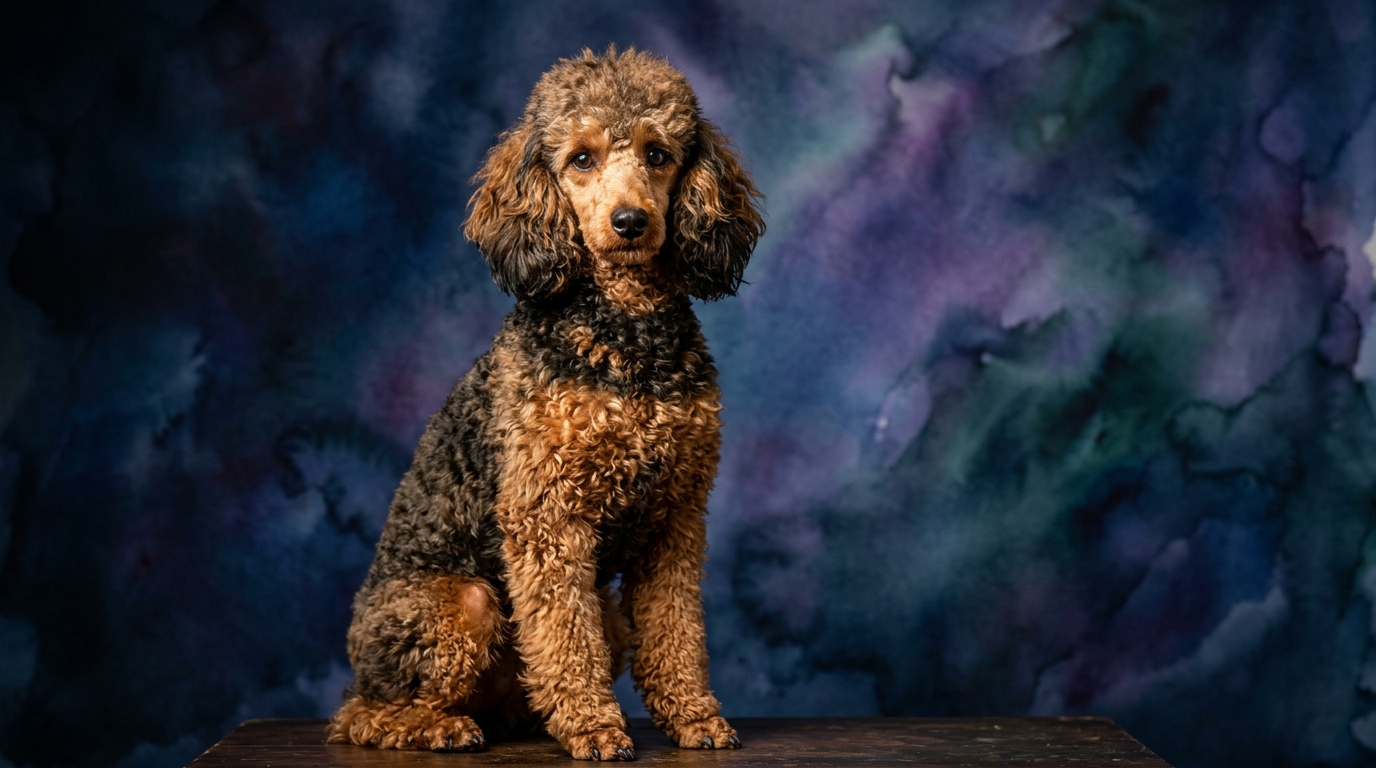

Side-by-Side IQ Profile: A Cognitive Blueprint
To understand the mental prowess of the Standard Poodle and the Rat Terrier, The Cosmic Pet Pet IQ Lab examines their profiles across five core dimensions. The Standard Poodle, holding a Coren rank of #2, consistently demonstrates exceptional cognitive abilities. Its Problem Solving is rated 5/5, indicating a superior capacity for abstract thought and multi-step solutions. Training Speed also scores 5/5, reflecting an unmatched aptitude for rapidly acquiring and retaining new commands. Social Intelligence, at 5/5, highlights their profound understanding of human cues and emotions, fostering deep communicative bonds. Their Instinctive Drive, rated 4/5, points to a strong, yet manageable, natural inclination for tasks like retrieving and agility. Memory scores 5/5, signifying an outstanding ability to recall commands, routines, and experiences over extended periods. In contrast, the Rat Terrier, unranked by Coren, presents a profile of consistent, moderate cognitive capabilities. Its Problem Solving is rated 3/5, suggesting practical, direct approaches to challenges, often relying on learned patterns rather than abstract reasoning. Training Speed also stands at 3/5, meaning they learn at a steady pace, requiring consistent reinforcement. Social Intelligence, at 3/5, indicates a solid understanding of basic human interactions, though with a more independent interpretation. Their Instinctive Drive, also 3/5, is notably geared towards their terrier roots—pursuit, digging, and independent exploration. Memory, rated 3/5, reflects a reliable capacity for remembering essential commands and routines, though less for intricate sequences.
Where the Standard Poodle Excels Cognitively
The Standard Poodle's cognitive strengths lie in its exceptional capacity for complex, multi-faceted learning and its profound social attunement. Their 5/5 Problem Solving means they don’t just learn a trick; they can understand the *concept* behind it, applying that understanding to entirely new situations, such as figuring out a novel latch mechanism or deducing a solution to retrieve a toy from an inaccessible spot. Their 5/5 Training Speed allows them to master advanced obedience, intricate agility courses, or complex trick sequences with remarkable efficiency, often needing only a handful of repetitions to solidify a new behavior. This translates into a dog that not only learns rapidly but also enjoys the mental engagement of continuous learning, making them exceptional candidates for competitive canine sports and service roles. Furthermore, their 5/5 Social Intelligence enables them to pick up on subtle changes in human tone, body language, and mood, leading to a highly responsive and empathetic companion who can anticipate a handler's next move or offer comfort based on perceived distress.
Where the Rat Terrier Shines Cognitively
While the Rat Terrier’s scores are consistently moderate, their cognitive profile translates into distinct strengths centered around practical application, tenacity, and independent action. Their 3/5 Problem Solving, for example, manifests as efficient, on-the-spot decision-making in real-world scenarios, particularly those related to their ancestral tasks. A Rat Terrier might not devise an abstract solution to a puzzle box, but it will persistently and effectively work to flush out a perceived 'pest' from a burrow, using direct, learned, or instinctive methods. Their 3/5 Instinctive Drive is not about breadth, but depth and focus; it’s a powerful, inherent motivation for pursuit and exploration that fuels their tenacity. This drive, combined with their practical problem-solving, makes them highly effective at tasks requiring persistence and independent thought, such as navigating varied terrain or tracking scents. Their moderate Social Intelligence often means they are less prone to dependency and can be content with a more self-directed existence, making them excellent companions for owners who appreciate a dog with a robust sense of self and decisive approach.
Which is Easier to Train and Why
When comparing ease of training, the Standard Poodle holds a clear advantage, primarily due to its 5/5 Training Speed, 5/5 Memory, and 5/5 Social Intelligence. Poodles are eager to please and possess an inherent desire to engage collaboratively, grasping new commands with astonishing speed and retaining them with minimal refresher training. This breed thrives on positive reinforcement and mental stimulation through training, making the process a rewarding experience as they are highly attuned to human feedback. The Rat Terrier, with its 3/5 Training Speed and 3/5 Memory, requires a more patient and consistent approach. While capable of learning, they may need more repetitions and a highly engaging environment to maintain focus. Their 3/5 Social Intelligence, coupled with their independent 3/5 Instinctive Drive, means they might be less inherently motivated by human approval alone and more by their own interests or environmental stimuli, making creative, consistent, and positive reinforcement paramount to success.
Which Suits Active Owners vs. Relaxed Owners
Both the Standard Poodle and the Rat Terrier are active breeds that thrive with engagement, but the *nature* of that engagement differs significantly. The Standard Poodle, with its profound mental capacity and moderate instinctive drive, excels with owners keen on providing consistent, diverse mental stimulation alongside physical exercise, flourishing in advanced obedience, agility, or complex trick training. Owners who enjoy teaching, problem-solving alongside their dog, and engaging in deeply communicative social interactions will find the Poodle a profoundly rewarding companion, understanding their minds need regular work. The Rat Terrier aligns well with owners who appreciate an independent spirit and can provide outlets for their specific physical and instinctive drives, relishing opportunities for chasing, digging, and exploring in outdoor adventures. Owners who enjoy a spirited companion, have a secure yard, and understand the need for consistent, boundary-setting training will find the Rat Terrier a great fit, providing ample physical and sensory exploration opportunities rather than demanding abstract mental puzzles.
The Verdict
Choose a Standard Poodle if you seek a companion eager for complex mental challenges, rapid learning, and a deep, empathetic social connection, thriving on structured engagement and advanced training.
Opt for a Rat Terrier if you value an independent, tenacious spirit, and enjoy providing ample physical activity and outlets for their natural instincts, preferring practical engagement over abstract mental tasks.
🧠 Find Your Pet's IQ Score
Our Pet IQ Lab assessment covers 25+ tests across 5 cognitive dimensions — personalized to your breed.
Take the Full IQ Test →Frequently Asked Questions
Do Standard Poodles get bored easily if not mentally stimulated?
Yes, Standard Poodles, with their high Problem Solving and Memory, thrive on mental engagement. Without sufficient stimulation, they may develop undesirable behaviors stemming from boredom or unfulfilled cognitive needs.
Can a Rat Terrier learn complex tricks and obedience routines?
A Rat Terrier can certainly learn a wide array of tricks and obedience routines, but their 3/5 Training Speed means it will require more patience, consistency, and engaging methods than with a breed like the Standard Poodle.
How does the Instinctive Drive differ between these two breeds in everyday life?
A Standard Poodle's 4/5 Instinctive Drive might manifest as a strong retrieve drive or enthusiasm for agility, while a Rat Terrier's 3/5 drive is more focused on chasing small animals or digging, requiring different management strategies.