
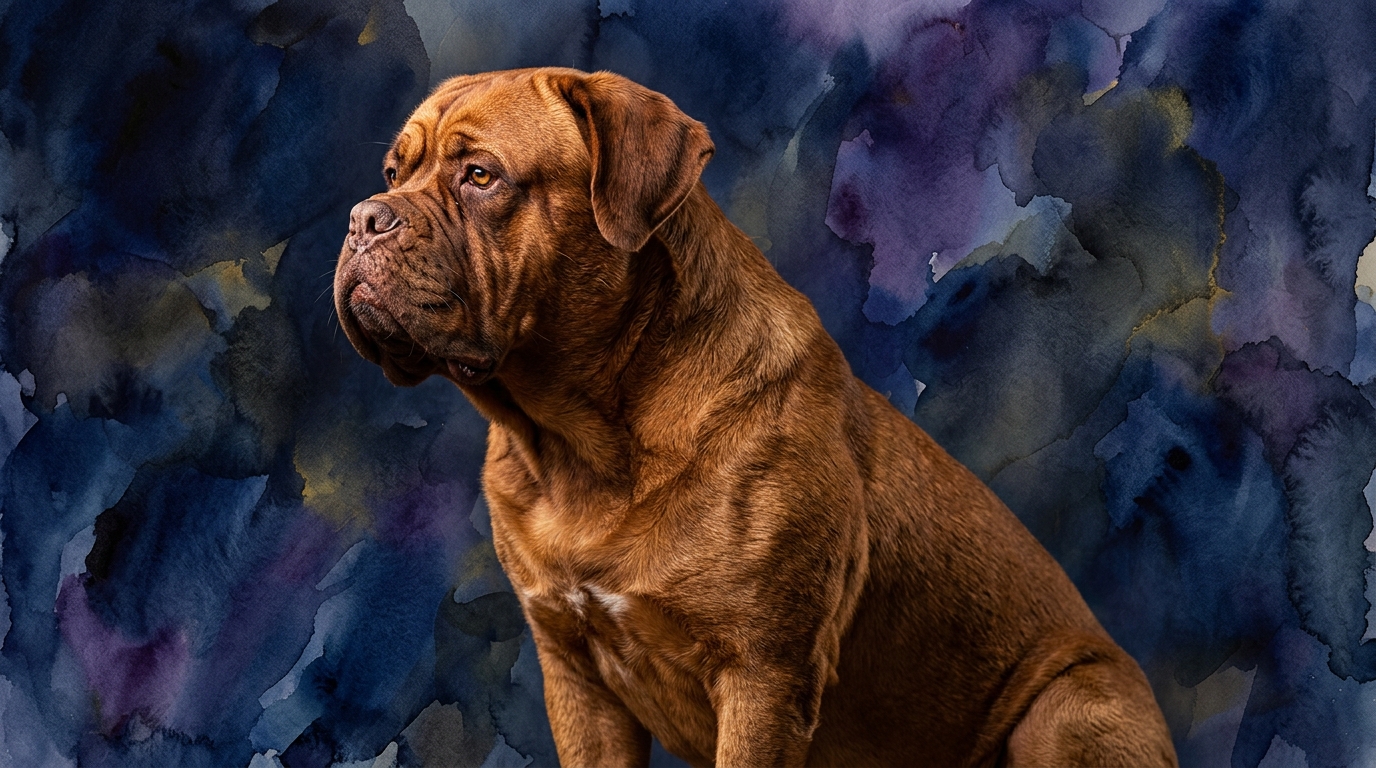
Side-by-Side IQ Profile: Bloodhound vs. Dogue de Bordeaux
The Cosmic Pet Pet IQ Lab provides a nuanced framework for understanding canine minds, assessing five key cognitive dimensions. For the Bloodhound, this reveals a highly specialized intellect, while the Dogue de Bordeaux presents a more balanced, generalized set of mental aptitudes.
Bloodhound's cognitive signature is dominated by its sensory prowess and unwavering focus. Its Problem Solving score of 5/5 reflects an exceptional ability to unravel complex scent trails, navigating varied terrains and distractions with singular determination. However, this intense specialization comes with a Training Speed of 1/5, indicating that while capable of immense focus on its task, redirecting that focus to human-desired commands can be a lengthy process. Social Intelligence scores 2/5, suggesting that human interaction, while valued, often takes a backseat to its primary drive. An Instinctive Drive of 5/5 underscores its genetic imperative for tracking, and a Memory score of 5/5 ensures it can recall intricate scent patterns and past experiences with remarkable accuracy, crucial for its work.
In contrast, the Dogue de Bordeaux exhibits a more uniformly distributed cognitive profile, without the extreme highs and lows seen in the Bloodhound. Its Problem Solving at 3/5 signifies a respectable capacity to figure out challenges, perhaps not with the Bloodhound's single-mindedness, but with practical application. Training Speed also sits at 3/5, indicating a moderate willingness to learn and respond to instruction, making them more amenable to standard obedience training. Social Intelligence scores 3/5, reflecting a solid capacity for bonding and understanding human cues, making them agreeable family members. An Instinctive Drive of 3/5 suggests a moderate level of inherent behaviors, such as guarding, but not to the overwhelming extent of the Bloodhound's tracking drive. Finally, a Memory score of 3/5 means they retain information adequately, remembering routines, commands, and familiar faces without the Bloodhound's extraordinary recall for specific, detailed sensory input.
Where the Bloodhound Excels Cognitively
The Bloodhound's cognitive strength lies almost entirely within its olfactory problem-solving and memory, making it an unrivaled specialist. Its 5/5 Problem Solving isn't about opening latches or deciphering puzzles in the human sense, but about interpreting a world of scent data with unparalleled precision, distinguishing individual odors amidst a cacophony of smells. This manifests as an extraordinary ability to follow a trail for miles, hours, or even days after it was laid, demonstrating complex cognitive mapping based purely on scent.
Complementing this is its 5/5 Memory, which allows it to store and recall specific scent profiles and the paths associated with them. A Bloodhound can remember a particular scent target and disregard countless others, a feat of cognitive filtering and retention that few other breeds can match. This breed doesn't merely follow a scent; it constructs a mental narrative of the trail, remembering turns, disturbances, and the subtle nuances of its quarry's path, showcasing a highly developed form of spatial and associative memory tied to its primary sense.
Where the Dogue de Bordeaux Shines Cognitively
The Dogue de Bordeaux's cognitive advantages stem from its balanced and adaptable mental makeup. Its 3/5 scores across Problem Solving, Training Speed, Social Intelligence, Instinctive Drive, and Memory signify a dog that is generally well-rounded and capable of integrating into various domestic environments with relative ease. Unlike the Bloodhound, which is driven by an overwhelming singular purpose, the Dogue de Bordeaux possesses a more flexible intelligence that allows it to engage with its human family on multiple levels.
The Dogue de Bordeaux's moderate Social Intelligence (3/5) allows it to read and respond to human emotions and intentions effectively, fostering a strong bond. Its Problem Solving (3/5) is practical, enabling it to navigate household routines, learn appropriate behaviors, and adapt to changes in its environment without the intense, often distracting, singular focus of a Bloodhound. This breed excels in being a stable, predictable companion, relying on a general cognitive competence rather than extreme specialization.
Training Dynamics: Bloodhound vs. Dogue de Bordeaux
When it comes to training, the practical differences between these breeds are pronounced, largely due to their disparate Training Speed and Instinctive Drive scores. The Bloodhound's 1/5 Training Speed is a direct consequence of its 5/5 Instinctive Drive; its nose is its world, and once engaged on a scent, external commands often become secondary. Training a Bloodhound requires immense patience, consistency, and a deep understanding of positive reinforcement, often needing to out-compete the allure of a scent with highly rewarding treats or praise. Their single-mindedness means that while they can learn commands, their execution might be slow or unreliable if a compelling scent is present, reflecting a dog that prioritizes its natural calling over human instruction.
Conversely, the Dogue de Bordeaux's 3/5 Training Speed makes it a more amenable student for general obedience. Its moderate Instinctive Drive (3/5) means it's less likely to be overwhelmingly distracted by external stimuli compared to a Bloodhound on a scent. They are typically eager to please their owners and respond well to consistent, fair training methods. While they can be stubborn at times, their willingness to engage and their capacity for social understanding (3/5 Social Intelligence) make them more straightforward to train for everyday companion tasks, as they value the interaction and approval from their humans more directly.
Matching Canine Minds to Lifestyles
For owners with an active lifestyle specifically centered around scent work or tracking, the Bloodhound is an unparalleled partner. Their relentless drive and exceptional cognitive abilities in this domain mean they thrive when given a 'job' that engages their primary instinct. Owners must be prepared to provide extensive opportunities for scent discrimination, tracking exercises, or even participation in search and rescue, channeling their immense instinctive drive into productive outlets. A Bloodhound is not a casual companion; it requires an owner who embraces its unique, intense focus and is willing to invest significant time in managing its instincts, making it unsuitable for those seeking a relaxed, low-maintenance dog.
The Dogue de Bordeaux, with its balanced cognitive profile, is better suited for owners seeking a more relaxed yet engaged companion. While they benefit from regular exercise and mental stimulation, their moderate instinctive drives and higher social intelligence mean they are content with family life, daily walks, and moderate play. They fit well into households that appreciate a steadfast, loyal presence and are prepared for a dog that enjoys being part of the family's daily rhythm without an overwhelming, specialized need. Owners who enjoy teaching basic obedience, engaging in moderate physical activity, and appreciate a calm demeanor will find the Dogue de Bordeaux a rewarding choice.
The Verdict
Choose a Bloodhound if you are a dedicated enthusiast of canine scent work, prepared to channel an extraordinary instinctive drive and memory into purposeful tracking activities.
Opt for a Dogue de Bordeaux if you seek a balanced, loyal companion capable of moderate training and social engagement, fitting seamlessly into a family-oriented lifestyle.
🧠 Find Your Pet's IQ Score
Our Pet IQ Lab assessment covers 25+ tests across 5 cognitive dimensions — personalized to your breed.
Take the Full IQ Test →Frequently Asked Questions
Is a Bloodhound difficult to manage for a first-time dog owner?
A Bloodhound's intense instinctive drive and low training speed can be challenging for inexperienced owners. Their single-minded focus on scent requires a dedicated handler who understands their unique cognitive makeup and can provide consistent, specialized training and enrichment.
Do Dogue de Bordeaux dogs require a lot of mental stimulation?
While not as specialized as a Bloodhound, a Dogue de Bordeaux benefits from regular mental stimulation to keep their moderate problem-solving and memory skills sharp. Puzzle toys, short training sessions, and varied walking routes can help prevent boredom and encourage their balanced cognitive engagement.
How do their social intelligence scores impact their interactions with other pets?
The Bloodhound's 2/5 social intelligence suggests they might be less attuned to subtle social cues from other animals, potentially leading to misunderstandings or simply disinterest if a scent trail is present. The Dogue de Bordeaux's 3/5 social intelligence indicates a better capacity for appropriate interactions, making them generally more adaptable to living harmoniously with other pets, especially with proper socialization.