
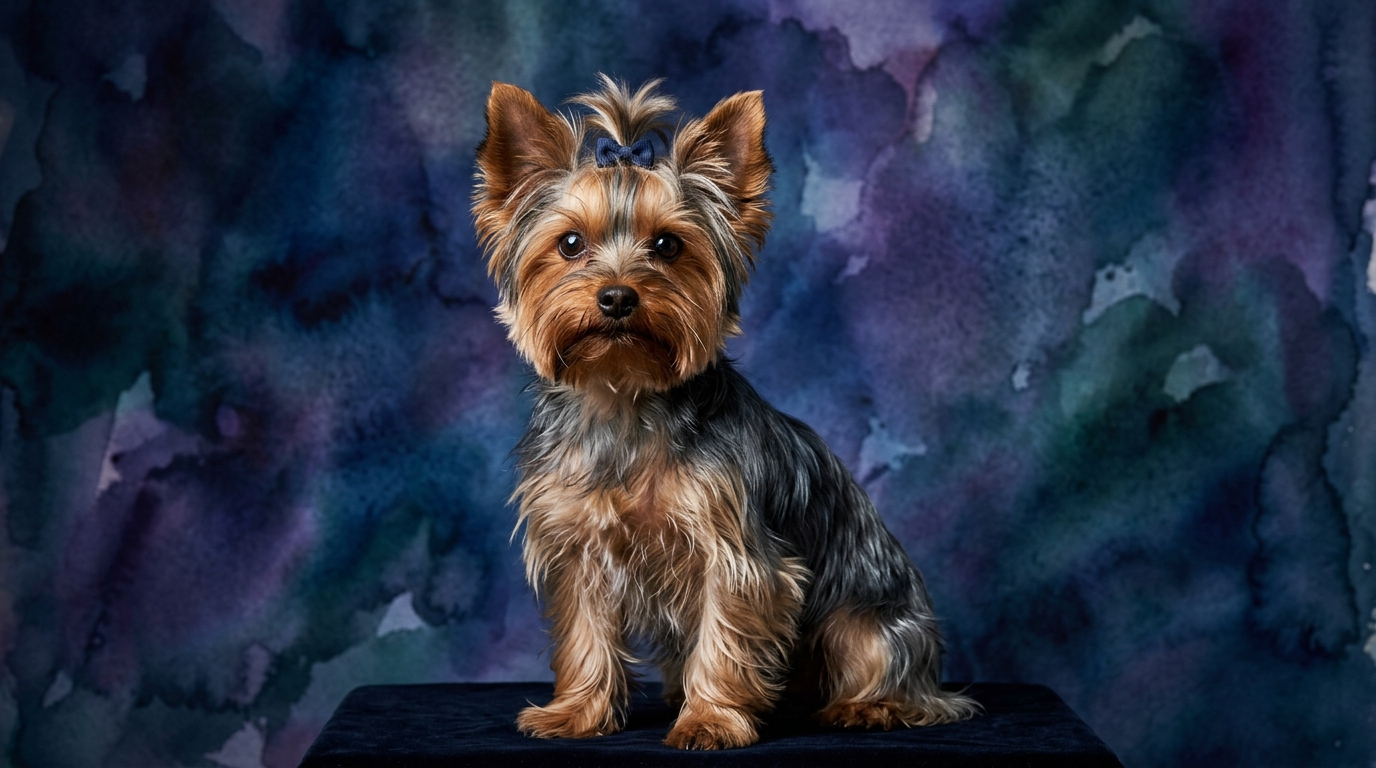
Side-by-Side IQ Profile: Border Collie vs. Yorkshire Terrier
The Cosmic Pet Pet IQ Lab employs five key dimensions to map a breed's cognitive landscape, providing a nuanced understanding beyond simple rankings. Here's how the Border Collie (Coren rank #1) and the Yorkshire Terrier (Coren rank #27) measure up.
For the Border Collie:
Problem Solving (5/5): This breed demonstrates exceptional capacity for novel solutions, quickly analyzing complex situations, and devising strategies to overcome obstacles, often without direct human guidance. Their cognitive flexibility allows them to adapt rapidly to changing environments and challenges.
Training Speed (5/5): Border Collies absorb new commands and routines with remarkable velocity, often requiring only a few repetitions to grasp complex tasks. Their eagerness to engage and process information makes them incredibly quick studies in structured learning environments.
Social Intelligence (4/5): While intensely focused on their primary handler, Border Collies possess a sophisticated understanding of human cues, intentions, and emotional states. They excel at working collaboratively, interpreting subtle body language, and responding appropriately within a working partnership.
Instinctive Drive (5/5): Their powerful herding instinct translates into an inherent, relentless motivation to gather, control, and manipulate their environment, whether it's sheep, toys, or even family members. This drive fuels their intense focus and tireless work ethic.
Memory (5/5): Border Collies exhibit a superior ability to recall sequences of commands, locations of objects, and past experiences, retaining complex information over extended periods. This robust memory underpins their capacity for intricate routines and long-term learning.
For the Yorkshire Terrier:
Problem Solving (3/5): Yorkshire Terriers approach challenges with a degree of ingenuity, often employing persistence and trial-and-error to achieve desired outcomes, particularly when motivated by a reward or personal comfort. Their problem-solving is often self-directed and focused on immediate gains.
Training Speed (4/5): Yorkies learn new commands at a commendable pace, typically picking up basic obedience with consistent, positive reinforcement. They respond well to clear instruction and thrive on the interactive engagement of training sessions.
Social Intelligence (4/5): These small terriers display a strong bond with their chosen humans, keenly attuned to their owners' moods and routines. They are adept at communicating their needs and desires through vocalizations and body language, forming deep, reciprocal relationships.
Instinctive Drive (4/5): The Yorkshire Terrier’s terrier heritage manifests as a distinct prey drive and a spirited determination. They possess a robust, self-assured nature, often displaying a fierce tenacity and a desire to explore and "hunt" small vermin or toys, despite their size.
Memory (4/5): Yorkies possess a solid memory for routines, favored people, and past interactions, allowing them to remember learned behaviors and social cues effectively. They can recall specific locations of their toys or treats with notable accuracy.
Where the Border Collie Wins Cognitively
The Border Collie’s cognitive strengths are particularly evident in its unparalleled capacity for complex, multi-stage tasks and its proactive approach to novel situations. Their Problem Solving score of 5/5 isn't merely about finding a way; it's about optimizing the solution, often anticipating subsequent steps. For instance, a Border Collie learning an agility course doesn't just remember each obstacle; it analyzes the most efficient path between them, adjusting its stride and angle on the fly. This isn't rote memorization but a dynamic application of spatial reasoning and predictive cognition.
Their 5/5 Training Speed is a direct consequence of their rapid information processing and profound desire for mental engagement. They don't just learn commands; they internalize the concept of learning, quickly generalizing rules from one task to another. A Border Collie taught to fetch a specific red ball can often, with minimal additional instruction, understand "fetch the blue toy" or "put all the toys in the basket." This cognitive leap from specific command to abstract concept is a hallmark of their advanced learning capabilities. Furthermore, their 5/5 Instinctive Drive provides an inexhaustible wellspring of motivation, allowing them to sustain intense focus on tasks that might quickly bore other breeds. This drive, combined with their exceptional Memory (5/5), allows them to master and retain vast repertoires of behaviors and cues, making them exceptional partners in intricate disciplines like competitive obedience, sheepdog trials, or service work. Their cognitive framework is built for continuous, high-level intellectual work.
Where the Yorkshire Terrier Wins Cognitively
While not achieving the same top-tier scores in raw problem-solving or training speed as the Border Collie, the Yorkshire Terrier's cognitive profile demonstrates distinct advantages in specific contexts, particularly related to adaptability and close companionship. Their 4/5 Social Intelligence, combined with their inherent terrier tenacity, means they are exceptionally adept at reading and manipulating their immediate human environment. A Yorkie might not solve a complex puzzle box, but it will quickly learn which specific vocalization or body posture elicits attention or a treat from its owner, demonstrating a sophisticated, goal-oriented social cognition.
Their 4/5 Instinctive Drive, while different from a herding dog's, manifests as a robust self-assurance and an acute awareness of their surroundings, often making them excellent small watchdogs. They are quick to alert their owners to anomalies, demonstrating a focused attention to auditory and visual cues within their territory. This keen observational ability, paired with a solid 4/5 Memory, allows them to establish and maintain consistent routines, providing a sense of stability and predictability that many owners appreciate. They remember which visitor is friendly, where their favorite napping spot is, and the precise timing of their meal, showcasing a practical, self-serving memory that contributes significantly to their domestic integration. Their problem-solving (3/5) often involves clever persistence in achieving personal comfort or attention, rather than abstract challenges, making them surprisingly resourceful in navigating their smaller world.
Which is Easier to Train and Why
When evaluating ease of training, the Border Collie unequivocally holds an advantage, primarily due to its 5/5 Training Speed and 5/5 Instinctive Drive. This breed possesses an intrinsic desire to work collaboratively and to understand human directives, absorbing new commands with minimal repetition. Their profound Problem Solving ability means they often anticipate what is expected and can generalize learned behaviors to new situations rapidly. For example, teaching a Border Collie a multi-step fetch command like "find the ball, bring it here, drop it in the basket" is often a matter of breaking it down once or twice, as they quickly grasp the sequence and purpose. Their high drive means they are intrinsically motivated by the act of learning and working, beyond just treats or praise.
The Yorkshire Terrier, with its 4/5 Training Speed, is still quite trainable, but its approach is typically more self-serving and requires more consistent, positive reinforcement. Yorkies learn effectively when there's a clear, immediate reward, such as a favorite treat or enthusiastic praise. Their terrier temperament means they can be more independent and less inclined to obey simply for the sake of cooperation; they need to see the benefit. While a Border Collie might learn "stay" for minutes on end with little prior practice, a Yorkie might require more frequent proofing and higher-value rewards to maintain focus, especially amidst distractions. Their Instinctive Drive (4/5) leans towards independent exploration and a strong "terrier will," which can sometimes be interpreted as stubbornness if not channeled appropriately. Their problem-solving (3/5) is more geared toward figuring out how to get what they want, rather than what you want, which can make advanced obedience a more patient endeavor.
Which Suits Active Owners vs. Relaxed Owners
The cognitive profiles of these two breeds naturally align with vastly different owner lifestyles. The Border Collie, with its 5/5 Problem Solving, 5/5 Instinctive Drive, and 5/5 Memory, is unequivocally suited for active owners who relish deep engagement and provide consistent mental and physical challenges. This breed thrives when given a "job," whether it's competitive dog sports like agility, flyball, or obedience, or even complex tasks around the home. An owner who enjoys hiking, running, and dedicating significant time to training and interactive play will find the Border Collie an unparalleled partner. Without sufficient mental stimulation, their intense cognitive energy and drive can manifest as boredom-related behaviors, such as incessant barking, destructive chewing, or attempting to "herd" family members or furniture.
Conversely, the Yorkshire Terrier, with its 3/5 Problem Solving and 4/5 Instinctive Drive, is an excellent match for more relaxed owners who appreciate a devoted, spirited companion without the demanding cognitive workload. While they benefit from regular walks and play, their physical and mental stimulation needs are considerably lower. A Yorkie is content with shorter play sessions, puzzle toys, and ample cuddle time, often happy to observe the world from a comfortable lap. Their 4/5 Social Intelligence makes them highly adaptable to varied social settings, easily fitting into a less structured daily routine, provided they receive consistent affection and attention. They are well-suited for urban living or for individuals seeking a loyal companion whose primary "job" is to provide companionship and alert to visitors, rather than master complex commands or herd livestock.
The Verdict
Opt for a Border Collie if you are an experienced, active owner committed to providing extensive daily mental and physical challenges, seeking a highly trainable and collaborative partner for advanced activities or competitive dog sports.
Select a Yorkshire Terrier if you desire a spirited, affectionate, and observant companion for a more relaxed lifestyle, appreciating its adaptability and loyal devotion without the need for intense, continuous cognitive engagement.
🧠 Find Your Pet's IQ Score
Our Pet IQ Lab assessment covers 25+ tests across 5 cognitive dimensions — personalized to your breed.
Take the Full IQ Test →Frequently Asked Questions
Do Border Collies get bored easily?
Yes, Border Collies possess a profound need for mental stimulation due to their 5/5 Problem Solving and Instinctive Drive; without it, they can quickly become bored, potentially leading to undesirable behaviors as they seek outlets for their cognitive energy. Providing regular training, puzzle toys, and interactive play is crucial for their well-being.
Are Yorkshire Terriers good for first-time dog owners?
Yorkshire Terriers can be suitable for first-time dog owners who are prepared for consistent training and socialization. Their 4/5 Training Speed means they learn well with positive reinforcement, and their strong social intelligence allows them to bond deeply, though their terrier tenacity requires clear boundaries.
How do their different instinctive drives manifest in daily life?
The Border Collie's 5/5 instinctive drive typically manifests as a powerful urge to herd and organize, leading to behaviors like circling, nipping at heels, or intensely focusing on movement. The Yorkshire Terrier's 4/5 drive appears as a keen prey drive and territorial alertness, often expressed through energetic chasing of small objects or vocal alerts to perceived intruders.