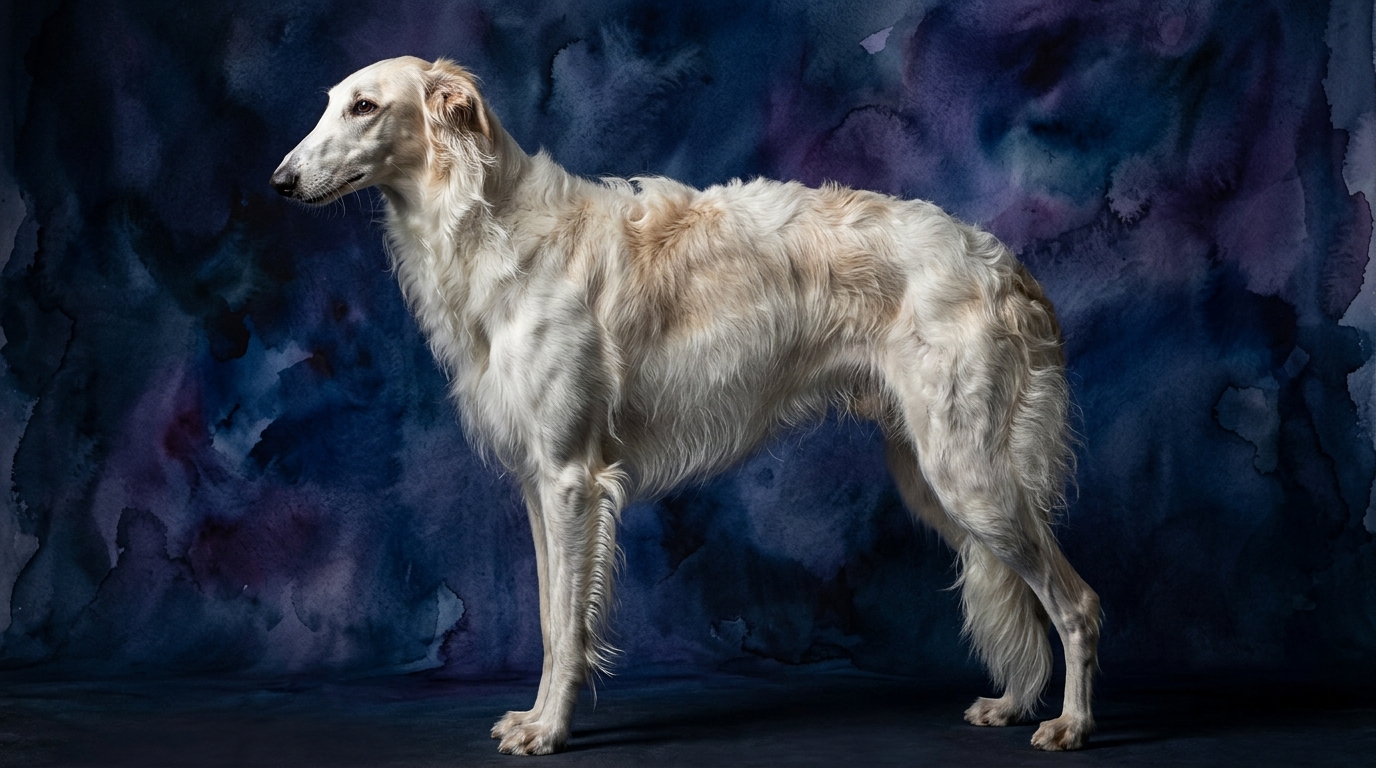

Side-by-Side Cognitive Profiles
The Borzoi, a sighthound of Russian origin, exhibits a problem-solving aptitude (3/5) often focused on independent decision-making during a chase, requiring quick assessment of terrain and prey movement rather than human direction. Their training speed (3/5) reflects a capacity to learn but also an independent streak; they grasp concepts but may require compelling motivation to comply, often prioritizing their own perceived objectives over rote obedience. Social intelligence (3/5) in Borzoi typically manifests as deep, reserved bonds with their immediate family, understanding subtle cues within their 'pack' while often being aloof with strangers. Their instinctive drive (3/5) is powerfully geared towards visual pursuit and the thrill of the chase, a deeply embedded cognitive program that influences their attention and focus. Memory (3/5) is robust for routes, familiar environments, and the patterns associated with their hunting heritage, allowing them to recall complex sequences of events or locations.
The Chinese Crested, a spirited toy breed, approaches problem-solving (3/5) with a focus on their immediate environment and human interaction, often figuring out how to gain attention, access desired items, or navigate household challenges. Their training speed (3/5) is generally moderate, as they are capable of learning a variety of commands and tricks, often motivated by praise and treats, though they can also be prone to distraction or a playful stubbornness. Social intelligence (3/5) is a cornerstone of their personality, as they are highly attuned to human emotions and social dynamics within their family unit, frequently seeking close physical contact and responding empathetically. Their instinctive drive (3/5) is less about hunting and more about companionship, comfort, and playful engagement, manifesting as a strong desire for warmth, security, and interactive games. Memory (3/5) in the Chinese Crested is excellent for routines, people, and specific locations of comfort or resources within their home, contributing to their adaptability as house pets.
Where Borzoi Cognitively Excels
Despite sharing similar numerical scores, the Borzoi's cognitive strengths distinctly lie in their capacity for autonomous action and spatial reasoning over vast distances. Their problem-solving (3/5) in a real-world scenario might involve independently navigating complex outdoor environments to pursue a moving target, making split-second decisions without human intervention. This reflects a mind wired for strategic pursuit and endurance, where processing visual information and predicting trajectories are paramount. Their memory (3/5) is particularly adept at recalling the layout of large areas and remembering specific visual cues, a skill honed over generations for effective hunting.
The Borzoi's instinctive drive (3/5) is a profound cognitive program, dictating their focus and attention. This isn't just a physical urge; it's a mental framework that prioritizes movement detection and the strategy of the chase, making them superb at tasks requiring sustained, independent focus on a distant objective. This deep-seated drive means they can process and react to stimuli at impressive speeds when it aligns with their natural inclinations, demonstrating a specific form of cognitive processing that sets them apart from breeds bred for closer human collaboration.
Where Chinese Crested Cognitively Excels
The Chinese Crested, while not built for the chase, demonstrates cognitive strengths in their profound social attunement and adaptability to a domestic setting. Their social intelligence (3/5) is keenly developed for interpreting human moods and intentions, allowing them to integrate seamlessly into family life and offer comfort or companionship with remarkable sensitivity. This nuanced understanding of human social cues translates into an ability to 'read the room' and respond appropriately, a valuable trait for a companion animal.
Their problem-solving (3/5) often involves clever strategies for interaction and comfort within a home environment, such as figuring out how to get onto a lap or open a cabinet door for a treat. This demonstrates a practical, home-centric application of their mental faculties. Furthermore, their memory (3/5) for routines and the preferences of their human companions allows them to anticipate events and adapt to household rhythms, making them highly predictable and integrated family members. This domestic focus allows them to excel in understanding and manipulating their immediate, human-centric world.
Trainability: Borzoi vs. Chinese Crested
When it comes to trainability, the Borzoi's independent nature (training speed 3/5) means they respond best to positive reinforcement and training methods that respect their sighthound instincts. While capable of learning a wide array of commands, they may choose not to comply if they don't perceive a clear benefit or if their attention is captured by something more compelling, such as a distant movement. Training often requires patience, consistency, and making the exercises engaging and rewarding from their perspective, rather than simply demanding obedience. Their focus can be exceptional when engaged in tasks that align with their chase drive, but less so for repetitive, arbitrary commands.
The Chinese Crested, with their moderate training speed (3/5), often demonstrates a greater eagerness to please their primary caregiver, which can be an advantage in obedience training. They are typically responsive to positive reinforcement, especially when treats and praise are involved, and their social intelligence (3/5) helps them understand their owner's expectations. However, their smaller size and occasional short attention span mean training sessions should be kept brief, engaging, and varied. While they may not possess the Borzoi's independent problem-solving for hunting, their desire for interaction and attention often makes them more amenable to structured training within a domestic context.
Suitability for Active vs. Relaxed Owners
The Borzoi's cognitive profile, particularly their strong instinctive drive (3/5) and independent problem-solving (3/5), makes them better suited for owners who understand and can accommodate their need for specific types of mental and physical stimulation. They thrive with active owners who can provide secure, expansive areas for them to run freely and express their sighthound nature safely. While not requiring constant 'work,' their minds are active, needing opportunities to observe, chase, and make independent decisions in open spaces. A relaxed owner who cannot provide these outlets might find a Borzoi to be bored or restless, even if physically calm indoors.
Conversely, the Chinese Crested's social intelligence (3/5) and focus on companionship make them highly adaptable to both active and more relaxed indoor lifestyles. They excel with owners who appreciate their close bond and can provide consistent interaction and attention. While they enjoy playful bursts of activity, their mental stimulation often comes from interactive games, learning new tricks, and being an integral part of family life. A relaxed owner who enjoys cuddling on the couch and engaging in indoor games would find a Chinese Crested a perfect match, as their cognitive engagement is deeply tied to their human companions and their immediate home environment.
The Verdict
Choose a Borzoi if you are an owner who appreciates elegant independence, can provide secure, open spaces for their sighthound instincts, and values a reserved yet deeply loyal companion.
Opt for a Chinese Crested if you seek a highly social, adaptable companion deeply attuned to human emotions, thriving on close interaction and fitting seamlessly into a varied home life.
🧠 Find Your Pet's IQ Score
Our Pet IQ Lab assessment covers 25+ tests across 5 cognitive dimensions — personalized to your breed.
Take the Full IQ Test →Frequently Asked Questions
Are Borzoi difficult to train?
Borzoi are not inherently difficult, but their independent nature means training requires patience, consistency, and making activities rewarding from their perspective. They respond best when tasks align with their natural drives and are presented as engaging challenges rather than mere commands.
Do Chinese Crested dogs require a lot of mental stimulation?
Chinese Crested dogs benefit from consistent mental stimulation, though it often manifests through interactive games, learning tricks, and social engagement with their owners. Their minds are active and thrive on participation in family life and problem-solving within their domestic environment.
Which breed is better for first-time dog owners?
The Chinese Crested might be a more forgiving choice for first-time dog owners due to their smaller size, adaptability to indoor living, and strong desire for companionship. The Borzoi's significant exercise needs and independent sighthound traits can be more challenging for those new to dog ownership.