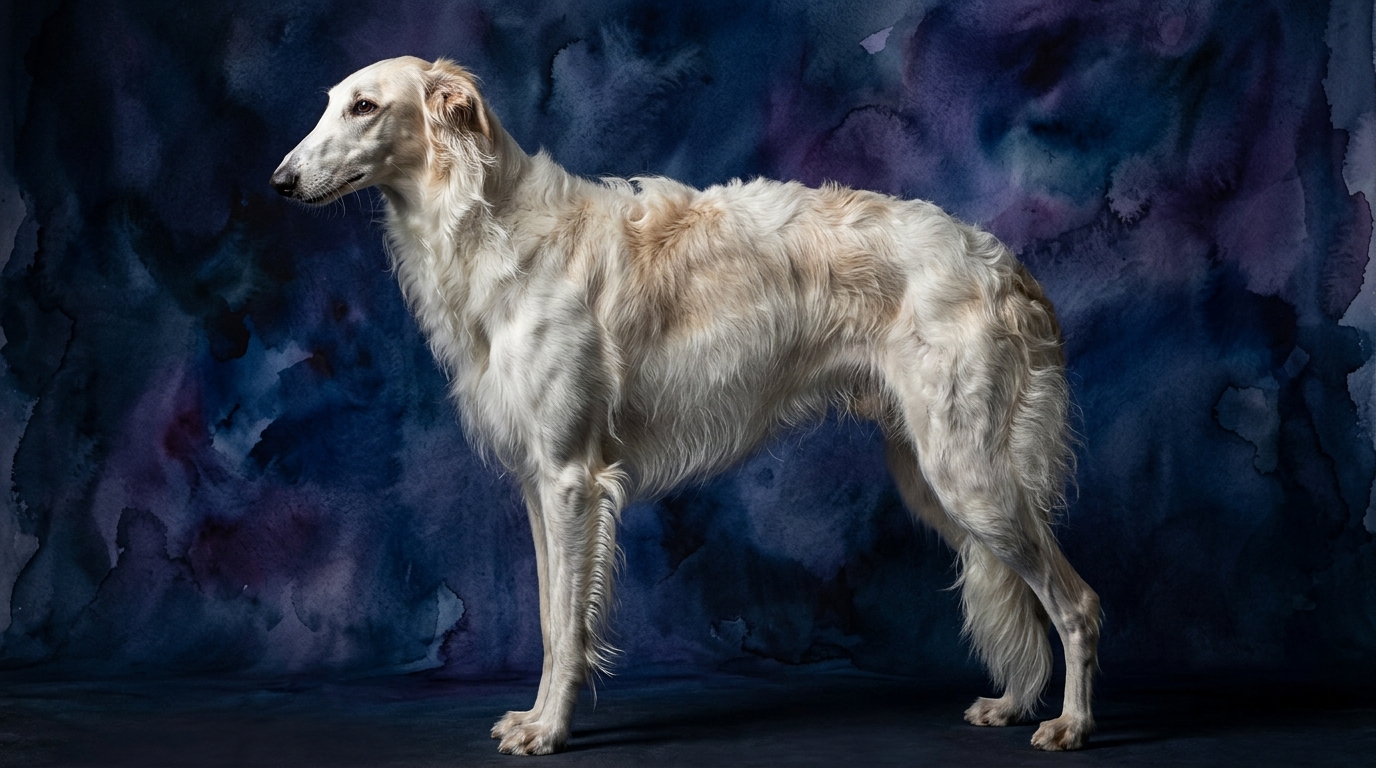

Side-by-Side Cognitive Profile: Borzoi vs. Miniature Poodle
The Cosmic Pet Pet IQ Lab evaluates canine cognition across five crucial dimensions. For the Borzoi, a majestic sighthound, their profile shows Problem Solving 3/5, Training Speed 3/5, Social Intelligence 3/5, Instinctive Drive 3/5, and Memory 3/5. This indicates a functional, independent intellect geared towards their historical role.
In contrast, the Miniature Poodle, a versatile companion and working breed, presents a different cognitive landscape. Their scores are Problem Solving 5/5, Training Speed 5/5, Social Intelligence 3/5, Instinctive Drive 3/5, and Memory 5/5. These numbers suggest a dog with exceptional cognitive flexibility and learning aptitude.
Delving deeper, a Borzoi's Problem Solving at 3/5 demonstrates a functional ability to navigate challenges, particularly those related to their sighthound heritage, such as locating prey in varied terrain. Their problem-solving often leans towards independent, self-directed solutions rather than collaborative ones. Their Training Speed at 3/5 means they can learn commands, but their independent nature often requires more repetition and motivation tailored to their sighthound drive. Consistency is key, and they aren't typically quick to pick up new behaviors without clear incentive. Social Intelligence at 3/5 means they form strong bonds with their families but are often reserved with strangers, observing rather than overtly engaging. Their Instinctive Drive at 3/5 is pronounced, manifesting as a strong urge to chase moving objects, a core part of their being influencing focus. Finally, their Memory at 3/5 indicates a functional recall for routines and familiar environments, but they may not retain complex sequences of commands with the same precision or speed as some other breeds.
The Miniature Poodle's Problem Solving at 5/5 means they excel at analyzing novel situations and devising effective solutions, whether it's figuring out how to open a puzzle toy or navigating a complex agility course. Their capacity for abstract thought is notable. Their Training Speed at 5/5 means they grasp new commands and concepts with remarkable speed, often requiring only a few repetitions to understand and execute a behavior, making them highly responsive. Social Intelligence at 3/5, similar to the Borzoi, indicates a functional understanding of social cues; they adapt well to human families and can read intentions but aren't necessarily predisposed to overly complex social maneuvering. Their Instinctive Drive at 3/5, originally water retrievers, means they retain a drive for retrieving and often enjoy activities that mimic their working heritage, but it's generally manageable. Lastly, their Memory at 5/5 means Miniature Poodles possess an outstanding ability to recall learned behaviors, locations, and past events, making them reliable in retaining a vast repertoire of commands and routines over time.
Where Borzoi's Cognition Shines
While the Borzoi's cognitive profile doesn't outscore the Miniature Poodle in any single dimension, their intelligence is uniquely optimized for independent pursuit and observation. Their problem-solving (3/5) and instinctive drive (3/5) are finely tuned for autonomous decision-making in vast, open spaces, allowing them to assess and react to prey movements without constant human direction. This self-reliance in the field means they excel at making split-second judgments based on visual cues and environmental factors, a form of practical intelligence crucial for their sighthound heritage. This specialized cognitive architecture makes them exceptional at their historical function, requiring a blend of perception, quick reaction, and independent judgment that is a hallmark of their breed. Their reserved social intelligence (3/5) also means they are often content observing, rather than constantly seeking interaction, a trait that appeals to owners who appreciate a more self-possessed companion.
Where Miniature Poodle's Cognition Excels
The Miniature Poodle demonstrates a clear cognitive advantage across several key dimensions, reflecting their history as versatile working and companion dogs. Their problem-solving abilities (5/5) are exceptional; they approach novel challenges with curiosity and can quickly deduce solutions, whether it's navigating complex puzzle feeders or understanding multi-step commands. This aptitude for abstract reasoning makes them adept at learning new tasks and adapting to varied environments. Complementing this is their remarkable training speed (5/5), allowing them to grasp new concepts and commands with minimal repetition, often seeming to anticipate their handler's intentions. Their outstanding memory (5/5) ensures that once a behavior is learned, it is retained with precision over extended periods, making them highly reliable in performing complex routines or remembering intricate sequences. These combined strengths make the Miniature Poodle exceptionally adept at tasks requiring sustained mental engagement, quick learning, and precise recall, ranging from advanced obedience to dog sports.
Training Aptitude: Borzoi vs. Miniature Poodle
Based on their cognitive profiles, the Miniature Poodle is undeniably easier to train for a wide array of behaviors and commands. Their training speed (5/5) means they absorb new information rapidly, often showing understanding after just a few repetitions. This is coupled with their exceptional memory (5/5), ensuring that learned behaviors are retained reliably over time. For instance, a Miniature Poodle can quickly learn a complex agility course or a multi-part obedience routine and perform it consistently, often exhibiting a strong desire to collaborate with their handler.
In contrast, the Borzoi's training speed (3/5) indicates a slower acquisition rate for new commands, often requiring more patience and consistent reinforcement. Their independent nature, stemming from their sighthound heritage, means they are less inclined to perform simply to please and may prioritize their own instincts, such as chasing a squirrel, over a recall command. While they are capable of learning, their memory (3/5) for complex sequences might not be as robust, making intricate training more of a long-term commitment. Training a Borzoi often requires a deeper understanding of their motivations and a willingness to work with their inherent independence, rather than expecting immediate, eager compliance. Positive reinforcement and making training a rewarding experience are paramount to success with a Borzoi.
Lifestyle Match: Active vs. Relaxed Owners
The choice between a Borzoi and a Miniature Poodle hinges significantly on an owner's lifestyle and their capacity for specific types of engagement. For owners seeking a dog for sustained, high-intensity physical activity combined with significant mental stimulation through structured training, the Miniature Poodle is an excellent fit. Their moderate instinctive drive (3/5) can be channeled into retrieving games, and their superior problem-solving (5/5) and training speed (5/5) thrive on activities like agility, obedience, or even scent work, requiring consistent mental engagement. They are often eager participants in family activities and enjoy being involved in daily routines, adapting well to a busy household that includes them in its adventures.
Conversely, the Borzoi, while possessing a strong instinctive drive (3/5) for chasing, is often content with bursts of intense exercise followed by long periods of relaxed lounging. Their activity needs are more about providing opportunities for powerful sprints in a secure area rather than continuous, high-energy output. They suit owners who appreciate a calm, dignified presence indoors but are committed to fulfilling their sighthound's need for occasional, vigorous, and safe off-leash running. While they don't require constant mental 'work' in the same way a Poodle might, they do benefit from structured walks and environments where their observational intelligence can be engaged. A Borzoi often appeals to owners who value a more independent companion and are comfortable providing space for their dog's self-possessed nature, understanding that their engagement style is often more subtle and less overtly enthusiastic.
The Verdict
Choose a Borzoi if you appreciate a dignified, independent companion that offers quiet companionship indoors, provided you can satisfy their innate need for powerful, unrestrained sprints in a secure environment. They thrive with owners who understand and respect their sighthound instincts and are prepared for a more nuanced, less overtly eager training journey.
Opt for a Miniature Poodle if you desire a highly trainable, versatile companion eager to engage in a wide range of activities, from advanced obedience to dog sports, and who thrives on consistent mental challenges. They are an excellent choice for active owners seeking a responsive, mentally agile partner ready for collaborative learning.
🧠 Find Your Pet's IQ Score
Our Pet IQ Lab assessment covers 25+ tests across 5 cognitive dimensions — personalized to your breed.
Take the Full IQ Test →Frequently Asked Questions
Are Borzoi difficult to train due to their independence?
Borzoi can be more challenging to train compared to breeds eager to please, primarily due to their independent sighthound nature and a training speed of 3/5. They learn at their own pace and require consistent, patient, and reward-based methods, often needing strong motivation beyond simple compliance.
Do Miniature Poodles require a lot of mental stimulation?
Yes, Miniature Poodles, with their 5/5 problem-solving and memory, thrive on mental stimulation and can become bored or destructive if not adequately engaged. Daily puzzle toys, training sessions, and interactive games are crucial for their well-being to prevent them from finding their own, less desirable, forms of entertainment.
How do their social intelligence scores (3/5 for both) compare in real life?
While both breeds score 3/5 for social intelligence, their manifestation differs. Borzoi are typically reserved with strangers but deeply affectionate with their family, often preferring observation. Miniature Poodles are often more generally outgoing and adaptable to various social settings, but still form their deepest bonds within their immediate household.