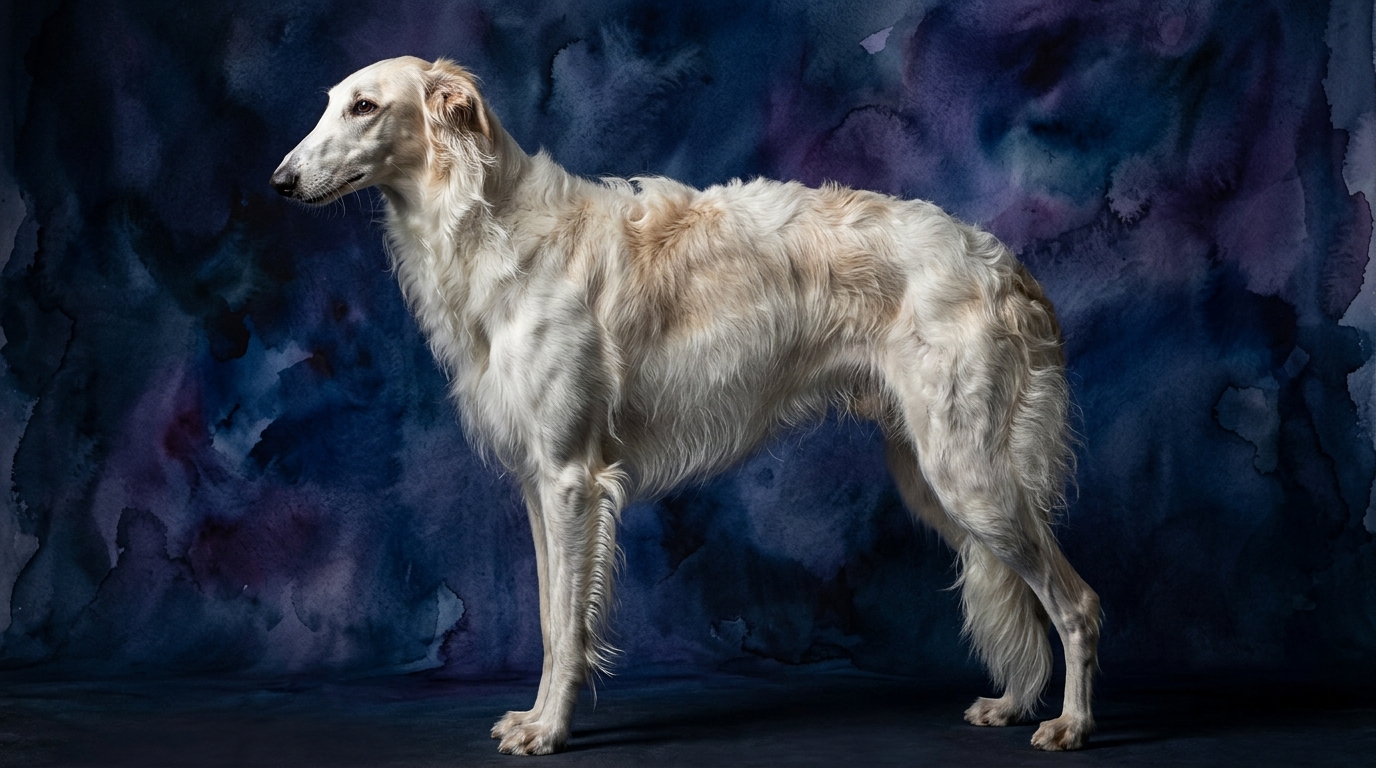

Side-by-Side Cognitive Profiles: Decoding the 3/5 Score
The Pet IQ Lab evaluates canine intelligence across five key dimensions, and remarkably, both the Borzoi and the Russian Toy register a consistent 3/5 across the board. However, understanding what a 3/5 means for each breed requires looking beyond the number and into their distinct historical roles and physical attributes.
For Problem Solving (3/5), the Borzoi’s cognitive strength is not typically about solving complex abstract puzzles, but rather about practical, often rapid, decision-making in dynamic, open environments. Imagine a Borzoi navigating a field, quickly assessing terrain changes or potential escape routes for a lure; their intelligence here lies in swift, instinctual processing tied to their physical capabilities and historical role as a sighthound. The Russian Toy’s 3/5 problem-solving manifests differently, often focused on manipulating their immediate, human-centric environment, such as figuring out how to open a crinkle bag for treats or strategically placing themselves for optimal lap access, demonstrating observational intelligence within their domestic sphere.
Training Speed (3/5) for the Borzoi reflects their independent sighthound nature. They are certainly capable of learning commands, but their motivation often needs to align with their own desires or instincts. Repetition and high-value positive reinforcement are crucial, but expecting instant, robotic obedience is unrealistic; their learning is steady and deeply influenced by their temperament. The Russian Toy’s 3/5 for training speed is shaped by their energetic yet sensitive disposition; they can pick up tricks quickly when engaged and motivated by praise or small rewards, but their attention span can be fleeting, necessitating consistency and making training feel like a fun game.
Social Intelligence (3/5) in the Borzoi is expressed through a quiet, discerning nature; they form profound bonds with their families, reading subtle cues and understanding household routines, yet they rarely display overt emotional exuberance. They observe and process social dynamics with a gentle, often reserved, demeanor. Conversely, the Russian Toy expresses its 3/5 social intelligence with an intense focus on their human companions; they are often highly attuned to their owner's moods, seeking to comfort or engage, and are adept at using their charm to solicit attention or cuddles, with their social world revolving tightly around their chosen people.
The Borzoi’s Instinctive Drive (3/5) is dominated by their powerful sighthound heritage, manifesting as an undeniable urge to chase anything that moves quickly, a drive that can be difficult to redirect once activated. Beyond prey drive, they also possess an instinct for comfort, seeking soft places and quiet companionship within their home. The Russian Toy’s 3/5 instinctive drive is primarily focused on seeking warmth, security, and close companionship. While some might display a spirited, toy-terrier-like interest in small critters, their overriding instincts are to be near their people, burrow under blankets, and ensure their personal comfort.
Finally, Memory (3/5) for the Borzoi is reliable for practical purposes; they remember routines, the layout of their home and familiar walking routes, and specific people who are part of their inner circle, recalling learned commands over long periods. The Russian Toy’s 3/5 memory is excellent for retaining information relevant to their social and comfort needs; they remember exactly where treats are stored, the specific sequence of events leading to a walk or play session, and the individuals who consistently provide affection and positive experiences.
Where the Borzoi's Cognition Shines
The Borzoi’s cognitive strengths are intrinsically linked to their historical role as aristocratic sighthounds, and their 3/5 problem-solving isn't about abstract puzzles, but about dynamic, real-time decision-making in vast open spaces. Imagine a Borzoi swiftly calculating the trajectory of a lure, adjusting its speed and direction over uneven terrain, or making split-second choices to navigate obstacles during a high-speed chase. This requires an exceptional form of spatial reasoning, predictive judgment, and an ability to process visual information at incredible speeds. Their memory, also rated 3/5, serves this function by allowing them to recall optimal routes, safe areas, and the nuances of various environments. They demonstrate a quiet, self-assured intelligence that prioritizes efficient, independent action, often appearing serene but always subtly aware of their surroundings. This breed thrives when given opportunities to engage these specific cognitive talents, whether in a fenced sprint or a long, exploratory walk where they can process and react to a changing landscape. Their social intelligence, while reserved, contributes to their ability to understand and adhere to household structure without constant supervision, showing a discerning awareness of their place within the family unit.
Where the Russian Toy's Cognition Excels
The Russian Toy, despite sharing the same 3/5 scores, demonstrates a distinct cognitive brilliance, particularly within the domestic sphere. Their 3/5 social intelligence manifests as an uncanny ability to read and respond to human emotions and subtle cues. They are often described as “velcro” dogs, not just physically, but emotionally, frequently adjusting their behavior to match their owner's mood. Their problem-solving (3/5) often involves intricate social maneuvering: figuring out precisely how to elicit a comforting cuddle, how to get a preferred toy from under furniture, or even how to gently nudge an owner towards a desired activity like a walk. This isn't brute-force problem-solving, but a nuanced, charming form of social engineering. Their memory (3/5) is excellent for recalling routines, the specific people who offer the best treats or snuggles, and the sequence of events that lead to their favorite activities. They leverage their small size and endearing presence to full cognitive advantage, proving that intelligence isn't solely about grand physical feats but also about masterful adaptation and interaction within one's immediate world; they are little masters of their human environment, often seeming to anticipate needs and desires with surprising accuracy.
Ease of Training: A Matter of Motivation and Drive
When evaluating the “ease of training” for Borzoi and Russian Toys, their shared 3/5 training speed score belies significant differences in approach and behavioral nuances. The Borzoi, a sighthound, often presents a unique training challenge due to its inherent independence and formidable prey drive. While they possess the cognitive capacity to learn commands, their willingness to execute them is often conditional. A Borzoi might understand “come” perfectly but choose to ignore it if a squirrel is in sight, demonstrating selective hearing rather than a lack of comprehension. Training a Borzoi requires immense patience, consistency, and highly motivating rewards to override their powerful instincts; short, engaging sessions are more effective than long, repetitive drills, as their focus can wane, especially if the task feels arbitrary. Owners must respect their independent spirit and aim for cooperation rather than absolute submission.
The Russian Toy, conversely, while also scoring 3/5, often appears more eager to please their primary human, which can make them seem quicker to train in certain contexts. However, their sensitivity means harsh corrections are counterproductive, leading to shut-down or anxiety. Their short attention span also necessitates positive reinforcement, making training feel like a fun game rather than a chore. They excel in learning tricks and basic obedience when engaged with enthusiasm and consistent, gentle guidance. The challenge with Russian Toys often lies in preventing “small dog syndrome,” where their social intelligence might lead them to believe they are the ones dictating terms. Early socialization and consistent, positive training from puppyhood are crucial to harness their intelligence and ensure they become well-adjusted companions, rather than tiny tyrants.
Cognitive Fit for Active vs. Relaxed Lifestyles
The Pet IQ Lab's identical scores for Borzoi and Russian Toys highlight that “intelligence” is multifaceted, manifesting differently depending on a breed's purpose and physical attributes. For owners with an active lifestyle, the Borzoi’s cognitive profile aligns well with their needs. While not a breed for endless, repetitive tasks, the Borzoi thrives on opportunities to engage their specific cognitive strengths: rapid decision-making during high-speed activity, spatial reasoning in open environments, and independent problem-solving related to movement and exploration. An active owner who can provide a secure, large area for regular sprints, or enjoys long, exploratory walks where the Borzoi can process varied stimuli, will find their majestic companion intellectually stimulated. Their cognitive engagement comes from the freedom to use their body and senses to navigate their world, rather than constant human direction. They are ideal for those who appreciate a dog that can make intelligent choices in dynamic, physical contexts, and then settle into quiet, dignified companionship indoors.
In contrast, the Russian Toy’s cognitive strengths make them an exceptional fit for more relaxed owners who desire a highly interactive and socially attuned companion. Their intelligence shines brightest in close domestic settings, where their keen social awareness and problem-solving skills are applied to navigating human relationships and household routines. A relaxed owner who values a dog that can read their moods, offer comfort, and engage in gentle play and interaction will find the Russian Toy a cognitively rich partner. Their activity is often mental and social, thriving on consistent human presence, lap time, and opportunities for charming interaction. They are content exploring the immediate home environment, solving the “puzzle” of getting attention, or mastering a new trick in a short, engaging session. For owners who prioritize companionship and a dog whose intelligence is expressed through social dexterity and adaptability to a human-centric world, the Russian Toy is an ideal match.
The Verdict
Opt for a Borzoi if you admire a majestic companion with independent thought, a strong drive for physical activity, and a reserved yet deep bond, thriving in environments that respect their sighthound instincts.
Select a Russian Toy if you seek a highly social, adaptable, and charming companion whose intelligence shines in domestic interactions and whose primary goal is to be a devoted, comforting presence.
🧠 Find Your Pet's IQ Score
Our Pet IQ Lab assessment covers 25+ tests across 5 cognitive dimensions — personalized to your breed.
Take the Full IQ Test →Frequently Asked Questions
Do Borzoi and Russian Toys learn at the same pace?
While both breeds score 3/5 for training speed, their learning styles differ. Borzoi might be slower due to their independent sighthound nature, requiring strong motivation, whereas Russian Toys can be quick with positive reinforcement but are sensitive and have shorter attention spans.
How does their problem-solving ability differ despite identical scores?
Borzoi's 3/5 problem-solving is often applied to physical tasks like navigating terrain or pursuit strategies, requiring quick, instinctual decisions. Russian Toys use their 3/5 to solve social problems, figuring out how to get attention or comfort from their human companions within a domestic setting.
Which breed is more emotionally expressive or socially aware?
Both score 3/5 in social intelligence, but express it differently. Russian Toys are typically more overtly attuned to human emotions and seek direct interaction, often acting as sensitive barometers of household moods. Borzoi are more reserved, showing their social awareness through subtle cues and a deep, quiet bond with their chosen family.