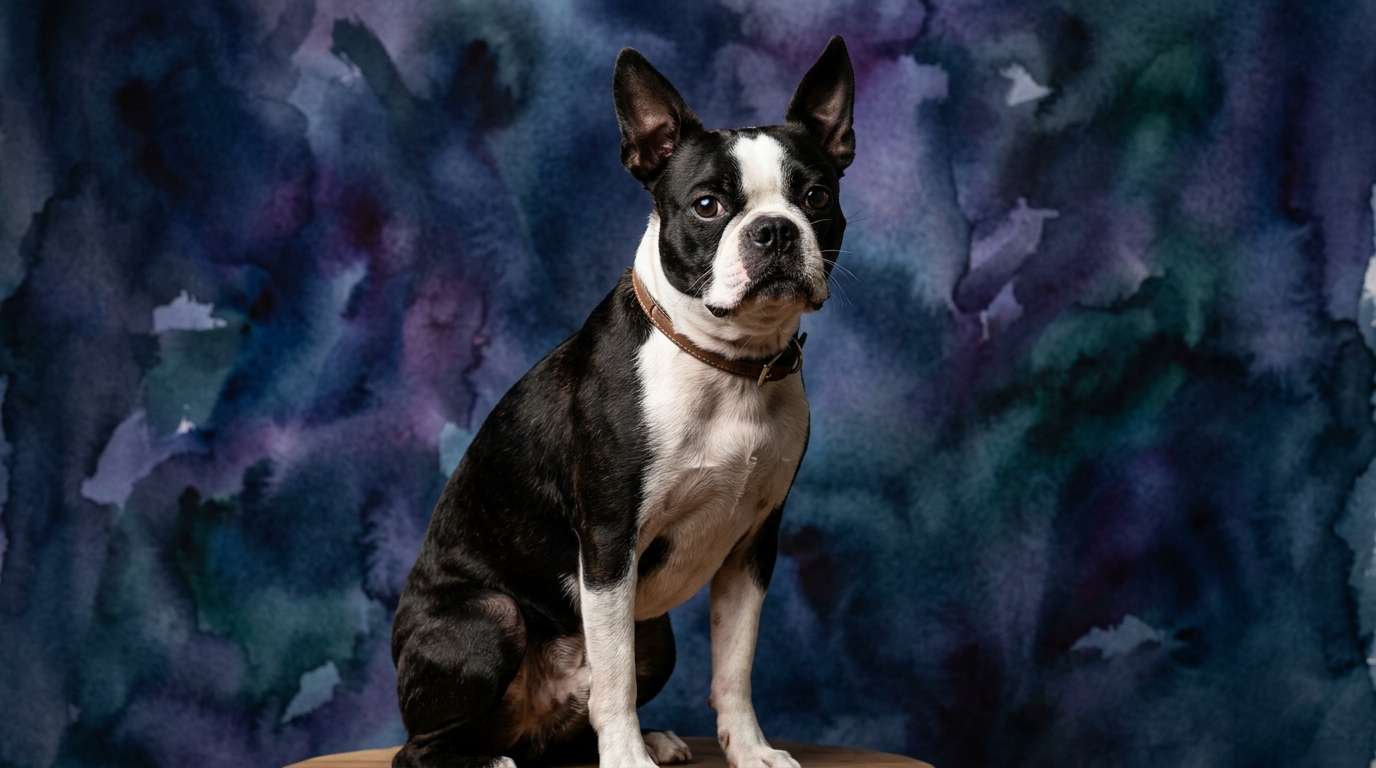

Side-by-Side Cognitive Profiles: Boston Terrier vs. Gordon Setter
At The Cosmic Pet Pet IQ Lab, we evaluate canine intelligence across five critical dimensions. The Boston Terrier, ranking #54 on the Coren scale, presents a profile marked by strong social aptitude. Their Problem Solving is rated 3/5, suggesting a moderate capacity for navigating novel challenges or figuring out puzzles independently. Training Speed also stands at 3/5, indicating they learn new commands with consistent effort but might not grasp complex sequences instantly. A standout feature is their Social Intelligence, scoring an impressive 4/5, which points to a keen awareness of human emotional states and social dynamics. Instinctive Drive is lower at 2/5, meaning they are less driven by primal urges like hunting or herding, while Memory is a solid 3/5, allowing them to retain routines and learned behaviors effectively.
The Gordon Setter, with a higher Coren ranking of #39, demonstrates a cognitive makeup geared towards purposeful engagement and active problem-solving. Their Problem Solving ability is rated 4/5, indicating a strong capacity for independent thought and strategic thinking in various situations. Training Speed is also high at 4/5, showcasing a rapid learning curve for new commands and tasks, especially when motivated. Social Intelligence is a respectable 3/5, meaning they understand human cues but perhaps not with the same nuanced sensitivity as the Boston Terrier. Their Instinctive Drive is moderate at 3/5, reflecting their sporting heritage and inclination towards exploration and scent work. Memory is a robust 4/5, crucial for remembering complex sequences, tracking, and retaining detailed information over time.
Where the Boston Terrier Excels Cognitively
The Boston Terrier's primary cognitive advantage lies in its exceptional Social Intelligence, scoring 4/5. This breed possesses an innate ability to read and respond to human emotions and household dynamics with remarkable accuracy. They often seem to anticipate their owner's moods, offering comfort or companionship precisely when needed, creating a profound, empathetic bond. This cognitive strength makes them extraordinarily attuned family members, adept at navigating the intricate social landscape of a home environment without causing disruption.
Furthermore, their lower Instinctive Drive (2/5) can be seen as a cognitive benefit in specific contexts. Unlike breeds with strong primal urges that might lead them to independent pursuits, the Boston Terrier's mind is less preoccupied with hunting, tracking, or patrolling. This allows their cognitive resources to be heavily invested in their immediate social world and human interactions, making them inherently more content with a domestic, companion-focused lifestyle. Their mental energy is channeled into understanding and responding to their people, fostering a deep sense of connection rather than seeking external stimulation through instinct-driven activities.
Where the Gordon Setter Shows Cognitive Superiority
The Gordon Setter's cognitive strengths are evident in its higher ratings for Problem Solving (4/5), Training Speed (4/5), and Memory (4/5). Their superior problem-solving ability allows them to independently assess situations and devise solutions, which is invaluable in complex tasks or when navigating new environments. This trait is often observed in their capacity to figure out how to retrieve a hidden toy or overcome an obstacle during training. Coupled with an excellent memory, they can retain intricate sequences of commands and learn from experiences more efficiently.
Their enhanced Training Speed (4/5) means they grasp new commands and concepts with relative swiftness, making them highly responsive to consistent guidance. This quick learning, combined with their moderate Instinctive Drive (3/5), fuels a purposeful engagement with their surroundings. This drive, rather than being a distraction, becomes a cognitive asset, channeling their focus and persistence towards tasks like scent work, field trials, or advanced obedience. They possess a mental stamina that allows them to sustain concentration and effort over extended periods, making them formidable partners in activities requiring sustained cognitive output.
Training Dynamics: Which Breed is Easier and Why?
When it comes to ease of training, the Gordon Setter generally holds an advantage, particularly for complex tasks and rapid acquisition of new commands. Their higher Training Speed (4/5) and Problem Solving (4/5) mean they are quicker to understand what is being asked of them and more adept at figuring out how to comply. Their moderate Instinctive Drive (3/5) can be effectively channeled into productive training, as they often thrive on having a purpose and mental engagement. They respond well to consistent, clear instruction and positive reinforcement, often demonstrating an eagerness to learn and perform tasks that challenge their intellect.
The Boston Terrier, while certainly trainable with a Training Speed of 3/5, might require more patience and repetition for intricate commands or multi-step tasks. Their primary motivation in training often stems from their strong Social Intelligence (4/5)—they want to please their owner and maintain harmony. However, their lower Instinctive Drive (2/5) means they may not have the same inherent drive for task completion for its own sake. Owners might find them more prone to 'selective hearing' if the task seems less relevant to their social bond or if they perceive a more appealing social interaction elsewhere. Training them effectively relies heavily on leveraging their desire for companionship and positive social reinforcement.
Cognitive Profiles and Owner Lifestyles: Active vs. Relaxed
For active owners seeking a canine partner for demanding pursuits, the Gordon Setter is the clear choice. Their superior Problem Solving (4/5), Memory (4/5), and Training Speed (4/5), coupled with a moderate Instinctive Drive (3/5), equip them perfectly for consistent mental and physical challenges. They excel in activities like advanced obedience, agility, field trials, or long-distance hiking, where their keen intellect and purposeful drive are fully engaged. These dogs thrive when given a job or a challenging activity that allows them to utilize their cognitive abilities and work collaboratively.
Conversely, for owners with a more relaxed lifestyle, the Boston Terrier is an ideal companion. Their exceptional Social Intelligence (4/5) and lower Instinctive Drive (2/5) make them profoundly content with a home-centric existence and moderate exercise. They are less demanding of constant intellectual stimulation beyond their social world, finding immense satisfaction in close human interaction and being an integral part of family life. Their cognitive energy is primarily directed towards understanding and interacting with their human companions, making them wonderfully adaptable to apartment living and less prone to boredom-driven destructive behaviors in a less active household.
The Verdict: Choosing Your Canine Companion
The Verdict
If your priority is a highly attuned, socially intelligent companion content with a domestic routine and less demanding of intense mental or physical exertion, the Boston Terrier is an excellent choice.
Opt for the Gordon Setter if you seek a keen, capable partner for engaging in complex training, outdoor adventures, or competitive dog sports, who thrives on purposeful activity and mental stimulation.
🧠 Find Your Pet's IQ Score
Our Pet IQ Lab assessment covers 25+ tests across 5 cognitive dimensions — personalized to your breed.
Take the Full IQ Test →Frequently Asked Questions
Are Boston Terriers good at puzzle toys?
Boston Terriers have a moderate problem-solving ability (3/5), meaning they can enjoy and figure out puzzle toys, but might take longer or require simpler designs compared to breeds with higher scores. Their motivation is often linked to social interaction or food rewards.
How does a Gordon Setter's instinctive drive affect its daily life?
A Gordon Setter's moderate instinctive drive (3/5) means they possess a natural curiosity, a desire to explore, and an inclination towards scent work. This translates to needing regular mental and physical engagement to prevent boredom and channeling their natural predispositions constructively.
Which breed is more prone to separation anxiety based on their IQ profile?
While both breeds can develop separation anxiety, the Boston Terrier's higher social intelligence (4/5) and lower instinctive drive might make them more prone to emotional distress when separated from their human companions, as their cognitive focus is heavily invested in social bonding.