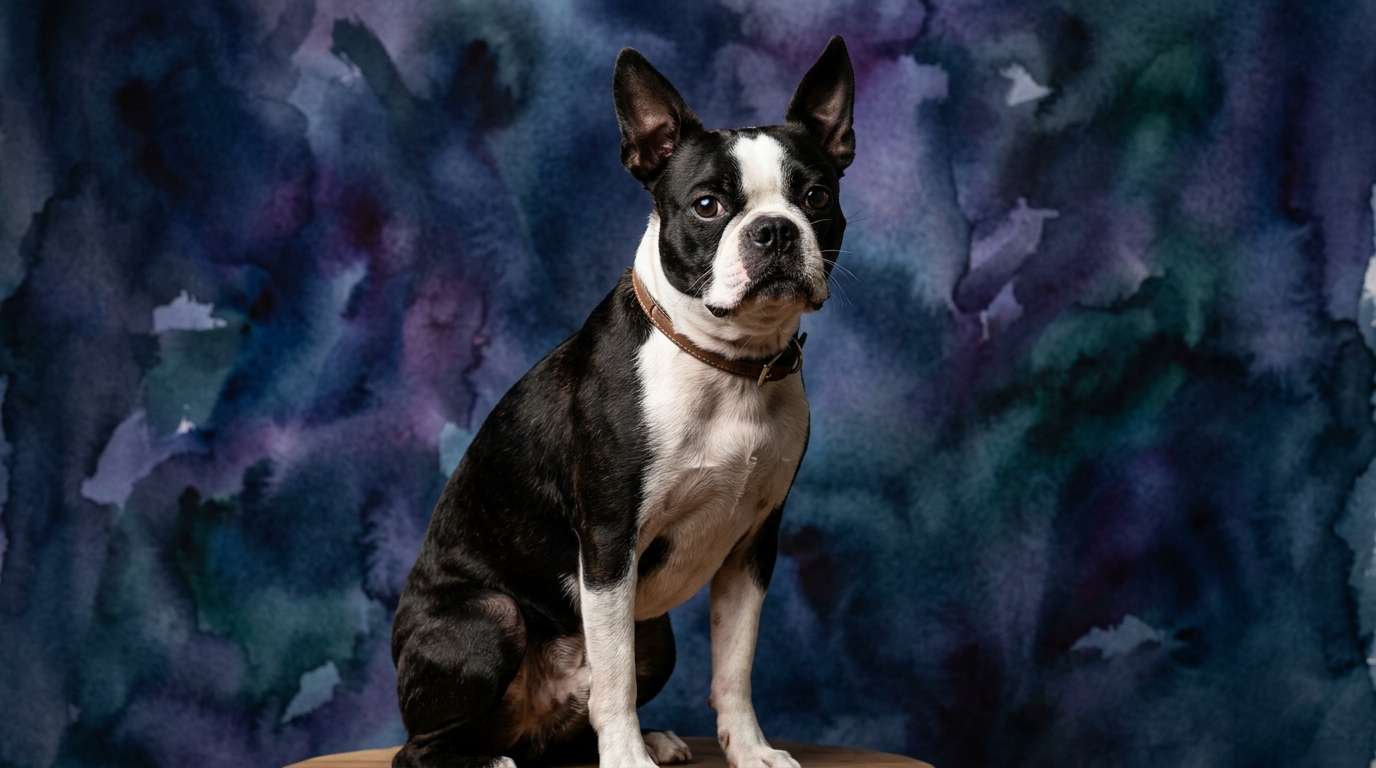

Side-by-Side Cognitive Profiles: Boston Terrier vs. Miniature Poodle
To truly understand the mental landscape of these two breeds, let's examine their individual cognitive profiles across five key dimensions, as assessed by The Cosmic Pet Pet IQ Lab, referencing their Coren ranks.
The Boston Terrier, ranked #54 by Coren, presents a balanced yet distinctly socially oriented intelligence profile:
Problem Solving (3/5): Boston Terriers exhibit a moderate capacity for problem-solving. They are capable of figuring out simple puzzles or navigating familiar obstacles, but they typically aren't the type to independently strategize complex solutions. Instead, they often rely on observation, trial-and-error, or, most frequently, seeking guidance and assistance from their human companions when faced with a novel challenge. Their approach is more practical and less abstract, preferring straightforward solutions that often involve their people.
Training Speed (3/5): Learning new commands and behaviors comes at a steady, rather than rapid, pace for the Boston Terrier. They require consistent repetition, clear instructions, and plenty of positive reinforcement to solidify their understanding. While they possess a strong desire to please their owners, their cognitive processing for new information is not exceptionally quick, meaning patience and persistence are key to successful training outcomes.
Social Intelligence (4/5): This is where the Boston Terrier truly excels. They possess a keen ability to read and interpret human emotions, body language, and subtle social cues within their environment. They are highly attuned to the moods of their family members, often adapting their own behavior to maintain harmony or offer comfort. This strong social acumen makes them wonderfully intuitive and empathetic companions, deeply connected to their human pack.
Instinctive Drive (2/5): The Boston Terrier has a relatively low instinctive drive for behaviors such as hunting, herding, or guarding. While individual variations exist, they are generally not prone to strong prey drives or territorial instincts that might lead to chasing small animals or excessive barking at perceived threats. Their focus is overwhelmingly on companionship and domestic integration rather than fulfilling ancient working roles.
Memory (3/5): Their memory is functional and reliable for daily routines, frequently practiced commands, and recognizing familiar people and places. However, they may not retain complex sequences of actions or less frequently used skills with the same long-term precision as some other breeds. Their memory serves their immediate social and routine needs effectively, but might require refreshers for intricate tasks.
The Miniature Poodle, with an impressive Coren rank of #2, displays a remarkably high-performing cognitive architecture:
Problem Solving (5/5): Miniature Poodles are outstanding problem-solvers, demonstrating exceptional cognitive flexibility and ingenuity. They possess a remarkable ability to analyze new situations, connect cause and effect, and independently devise creative solutions to overcome obstacles. Whether it's figuring out how to open a gate or solving a complex puzzle toy, their strategic thinking is often impressive and deliberate, showcasing true mental agility.
Training Speed (5/5): With a training speed score of 5 out of 5, Miniature Poodles are among the fastest learners in the canine world. They grasp new commands, tricks, and concepts with astonishing rapidity, often requiring only a handful of repetitions to understand and execute a task flawlessly. This quick uptake is a hallmark of their breed, making them a joy to train for a wide range of activities and disciplines.
Social Intelligence (3/5): While capable of forming deep and affectionate bonds, the Miniature Poodle's social intelligence, at 3 out of 5, is more focused on direct interaction and understanding clear communication rather than subtle emotional nuances. They thrive on clear commands and consistent feedback, and while they are loving companions, they might not always pick up on implicit human emotional states with the same intuitive grace as a Boston Terrier.
Instinctive Drive (3/5): Poodles, originally bred as water retrievers, retain a moderate level of instinctive drive, particularly for retrieving tasks and activities involving water. This can manifest as a strong desire to 'work' or engage in purposeful activities. While not as intense as some sporting breeds, this drive contributes to their eagerness to learn and participate in structured tasks, often with great enthusiasm.
Memory (5/5): The Miniature Poodle possesses an exceptional memory, allowing them to recall a vast repertoire of commands, complex sequences, and past experiences with remarkable accuracy and over long periods. Once a skill or piece of information is learned, it tends to be deeply ingrained, enabling them to build an extensive knowledge base and perform elaborate routines with ease and precision.
Where the Boston Terrier Cognitively Shines
The Boston Terrier's primary cognitive advantage lies in its superior social intelligence, scoring a notable 4 out of 5. This breed excels at understanding and navigating the intricate social landscape of a human household. They are remarkably adept at reading non-verbal cues, discerning emotional shifts in their owners, and reacting appropriately to maintain a harmonious environment. For instance, a Boston Terrier might instinctively offer a comforting nudge when their owner is upset or quietly retreat when a peaceful atmosphere is desired, demonstrating a deep empathetic connection. This intuitive grasp of social dynamics fosters a profound, empathetic bond, making them highly responsive and emotionally attuned companions who often anticipate their owner's needs before a verbal command is even given. Their moderate problem-solving skills are frequently channeled into social contexts, where they might 'solve' a situation by seeking human attention or comfort, showcasing their people-oriented approach to challenges.
Where the Miniature Poodle Cognitively Excels
In terms of pure cognitive power, the Miniature Poodle is a clear frontrunner, boasting perfect 5 out of 5 scores in both problem-solving and memory. Their capacity to independently analyze novel situations and formulate effective strategies is truly impressive; they don't merely react, but actively think through challenges. For example, a Poodle might quickly figure out a multi-step puzzle toy or devise a clever way to retrieve an out-of-reach item, demonstrating genuine ingenuity and foresight. This formidable problem-solving ability is complemented by an outstanding memory, allowing them to recall an extensive array of commands, complex trick sequences, and past learning experiences with remarkable precision and longevity. This combination enables them to build a deep and broad knowledge base, making them exceptional candidates for intricate training and advanced canine activities where sustained retention and application of learned skills are paramount.
Training Aptitude: Which is Easier to Train and Why?
When evaluating ease of formal training, the Miniature Poodle holds a significant advantage due to its exceptional training speed and sophisticated problem-solving capabilities. Poodles assimilate new commands, complex sequences, and abstract concepts with remarkable efficiency, often mastering a new task after only a few repetitions. Their inherent eagerness to engage mentally and their capacity for analytical thought mean they don't just mimic actions but truly understand the underlying principles, which facilitates easier generalization of skills across different environments and situations. This makes them highly responsive to positive reinforcement and eager participants in learning. In contrast, the Boston Terrier, while possessing a strong desire to please, learns at a more moderate pace. Their training requires greater consistency, more frequent repetition, and a patient, step-by-step approach to solidify new behaviors. While both breeds respond well to positive reinforcement, the Poodle's higher instinctive drive, particularly for task-oriented engagement, can make them more readily motivated by work-based rewards, whereas the Boston Terrier often thrives on social praise and affectionate interaction as primary motivators.
Lifestyle Suitability: Active Owners vs. Relaxed Owners
For owners who are intrinsically active and enjoy consistent mental engagement with their canine companion, the Miniature Poodle is an exceptional match. Their high problem-solving scores and outstanding memory mean they thrive on structured training, advanced obedience, canine sports like agility or rally, and interactive puzzle toys that challenge their intellect. They require regular mental stimulation to remain content and prevent boredom, making them ideal for individuals who are prepared to dedicate significant time to teaching new skills and providing intellectual outlets. A more relaxed owner, or one unable to consistently provide this level of mental exercise, might find a Poodle’s unmet cognitive needs manifesting as unwanted behaviors, such as excessive barking or destructive chewing. Conversely, the Boston Terrier, with its balanced cognitive profile and strong social intelligence, is perfectly suited for owners seeking a loving companion that integrates seamlessly into a more relaxed home environment. While they certainly enjoy walks and playtime, their lower instinctive drive and moderate need for complex mental tasks mean they are often content with regular companionship, routine activities, and less intensive intellectual demands. Their primary joy stems from being emotionally connected to their people, making them wonderful companions for those who prioritize affectionate interaction and a generally calm household atmosphere.
The Verdict
Opt for a Boston Terrier if you seek an emotionally intuitive companion who excels at reading your mood and seamlessly integrating into a relaxed, affectionate home life, valuing social harmony above complex tasks.
Choose a Miniature Poodle if you are an active owner eager to engage in advanced training, canine sports, and intellectual challenges with a dog that learns with remarkable speed and retains information flawlessly.
🧠 Find Your Pet's IQ Score
Our Pet IQ Lab assessment covers 25+ tests across 5 cognitive dimensions — personalized to your breed.
Take the Full IQ Test →Frequently Asked Questions
Are Boston Terriers good at learning tricks?
Boston Terriers can certainly learn a variety of tricks, especially those involving social interaction or simple sequences. While their training speed is moderate, their desire to please their owners and their strong social intelligence make them receptive to fun, engaging training sessions.
Do Miniature Poodles need a lot of exercise?
Miniature Poodles require regular physical exercise, but their greater need is often for mental stimulation. Daily walks and play are important, but they truly thrive when their keen minds are challenged with training, puzzle toys, or canine sports to prevent boredom.
Which breed is better for first-time dog owners?
Both breeds can be suitable for first-time owners, but their needs differ. A Boston Terrier might be slightly easier due to its lower demand for complex mental stimulation and higher social intuition. A Miniature Poodle requires an owner committed to consistent, engaging mental training.