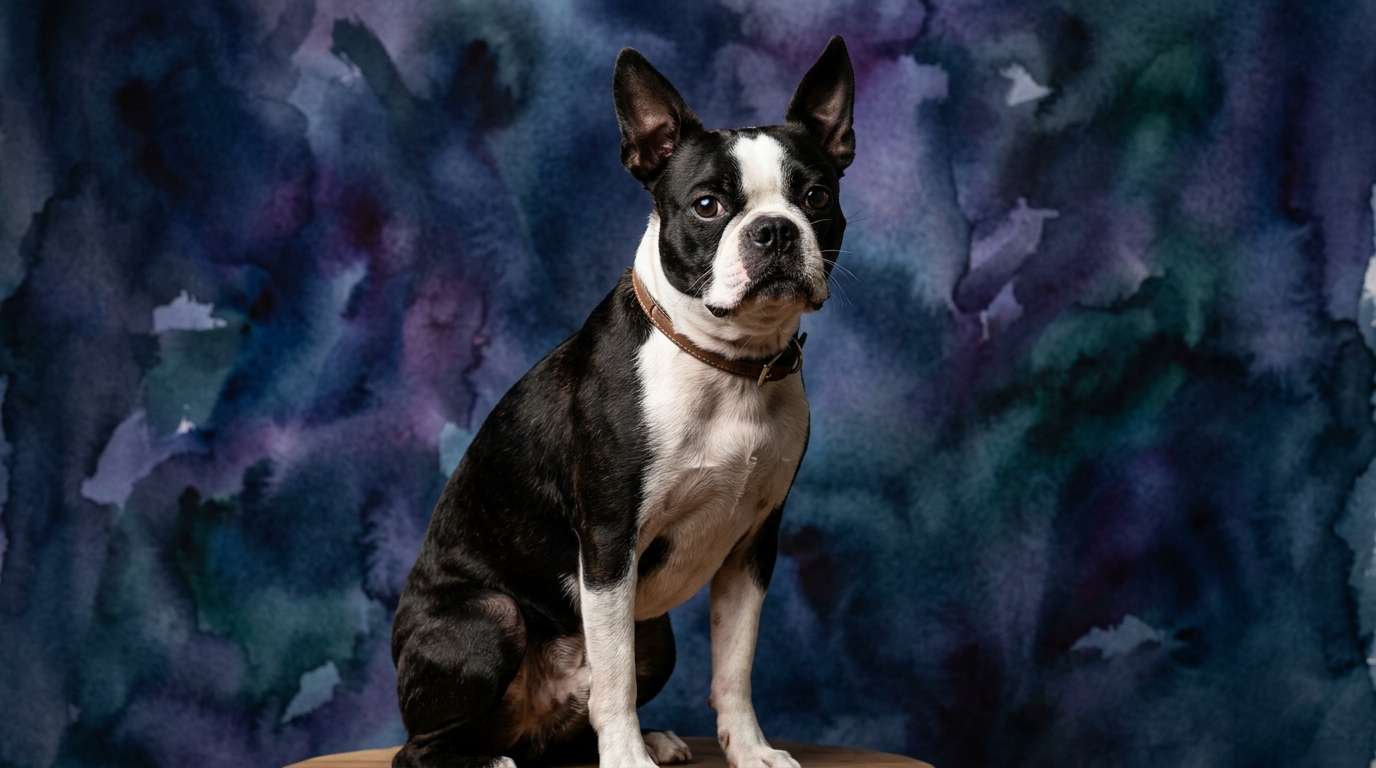

Side-by-Side IQ Profile: Boston Terrier vs. Russian Toy
The Cosmic Pet Pet IQ Lab assesses canine intelligence across five key dimensions, providing a granular view of each breed's mental aptitude. For the Boston Terrier, a Non-Sporting group dog ranked #54 by Coren, its Problem Solving scores 3/5, indicating an ability to navigate common household challenges and learn routines without excessive difficulty, though complex puzzles may require assistance. Its Training Speed also rates 3/5, suggesting a moderate pace for acquiring new commands and behaviors, requiring consistent but not overly intensive repetition. Social Intelligence is a notable strength at 4/5, highlighting their strong attunement to human emotions and cues, making them highly responsive companions. Instinctive Drive is lower at 2/5, meaning they possess less inherent drive for traditional canine tasks like hunting or guarding, focusing more on companionship. Memory for the Boston Terrier is 3/5, allowing them to retain learned behaviors and recognize familiar faces and places effectively.
The Russian Toy, a delicate member of the Toy group and not Coren-ranked, presents a slightly different cognitive blueprint. Its Problem Solving ability mirrors the Boston Terrier at 3/5, suggesting a similar capacity for understanding cause-and-effect in their immediate environment and learning household rules. Training Speed also aligns at 3/5, meaning they learn at a comparable rate, responding well to positive reinforcement and clear instructions. Social Intelligence for the Russian Toy is 3/5, indicating they are capable of forming strong bonds and understanding human communication, though perhaps with a slightly more reserved or selective approach than the Boston Terrier. Where the Russian Toy distinctly differs is its Instinctive Drive, scoring 3/5, which suggests a more pronounced natural inclination for exploring, chasing small objects, or demonstrating a degree of territorial awareness. Memory for the Russian Toy is also 3/5, enabling them to recall past experiences and learned commands reliably.
Where the Boston Terrier Wins Cognitively
The Boston Terrier's distinct cognitive advantage lies in its superior Social Intelligence, scoring 4/5 compared to the Russian Toy's 3/5. This higher score translates into a profound ability to interpret human emotions and intentions, making them exceptionally empathetic and responsive companions. A Boston Terrier is often described as 'human-like' in its understanding, readily picking up on subtle cues, mood shifts, and even anticipating owner actions. This heightened social awareness contributes to their adaptability in various social settings and their generally amiable disposition towards strangers and other pets. Their eagerness to please stems directly from this strong social connection, making them highly motivated by positive human interaction and approval. This cognitive edge means they often integrate seamlessly into family life, requiring less explicit direction in social scenarios and often acting as natural emotional support animals due to their perceptive nature.
Where the Russian Toy Wins Cognitively
The Russian Toy exhibits a cognitive win in its Instinctive Drive, scoring 3/5 compared to the Boston Terrier's 2/5. Despite their small stature, this higher drive signifies a more robust connection to inherent canine behaviors. This isn't about aggression, but rather a stronger inclination towards natural canine pursuits like chasing, exploring, and exhibiting a degree of watchfulness. While the Boston Terrier is primarily focused on human companionship, the Russian Toy often demonstrates a keen interest in its environment, potentially showing more curiosity about new smells or moving objects. This can manifest as a spirited playfulness, a tendency to 'hunt' toys, or even a surprisingly alert response to unusual sounds, acting as a miniature alarm system. Owners might observe a greater self-sufficiency in play and exploration in the Russian Toy, driven by these more pronounced instincts, which can be channeled into engaging activities like scent games or miniature agility.
Which Is Easier to Train and Why
Both the Boston Terrier and the Russian Toy share a Training Speed score of 3/5, suggesting they acquire new skills at a moderate, comparable pace. However, the Boston Terrier's superior Social Intelligence (4/5) often gives it an edge in perceived ease of training. Their deep desire to please their human companions means they are highly motivated by praise and positive reinforcement, often making the training process feel more collaborative and less like a chore. They are more likely to maintain focus on their handler and respond readily to verbal cues and body language, thriving on the bond built during training sessions. While they can be stubborn at times, their inherent social drive makes them generally cooperative students, eager for approval.
The Russian Toy, with its 3/5 Training Speed and 3/5 Social Intelligence, is certainly trainable, but its higher Instinctive Drive (3/5) can introduce different challenges. While they form strong bonds, their attention might be more easily diverted by environmental stimuli – a rustling leaf, a distant sound, or a small moving object could be more captivating than a training command. This means owners might need to work harder to maintain focus, especially in distracting environments, and training might require more patience and consistency to overcome these natural inclinations. While equally capable of learning, the Russian Toy's independence and stronger natural drives might require a more creative approach to motivation and distraction management compared to the Boston Terrier's inherent people-pleasing nature.
Which Suits Active Owners vs. Relaxed Owners
For owners seeking a highly engaged and socially interactive companion, the Boston Terrier's cognitive profile aligns well with an active social lifestyle. Their high Social Intelligence means they thrive on being included in family activities, whether it's a brisk walk in the park, a visit to a dog-friendly cafe, or simply lounging on the couch together. They are generally adaptable to various environments and social situations, making them excellent companions for owners who enjoy bringing their dog along. While not requiring extreme athletic endeavors, they appreciate consistent mental stimulation through interaction and short, engaging play sessions. Their lower Instinctive Drive means they are less likely to be independently driven by chasing or exploring, preferring to engage as part of a human-led activity.
The Russian Toy, despite its small size, appeals to owners who appreciate a dog with a bit more independent spirit and a stronger connection to natural canine behaviors. While they are affectionate, their higher Instinctive Drive (3/5) suggests they might benefit from owners who can channel this energy into structured play or mental exercises like scent work, even if it's within the confines of a home or yard. They can be surprisingly energetic for their size, enjoying games of fetch or exploring new areas with enthusiasm. While they can adapt to a relaxed home, owners who appreciate and can engage with a dog's natural curiosity and playful instincts, perhaps with short bursts of activity followed by cuddles, might find the Russian Toy a rewarding match. They are not necessarily for sedentary owners, but rather for those who enjoy playful engagement that taps into their innate drives.
The Verdict: When to Choose Each Companion
Choosing between a Boston Terrier and a Russian Toy hinges on the specific blend of companionship and cognitive engagement an owner desires. Both breeds offer unique joys, but their internal workings guide them toward different owner profiles. The Boston Terrier, with its profound social intelligence and moderate training speed, excels as a deeply empathetic and adaptable family member, thriving on consistent human interaction and fitting seamlessly into varied social environments. They are ideal for owners who prioritize a dog that is acutely tuned into their emotions and eager to participate in all aspects of family life, offering a loyal and responsive presence.
Conversely, the Russian Toy, with its balanced problem-solving and training speed, coupled with a higher instinctive drive, is suited for owners who appreciate a spirited companion with a natural zest for exploration and play. They are a wonderful choice for those who enjoy engaging with a dog's inherent curiosity and playful instincts, perhaps through structured games or short, energetic bursts of activity. While affectionate, they offer a slightly more independent demeanor, making them a good fit for owners who appreciate a dog with a bit more 'spark' and a strong connection to its primal canine joys, even in a tiny package.
The Verdict
Choose a Boston Terrier if you seek a highly empathetic, people-focused companion that seamlessly integrates into family life and thrives on consistent social interaction.
Opt for a Russian Toy if you appreciate a spirited, curious dog with a playful independent streak, and enjoy channeling their natural instincts into engaging activities.
🧠 Find Your Pet's IQ Score
Our Pet IQ Lab assessment covers 25+ tests across 5 cognitive dimensions — personalized to your breed.
Take the Full IQ Test →Frequently Asked Questions
Are Boston Terriers good with children?
Yes, Boston Terriers often do well with children due to their high social intelligence and generally amiable nature. They are typically patient and enjoy being part of family activities, making them suitable companions for respectful children.
Do Russian Toys require a lot of exercise?
Despite their higher instinctive drive, Russian Toys do not require extensive exercise due to their small size. Short, regular walks and indoor play sessions are usually sufficient to meet their physical and mental stimulation needs.
Which breed is more prone to separation anxiety?
The Boston Terrier, with its higher social intelligence and strong bond with humans, may be more prone to separation anxiety if left alone for extended periods. The Russian Toy, while affectionate, might display a slightly more independent streak, potentially handling solitude a bit better, though neither breed thrives on prolonged isolation.