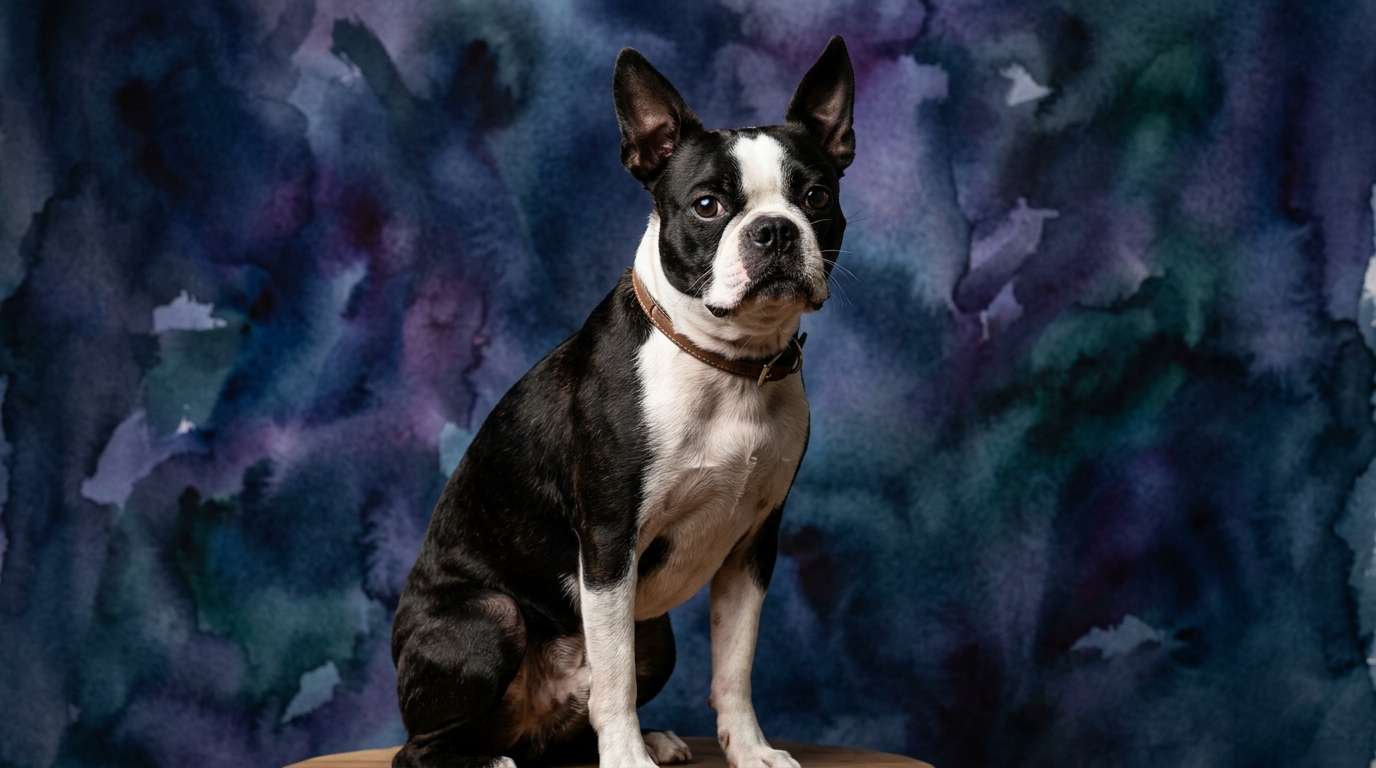

Side-by-Side Cognitive Profiles: Boston Terrier vs. Smooth Fox Terrier
The Cosmic Pet Pet IQ Lab employs a five-dimensional framework to assess canine intelligence, moving beyond simple obedience to capture a holistic view of a breed's mental capabilities. For the Boston Terrier, a member of the Non-Sporting group and Coren-ranked at #54, its profile paints a picture of a companion-oriented mind. Its problem-solving capacity sits at a solid 3/5, indicating competence in navigating everyday challenges and understanding cause-and-effect in their immediate environment. Training speed is also rated 3/5, suggesting they learn new commands and routines effectively with consistent guidance. Where the Boston truly stands out is its social intelligence, scoring an impressive 4/5, reflecting a keen ability to interpret human cues and desire for interaction. Its instinctive drive is a lower 2/5, meaning less inclination towards independent hunting or territorial behaviors, while its memory is a reliable 3/5, ensuring retention of learned information.
The Smooth Fox Terrier, a tenacious member of the Terrier group, presents a slightly different cognitive blueprint, though not Coren-ranked. Its problem-solving score mirrors the Boston at 3/5, demonstrating an ability to overcome obstacles, often with a characteristic terrier tenacity. Training speed is also 3/5, meaning they are capable learners, though their independent spirit might require a more engaging approach. Social intelligence for the Smooth Fox Terrier is 3/5, indicating they are interactive and bond with their families, but perhaps with a greater degree of self-reliance compared to the Boston. A key differentiator is their instinctive drive, rated 3/5, which points to a stronger inherent urge for chasing, digging, and exploration. Their memory, like the Boston, is a functional 3/5, allowing them to recall learned experiences and commands.
Where the Boston Terrier Excels Cognitively
The Boston Terrier’s most pronounced cognitive advantage lies in its exceptional social intelligence, scoring a 4/5 compared to the Smooth Fox Terrier’s 3/5. This higher rating means Boston Terriers possess an acute ability to interpret human emotions, body language, and vocal tones. They are remarkably attuned to their owners' moods, often seeming to anticipate needs or desires, and respond with a profound level of empathy and engagement. This cognitive strength fosters a deeply reciprocal bond, making them highly responsive to praise and interaction. Their understanding of social dynamics within the household allows them to integrate seamlessly, often adapting their behavior based on subtle human cues.
Furthermore, the Boston Terrier's lower instinctive drive (2/5 compared to the Smooth Fox Terrier's 3/5) can be seen as a cognitive advantage within a domestic setting. While not a 'win' in terms of raw drive, this reduced inclination for independent, instinct-driven pursuits like intense chasing or digging means they are less prone to behaviors that might conflict with human expectations. Their focus is more readily directed towards human interaction rather than environmental exploration driven by prey drive. This allows their social intelligence and willingness to engage to come to the forefront, making them generally more manageable and less prone to 'selective hearing' when a compelling scent or movement captures their attention.
Where the Smooth Fox Terrier Shows Its Cognitive Strengths
The Smooth Fox Terrier's cognitive prowess is most evident in its instinctive drive, rated 3/5, a point higher than the Boston Terrier. This robust drive isn't merely about physical energy; it signifies a keen cognitive focus on environmental engagement and problem-solving through tenacious physical action. A Smooth Fox Terrier with a 3/5 instinctive drive possesses an inherent and persistent motivation to explore, hunt, and investigate, often using their keen senses to track and locate. This translates into a strong capacity for independent work, where their cognitive strength lies in their ability to remain singularly focused on a task driven by their innate instincts, such as pursuing a scent trail or meticulously 'working' a puzzle toy until it yields its reward. Their persistence, fueled by this drive, is a cognitive asset, enabling them to overcome challenges through sheer determination.
While both breeds share a 3/5 score in problem-solving and training speed, the Smooth Fox Terrier often applies these cognitive skills with a distinct terrier flair. Their problem-solving might involve more resourceful, sometimes clever, strategies to achieve their goals, particularly if those goals align with their natural drives. For instance, they might quickly figure out how to open a cupboard or navigate a complex obstacle course if a perceived 'prey' (like a favorite toy or a hidden treat) is the objective. Their training speed, while similar, can be exceptionally quick when the learning process is framed as a game or a challenge that taps into their energetic and independent spirit, making them highly capable when properly motivated and engaged.
Training Dynamics: Which Breed is Easier and Why?
When considering ease of training, the Boston Terrier generally holds an edge, primarily due to its superior social intelligence and lower instinctive drive. A Boston Terrier’s 4/5 social intelligence means they are inherently more inclined to please their human companions and are highly responsive to positive reinforcement, especially praise and affection. They quickly grasp what is expected of them by reading subtle cues from their trainer and are less likely to be sidetracked by external stimuli due to their lower instinctive drive. Their eagerness to engage and their cooperative nature make them receptive students, often accelerating the learning process for basic obedience and house manners, as their primary motivation is often to maintain harmony and connection with their family.
The Smooth Fox Terrier, with its 3/5 social intelligence and 3/5 instinctive drive, presents a different training dynamic. While equally capable of learning due to their 3/5 training speed, their independent nature and strong inherent drives mean that training requires more consistency, creativity, and a deep understanding of their terrier mindset. They might learn a command quickly but choose whether to obey it based on their own assessment of the situation or if a more compelling distraction, such as a squirrel or an interesting scent, captures their attention. Training a Smooth Fox Terrier often benefits from being framed as a game or a challenge, leveraging their natural tenacity and desire to 'win,' rather than relying solely on a desire to please. Their focus may need to be actively managed to prevent their instincts from taking over during training sessions.
Lifestyle Match: Active Owners vs. Relaxed Owners
The Boston Terrier’s cognitive profile makes it a superb fit for owners seeking a deeply engaged and adaptable companion, whether they lead a moderately active or more relaxed lifestyle. While they certainly enjoy walks and playtime, their lower instinctive drive (2/5) means their exercise requirements are generally manageable, often satisfied with a few brisk walks and indoor games. Crucially, their high social intelligence (4/5) means they thrive on mental stimulation through interaction with their family, rather than solely through physical exertion. Relaxed owners who can provide consistent companionship, short bursts of play, and cognitive engagement through training or puzzle toys will find the Boston Terrier integrates seamlessly into their daily rhythm, valuing quality time and connection above intense physical demands.
Conversely, the Smooth Fox Terrier is undeniably better suited for active owners who can match its robust energy levels and provide ample outlets for its cognitive strengths. Its 3/5 instinctive drive and tenacious problem-solving mean this breed needs consistent physical activity and mental challenges to prevent boredom and channel its natural urges. Owners who enjoy outdoor adventures, participate in dog sports like agility, earthdog trials, or embark on long, stimulating hikes will find a willing and enthusiastic partner in a Smooth Fox Terrier. Their independent spirit and drive to explore mean they are less content to be couch potatoes and require structured activities that engage both their bodies and their minds. For genuinely relaxed owners who prefer minimal interaction and exercise, the Smooth Fox Terrier's cognitive needs may prove challenging to meet, potentially leading to undesired behaviors stemming from unfulfilled mental and physical stimulation.
The Verdict
Choose the Boston Terrier if you prioritize a deeply communicative, emotionally attuned companion who integrates seamlessly into family life and responds readily to social cues.
Choose the Smooth Fox Terrier if you seek an energetic, tenacious partner for adventures and dog sports, valuing an independent spirit that thrives on engaging with the world through its keen senses and robust drives.
🧠 Find Your Pet's IQ Score
Our Pet IQ Lab assessment covers 25+ tests across 5 cognitive dimensions — personalized to your breed.
Take the Full IQ Test →Frequently Asked Questions
Are Boston Terriers generally good with children?
Yes, Boston Terriers, with their high social intelligence and affectionate nature, often bond well with children, especially when properly socialized. Their desire for companionship makes them gentle and playful family members, though supervision is always recommended with any dog and child.
Do Smooth Fox Terriers tend to bark a lot?
Smooth Fox Terriers can be vocal, using barks to alert their owners or express excitement, a trait often linked to their instinctive drive and alert nature. Consistent training from a young age can help manage excessive barking, but they are generally more prone to vocalization than some other breeds.
Which breed is better suited for apartment living?
The Boston Terrier is generally better suited for apartment living due to its smaller size, moderate exercise needs, and lower instinctive drive, as long as it receives daily walks and mental engagement. The Smooth Fox Terrier can adapt, but requires significantly more structured outdoor activity and mental stimulation to thrive in an apartment setting.