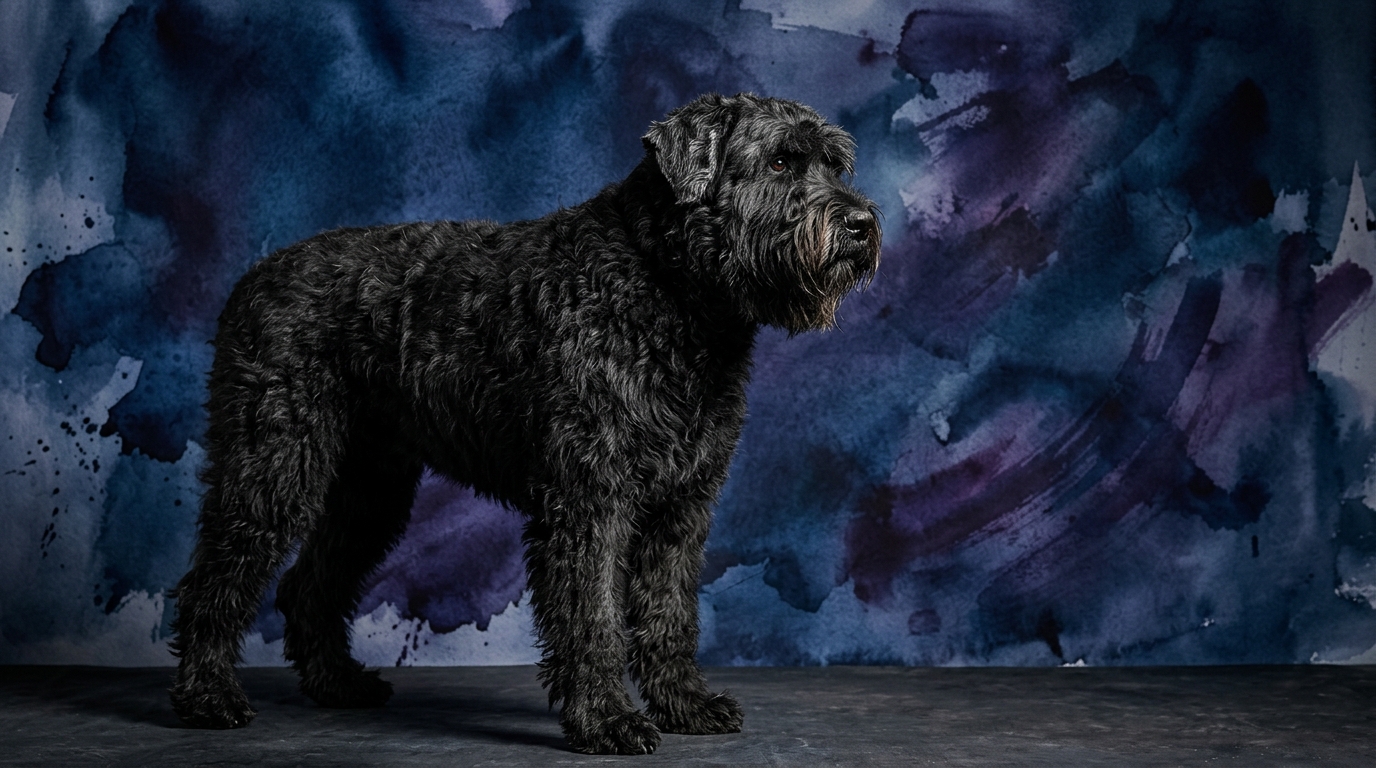

Side-by-Side IQ Profile: Herding Grit vs. Sporting Grace
The Cosmic Pet Pet IQ Lab assesses canine intelligence across five critical dimensions, providing a nuanced look beyond simple obedience. For the Bouvier des Flandres, a breed rooted deeply in herding, its cognitive scores reflect a balanced, pragmatic intellect: Problem Solving at 3/5, Training Speed at 3/5, Social Intelligence at 3/5, Instinctive Drive at 3/5, and Memory at 3/5. This consistent scoring across the board suggests a dog whose cognitive functions are evenly developed, allowing for reliable performance in complex, real-world herding tasks.
In contrast, the English Setter, a graceful sporting dog with a Coren rank of #37, exhibits a profile geared towards its hunting heritage. Its Problem Solving is rated at 4/5, indicating a greater aptitude for navigating novel challenges. Training Speed also scores higher at 4/5, suggesting a quicker grasp of new commands and routines. Social Intelligence mirrors the Bouvier at 3/5, while Instinctive Drive, crucial for its hunting role, also stands at 3/5. Notably, its Memory reaches 4/5, pointing to a superior capacity for retaining information, crucial for tracking and retrieving prey over varied terrain and extended periods.
Where the Bouvier des Flandres Excels Cognitively
While the English Setter generally outscores the Bouvier in several metrics, the Bouvier des Flandres demonstrates a unique cognitive resilience and practical application of its intelligence. Its consistent 3/5 across all dimensions signifies a robust, well-rounded intellect perfectly suited for demanding, independent work. The Bouvier's Problem Solving at 3/5, for example, isn't about abstract puzzles but rather the pragmatic, on-the-spot decisions required to manage livestock effectively, such as anticipating a sheep's movement or finding the best path through a gate. This involves a sustained, focused cognitive effort to maintain order and control in dynamic environments.
Furthermore, the Bouvier's 3/5 in Memory, while not as rapid for new commands as the Setter's, translates into an enduring retention of practical routines, boundaries, and the intricate social dynamics of a flock. Its 3/5 Social Intelligence combines with its Instinctive Drive to foster a strong, yet controlled, working relationship with its handler and the animals it manages, requiring a specific blend of independent thought and responsiveness. This breed's cognitive strengths lie in its steadfastness, its capacity for independent judgment within its working framework, and a balanced application of its faculties to consistently perform complex, physical tasks.
Where the English Setter Excels Cognitively
The English Setter's cognitive profile showcases distinct advantages, particularly in areas that benefit a sporting dog. Its 4/5 Problem Solving score suggests a greater capacity for adapting to varied hunting scenarios, quickly assessing situations, and formulating effective strategies to locate and point game. This often involves navigating complex terrain, interpreting subtle environmental cues, and making swift decisions under pressure, an intellectual agility that sets it apart.
Crucially, the English Setter's 4/5 in Training Speed highlights its readiness to absorb and execute new commands efficiently. This quick uptake is invaluable in field work, where precise directions and immediate responses are paramount. Coupled with a 4/5 Memory, the English Setter not only learns rapidly but also retains a vast repertoire of signals, scents, and locations, enabling it to remember where game was found or where specific commands were given, even after extended periods. This superior recall and learning efficiency make it a highly effective and responsive partner in the field, capable of sophisticated teamwork and nuanced understanding of its handler's intentions.
Which is Easier to Train and Why
Based on their Training Speed scores, the English Setter (4/5) generally presents an easier and faster training experience compared to the Bouvier des Flandres (3/5). The Setter's quicker grasp of new commands stems from its eagerness to please and its focused attention on its handler, a trait often refined in sporting breeds to ensure close cooperation during hunts. They tend to be more sensitive to verbal cues and positive reinforcement, showing a strong desire to perform correctly and earn praise, which accelerates the learning process for a wide range of tasks.
The Bouvier, while certainly trainable, requires a more patient, consistent, and often firmer approach. Its 3/5 Training Speed reflects a more independent nature, characteristic of a herding dog expected to make decisions autonomously. Bouviers can sometimes test boundaries or require more repetition to solidify a command, not due to a lack of understanding, but rather a thoughtful processing of whether the command aligns with their perceived task or if their own judgment should prevail. Owners will find success with the Bouvier through clear, consistent expectations and rewarding their inherent drive to work, rather than expecting instantaneous compliance.
Which Suits Active Owners vs. Relaxed Owners
Neither the Bouvier des Flandres nor the English Setter is suited for truly relaxed, sedentary owners; both breeds demand significant engagement, though the nature of that engagement differs. The Bouvier des Flandres, with its herding background and robust cognitive profile, thrives with active owners who can provide consistent mental stimulation and a sense of purpose. They need structured activities, whether it's herding trials, obedience, agility, or simply a 'job' around the home, combined with ample physical exercise. Owners who enjoy long, purposeful walks, engage in dog sports, or have a property that benefits from a 'working' dog will find the Bouvier a fulfilling companion.
The English Setter, as a sporting breed, requires substantial physical exercise, particularly off-leash running in safe, open spaces to satisfy its innate need to range and scent. Owners who enjoy outdoor adventures like hiking, trail running, or field activities will align well with this breed's needs. While they also appreciate mental engagement, it often revolves around scent work, retrieving games, or advanced obedience. They are less about sustained, independent problem-solving in a structured 'job' and more about energetic, cooperative ventures with their human partners. Therefore, both breeds require active owners, but the type of activity and mental engagement should align with their respective historical roles.
The Verdict: When to Choose Each
The Verdict
Choose the Bouvier des Flandres if you seek a steadfast, independent-minded companion capable of robust problem-solving in practical, structured roles, and you are prepared for consistent, patient training.
Opt for the English Setter if you desire a highly responsive, quick-learning partner for active outdoor pursuits, valuing its superior memory and enthusiasm for cooperative field work.
🧠 Find Your Pet's IQ Score
Our Pet IQ Lab assessment covers 25+ tests across 5 cognitive dimensions — personalized to your breed.
Take the Full IQ Test →Frequently Asked Questions
Do Bouvier des Flandres dogs require a lot of mental stimulation?
Yes, Bouviers absolutely thrive on mental stimulation. Their herding background means they possess a strong drive to work and solve problems, benefiting greatly from consistent training, puzzle toys, and engaging in dog sports like obedience or agility to keep their minds occupied.
Are English Setters good for first-time dog owners?
English Setters can be suitable for first-time owners who are committed to providing ample exercise and consistent positive reinforcement training. Their eagerness to please and higher training speed can make them rewarding to teach, but their energy levels demand dedication to their physical needs.
Which breed is more prone to independent decision-making?
The Bouvier des Flandres, with its herding heritage and balanced 3/5 problem-solving and social intelligence, is generally more prone to independent decision-making. They were bred to work autonomously with livestock, often requiring them to assess situations and act without direct handler commands, making them thoughtful and sometimes self-reliant.